From the N-word debate to the Ole Miss controversy, we created four memes to expose cultural hypocrisy, challenge double standards, and highlight the biblical foundation of human dignity.
A Familiar Controversy, a Deeper Question
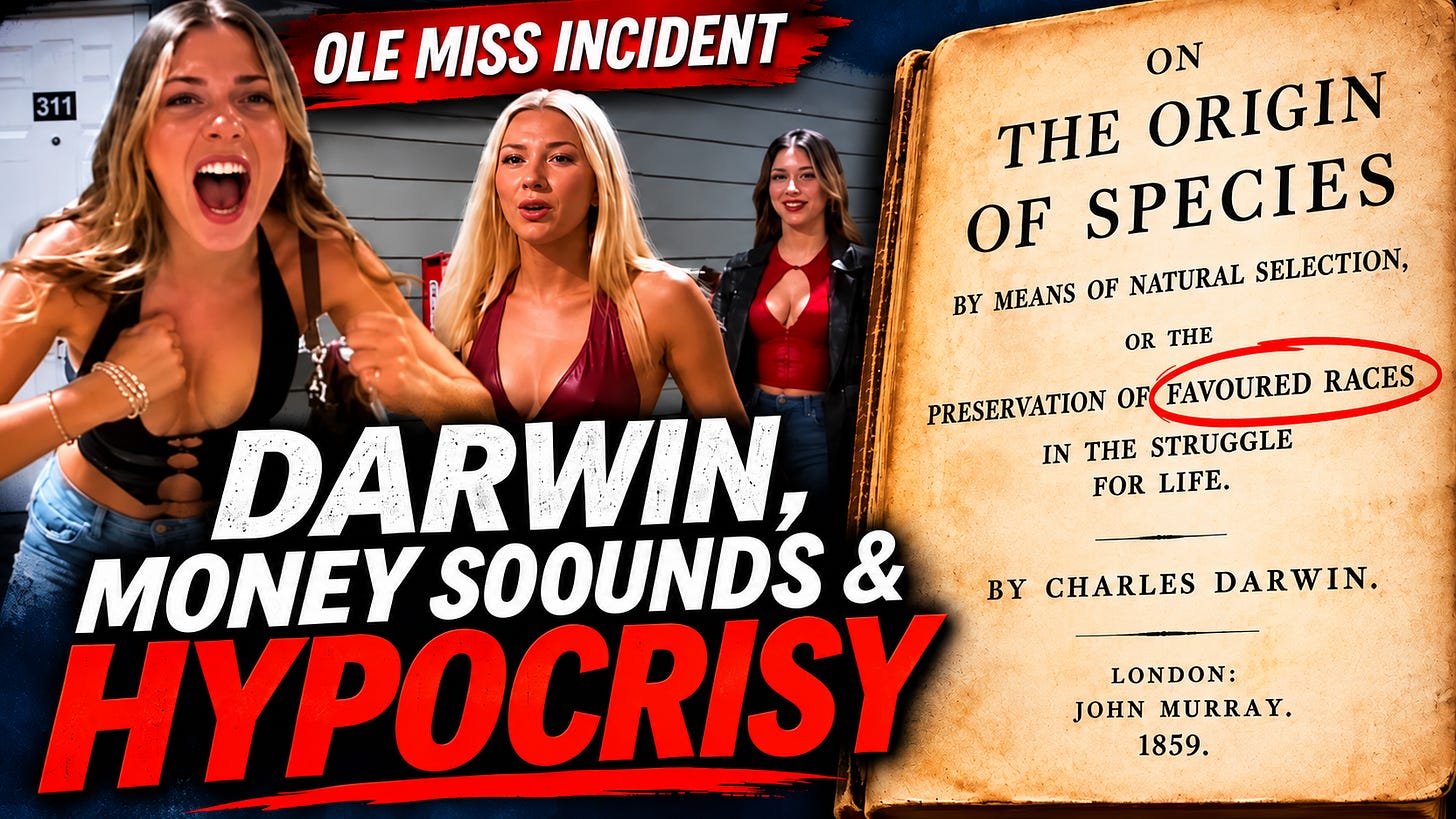
Once again, America finds itself caught in a controversy involving race, offensive behavior, and the familiar machinery of public outrage. This time, the controversy centers on a viral doorbell-camera video from the University of Mississippi, commonly known as Ole Miss, showing several white women outside an apartment occupied by Black female students. Two of the women appeared to make monkey sounds and gestures, prompting widespread condemnation, a university investigation, and a public apology from one of the individuals involved. But as additional information emerged, important questions arose about whether the women actually knew who lived in the apartment or whether their behavior was deliberately directed at anyone because of so-called race.
Editor’s Note: We use the term “so-called race” deliberately because, from our biblical and conservative worldview, we reject the notion that humanity is divided into distinct biological races. Race is a socially constructed classification based largely on perceived physical differences and ancestry, rather than a scientifically established division of humanity into separate biological categories. We use the term throughout this article because it reflects society’s common understanding, not because we accept those classifications as defining separate kinds of human beings. Scripture teaches that we are one human family, created in God’s image and made of one blood (Acts 17:26, KJV).
Those questions matter, particularly in a culture increasingly willing to assign the worst possible motives before all the facts are established. In his November 11 article at The Daily Wire, “Only An Idiot Would Fall For The Ole Miss Hate Hoax,” Matt Walsh challenges the media’s portrayal of the incident, highlighting one woman’s statement that she did not know the occupants’ race and reports that the group had allegedly been making similar animal noises at multiple apartment doors. While these accounts do not conclusively resolve the question of intent, they raise serious concerns about the rush to judgment, selective reporting, and potentially disproportionate consequences for those involved. We strongly encourage readers to examine Walsh’s article, particularly his analysis of what the initial media coverage omitted and why those missing details matter.

This controversy also brings us back to an article we published on May 17, 2026, titled “Chud the Builder and the N-Word Debate: Truth, Liberty, Hypocrisy, and Consequences.” In that examination, we challenged the cultural double standards surrounding racially offensive language, particularly the selective acceptance and condemnation of different variations of the N-word. We argued that constitutionally protected speech and morally responsible conduct are not necessarily the same thing, that freedom of expression does not guarantee freedom from social consequences, and that offensive or provocative behavior should not automatically be treated as conclusive evidence of a person’s deepest beliefs or intentions. Context, individual responsibility, and consistent moral standards should matter more than emotional reactions or political convenience.
That earlier article established a principle central to the Conservative TAKE: moral standards should be consistent, human dignity should be universal, and biblical truth should not be replaced by selective cultural outrage. If racial mockery is wrong because it degrades another person’s humanity, that standard should apply regardless of the race or political identity of the person involved. Likewise, defending someone’s right to speak does not require celebrating their behavior, just as condemning offensive conduct does not justify abandoning fairness, proportionality, or the presumption of individual responsibility. These principles remain relevant whether the Ole Miss incident was deliberately racist, an immature attempt at humor, or something whose full circumstances have not yet been established.
But our argument goes beyond the particular facts of this incident. Even if we accept the prevailing allegation that the gestures were intentionally racist, a deeper philosophical question remains: What makes racial dehumanization inherently wrong, and where does the equal moral worth of every human being originate? Modern secular culture frequently embraces evolutionary explanations of human origins, promotes humanism as a moral framework, and insists upon universal human dignity. As Christians who believe in biblical creation, we believe those claims invite a serious examination of the foundations of morality, particularly when evolutionary or biological concepts are misused to justify hierarchies of human worth. Our position is that equality is not something mankind invents, governments grant, or cultural movements redefine. It is grounded in the biblical truth that humanity was created in God’s image and that God made all nations of one blood.
With that foundation established, we’ve developed four satirical memes that approach the controversy from different angles, using humor to examine what we see as contradictions involving human origins, selective outrage, secular morality, and racial superiority. Each meme illustrates a different aspect of the same fundamental argument: a society cannot consistently condemn the dehumanization of others while embracing the principle that some human beings possess inherently greater worth than others. The cartoons are intentionally exaggerated, but the biblical questions behind them are serious. Whether the allegations surrounding Ole Miss ultimately prove accurate or not, the principles remain the same—and that brings us to our four memes.
1. Science Class: You Can’t Have It Both Ways

Caption: If we’re all just products of blind evolution, where exactly does equal human dignity come from? You can’t rank humanity by biology on Monday, condemn dehumanization on Tuesday, then pretend there’s no contradiction. Genesis offers a simpler answer: every person bears God’s image.
Our first meme takes place in a classroom where an enthusiastic teacher presents the familiar evolutionary progression illustration. The students cheer as she explains the relationship between humans and apes, celebrating what they regard as scientific enlightenment. In the next panel, however, the atmosphere changes dramatically when someone discovers that women have allegedly been making monkey sounds toward other people. The same classroom that was celebrating evolutionary explanations of human origins is suddenly filled with shock and disgust.
The joke reaches its conclusion when one student asks whether humanity is truly one family or whether people are now supposed to be ranked against one another. He then holds up the book of Genesis, reminding his classmates that mankind was created in God’s image and that Scripture establishes no hierarchy of human worth based on racial appearance. The final caption summarizes the message: “YOU CAN’T HAVE IT BOTH WAYS.”
The satire challenges a distinction that is often overlooked in modern cultural arguments: the difference between explaining biological origins and establishing moral value. Evolutionary theory addresses biological development and common ancestry; it does not itself establish racial superiority as a scientific or moral conclusion. Nevertheless, biological theories have historically been misappropriated by people seeking to justify racial hierarchies, eugenics, and other systems that classify human beings according to supposed degrees of superiority or inferiority. Our concern is with those ideological applications and the broader worldview question they raise.
From a biblical perspective, humanity’s moral equality is not something society must discover through biological classification or negotiate through changing cultural standards. Genesis 1:27 declares, “So God created man in his own image, in the image of God created he him; male and female created he them.” That statement establishes the inherent dignity of mankind before questions of ethnicity, nationality, political identity, or social position ever arise. The human person possesses worth because of the Creator, not because of membership in a favored biological, political, or cultural category.
This is the central point of the first meme. When society condemns racial dehumanization, Christians should affirm that condemnation while asking whether the surrounding culture is equally committed to rejecting every philosophy that assigns different levels of human worth to different groups. If humanity is genuinely equal in moral dignity, then superiority and inferiority cannot be assigned according to race, ancestry, or perceived biological advantage. Our biblical position is that every human being bears God’s image, and no racial ranking is necessary or permissible.
2. Monday Versus Tuesday: Welcome to the Department of Selective Outrage

Caption: Monday: celebrate evolution as the explanation for everything. Tuesday: act stunned when people use animal comparisons to demean other human beings. Maybe human dignity needs a foundation stronger than whatever cultural argument happens to be trending this week.
The second meme moves away from the classroom and into the absurdity of modern institutional culture. On Monday, a cheerful group gathers beneath a banner celebrating Darwin Appreciation Week. Everyone is smiling, congratulating themselves, and enthusiastically declaring their confidence in science and evolutionary explanations of human origins. By Tuesday, the scene has shifted to the fictional Department of Selective Outrage, where the staff members are running around in panic because someone has made offensive monkey noises. Papers are flying, emotions are escalating, and a large sign on the wall announces that all people have equal dignity.
The humor comes from the exaggerated transition between intellectual celebration and moral panic, but the deeper target is the modern tendency to substitute fashionable declarations for consistent principles. It is easy for institutions, activists, educators, and public personalities to proclaim their support for equality. The more difficult task is establishing what that equality means, explaining why it is morally binding, and applying it when doing so becomes personally or politically inconvenient.
History offers sobering reasons to take that question seriously. Nazi racial ideology, Stalinist class persecution, the Khmer Rouge’s campaign of mass violence in Cambodia, and the ethnic extermination carried out during the Rwandan genocide arose within different historical circumstances and ideological traditions. They cannot all be reduced to one identical doctrine, but each illustrates the danger that emerges when powerful movements convince themselves that certain categories of human beings are enemies, obstacles, inferior populations, or otherwise expendable. Whether the dividing line is race, ethnicity, political class, or ideological loyalty, the moral danger appears when those classifications are used to deny people the protections and dignity owed to human beings.
From our Christian perspective, these historical tragedies reinforce the necessity of an objective moral foundation that stands above governments, intellectual fashions, and political movements. If the worth of a person depends ultimately upon the judgment of another person, an institution, or a ruling ideology, then the protection of that worth becomes vulnerable to whoever possesses the power to redefine it. Biblical creation offers a different foundation: human dignity is not granted by those in authority, and therefore it cannot legitimately be withdrawn by them.
This also brings us directly back to the Ole Miss controversy. Condemning the alleged conduct is entirely compatible with biblical morality; indeed, treating another person with deliberate racial contempt contradicts the principle of being created in God’s image. But condemnation should not become an excuse for collective racial blame, selective enforcement, or treating an offender as though that person’s own human dignity has disappeared. Moral accountability and the inherent worth of the individual can coexist, even when the individual’s conduct deserves serious criticism.
The Department of Selective Outrage is fictional, of course, but the temptation it represents is real. A society that insists upon equal dignity must be prepared to defend that dignity consistently, not merely when the latest controversy makes doing so socially advantageous.
3. The Modern Worldview Group Chat: When Genesis Enters the Conversation

Caption: The modern worldview group chat gets awkward fast: evolution explains our origins, secularism says Scripture isn’t needed for human worth, then everyone demands absolute equality and dignity. Genesis 1:27 and Acts 17:26 were already there with a consistent answer.
Our third meme presents the argument as a fictional group-chat conversation. The Darwin Fan Club opens by celebrating evolution as the explanation of human origins, followed by Secular Humanism declaring that Scripture is unnecessary for defining human worth. Breaking News then interrupts the discussion with the report of people making racist monkey noises, creating the perfect opportunity for Biblical Worldview to enter the conversation with a reminder of Genesis 1:27 and Acts 17:26 . The punchline arrives when the Darwin Fan Club quietly leaves the chat.
The joke works because it compresses a substantial philosophical disagreement into the familiar language of internet culture. Modern society frequently uses words such as equality, dignity, justice, and human rights as though everyone agrees on their ultimate meaning and authority. Yet those words invite important questions. Are human rights merely agreements reached by societies? Does human dignity exist independently of government recognition? If a majority rejects a particular group’s equality, does that decision change the moral truth of the matter, or does it simply reveal the majority’s injustice?
Secular philosophers have offered arguments for universal human dignity without appealing to Scripture, and those arguments deserve to be understood on their own terms. Our position, however, is that biblical revelation provides the clearest and most reliable foundation for the moral equality of humanity. We do not believe human dignity begins with a political declaration, judicial decision, scientific consensus, or cultural agreement. We believe it is an inherent feature of mankind’s creation by God, and that human institutions are morally obligated to recognize what God has already established.
Acts 17:26 provides the second essential passage in this argument: “And hath made of one blood all nations of men for to dwell on all the face of the earth…” For Christians, this is not merely an inspirational statement about cooperation among different communities. It is a declaration that mankind shares a common origin under one Creator and that distinctions of nationality, ethnicity, appearance, or cultural identity cannot establish separate categories of human worth.
That principle has direct consequences for how we evaluate racial controversies. The Black students involved in the Ole Miss incident possess inherent dignity because they are created in God’s image. The women whose conduct prompted the controversy also possess inherent dignity, regardless of whether their actions warrant criticism, discipline, or other lawful consequences. Recognizing the humanity of both parties does not create moral equivalence between their respective actions; it simply applies the same biblical standard to everyone.
This is also where our earlier N-word article becomes especially relevant. We argued then that racist contempt, deliberate provocation, lawful expression, and social consequences must be considered carefully rather than collapsed into one emotional reaction. Those distinctions remain important because defending liberty without moral responsibility invites disorder, while pursuing accountability without fairness and consistent principles can create new injustices.
The group-chat meme ultimately makes a simple point: Christians do not need to invent a new theory of human worth every time another controversy goes viral. Genesis and Acts already provide the principles by which we can oppose racial contempt, reject favoritism, recognize individual responsibility, and defend the equal dignity of all humanity.
4. The Worldview Software Update: When Moral Consistency Crashes

Caption: When your worldview has to hold “human worth depends on evolutionary ranking” and “every human has equal dignity” at the same time, the system starts throwing error messages. Maybe it’s not humanity that needs an update. Maybe the worldview does. Genesis 1:27 already settled the issue.
The fourth meme borrows from the classic internet image of a nervous man sweating over two buttons. In our version, a professor desperately tries to choose between the idea that human worth depends upon evolutionary ranking and the declaration that every human being possesses equal dignity. His apparent philosophical crisis is interrupted by a Christian casually walking past with a Bible and reminding him that Genesis 1:27 has already established the answer.
The humor depends upon a specific contradiction: a belief in unequal human worth cannot be reconciled with a sincere commitment to equal human dignity. The cartoon presents that conflict through the language of evolutionary ranking, but the principle applies far beyond debates about human origins. Any worldview that elevates one race, ethnicity, political class, or group into a category of greater human worth while assigning another group an inferior status has abandoned the very equality it may claim to defend.
This is why the historical record matters. In the nineteenth and twentieth centuries, ideas about human improvement, biological hierarchy, racial supremacy, and the elimination of supposedly undesirable populations were advanced by individuals and movements that believed they were serving progress, national greatness, scientific advancement, or political transformation. Such ideas took different forms, and they were not exclusive to one philosophical tradition. Nevertheless, they demonstrate how dangerous moral reasoning becomes when human beings are treated as material to be classified, controlled, or discarded according to someone else’s vision of a better society.
The biblical understanding of creation challenges that entire approach to human value. A person’s worth is not measured by intelligence, physical appearance, productivity, ancestry, social position, or perceived usefulness. Nor does it increase or decrease according to political loyalty or ideological agreement. The dignity of a human being is inherent because that person belongs to the human family created by God.
At the same time, equal dignity does not mean that every action is morally equal. Scripture recognizes good and evil, justice and injustice, righteousness and wrongdoing. A person who deliberately humiliates another can be held accountable without losing the inherent dignity that belongs to every human being. This distinction matters because modern outrage often encourages people to confuse moral condemnation of conduct with rejection of the person as a human being.
The fourth meme therefore closes the philosophical argument introduced by the first three. If a worldview makes human dignity conditional upon biological or social ranking, it has a serious moral problem. If it recognizes every person as inherently worthy of dignity, it must explain why that principle is binding and why no authority may rightfully suspend it for an unpopular group. Our Christian answer is that equal human dignity originates with God and remains binding regardless of culture, politics, or human opinion.
From the N-Word Debate to Ole Miss: Consistency Must Apply to Everyone
Although the four memes focus primarily on the question of human origins and moral foundations, the cultural principles established in our May article remain essential to this discussion. The controversy surrounding Chud the Builder involved a provocative public figure using racially offensive language to challenge social boundaries and generate reactions. We argued that his freedom to speak did not require others to approve of the behavior, provide him with an audience, or allow him to remain in private spaces where his conduct violated established expectations.
The same reasoning applies to the Ole Miss incident. The individuals involved are responsible for their actions, the students who felt targeted have a legitimate interest in being heard, and the university has a responsibility to review the incident fairly under its applicable rules. Public criticism is also a normal part of a free society. What we should resist is the impulse to dispense with evidence, fairness, proportionality, and consistent standards simply because a controversy evokes powerful emotions.
We should also distinguish carefully between racially offensive conduct, deliberate provocation, prejudice, and an established belief in racial superiority. These categories may overlap, but they are not necessarily identical, and responsible public commentary should avoid treating every question about a person’s motives as though it has already been answered. We can identify conduct as degrading without claiming to know every private belief of the individual responsible.
A biblical approach also rejects collective racial guilt. The misconduct of particular individuals does not establish the moral character of everyone who shares their ethnicity, just as a person’s innocence or guilt cannot be determined by racial appearance. If we genuinely believe that all people are created in God’s image, our response to racial controversy must remain grounded in individual responsibility rather than tribal accusation.
This is ultimately what ties the two articles together. In May, we examined the difference between liberty and license, the selective treatment of offensive language, and the necessity of moral responsibility. Today, we are asking the deeper question of why human dignity exists in the first place. The answers are connected: freedom requires responsibility, accountability requires fairness, and fairness requires a standard of human worth that does not change according to who happens to be speaking or who happens to be offended.
the Conservative TAKE…
One Creator, One Human Family, One Moral Standard
The purpose of these four memes is not to trivialize the experience of students who believe they were subjected to racial humiliation. Nor is it to suggest that an offensive encounter somehow becomes acceptable because somebody can construct a philosophical argument about evolution or secularism. The purpose is to use satire to raise a larger question that our culture too often avoids: What makes every human being inherently worthy of dignity, and are we willing to apply that conviction consistently?
For the Conservative TAKE, the answer begins with biblical creation. We believe that God created mankind in His image and that all humanity shares a common origin under Him. Those convictions lead us to reject racial superiority, dehumanization, favoritism, and collective guilt. They also require us to uphold personal responsibility, lawful freedom, moral accountability, and fairness even when the people involved hold beliefs we strongly oppose.
The four cartoons approach the argument differently. The classroom meme questions the philosophical foundation of equality. The Monday-versus-Tuesday meme exposes the temptation toward selective outrage. The group-chat meme contrasts competing explanations of human worth. The software-update meme illustrates the contradiction inherent in any attempt to combine racial hierarchy with universal human dignity. Taken together, they make a case for something we believe America urgently needs: a consistent understanding of human value that stands above political fashion, social-media outrage, and ideological convenience.
We do not believe mankind needs another fashionable theory of human dignity. We believe society needs to recover the truth that human dignity does not originate with mankind at all. It originates with the God who created us, and that truth imposes obligations upon every person, regardless of race, nationality, politics, or religious belief.
Genesis 1:27 teaches that mankind was created in God’s image. Acts 17:26 teaches that God made all nations of one blood. Those passages establish the foundation of the position we defend: one Creator, one human family, and one standard of inherent human dignity.
We can condemn offensive conduct without abandoning liberty. We can defend liberty without celebrating offensive conduct. We can demand accountability without treating anyone as less than human. But we cannot honestly defend equal human worth while simultaneously embracing a hierarchy that makes some people inherently superior to others.
You can’t have it both ways.
___________________________________________________
Further Reading: Biblical Foundations
The following Scripture passages provide the biblical foundation for our position on creation, human dignity, racial equality, moral responsibility, and the proper use of speech. All references are from the King James Version (KJV).
-
Genesis 1:27 — Humanity Created in God’s Image
Establishes that mankind was created in the image of God, providing the foundation for the inherent dignity and worth of every human being.
Read Genesis 1:27 (KJV) -
Acts 17:26 — One Blood, All Nations
Affirms that God made all nations of one blood, establishing humanity’s shared origin and rejecting the notion of inherently superior or inferior races.
Read Acts 17:26 (KJV) -
James 2:1–13 — Against Partiality and Favoritism
Warns believers against showing favoritism or judging others according to outward appearances, wealth, or social standing.
Read James 2:1–13 (KJV) -
Ephesians 4:29 — The Moral Responsibility of Speech
Instructs believers to avoid corrupt communication and instead speak in ways that edify others.
Read Ephesians 4:29 (KJV) -
Proverbs 18:21 — The Power and Consequences of Words
Reminds us that words have the power to influence, encourage, harm, or destroy, reinforcing the relationship between freedom of speech and personal responsibility.
Read Proverbs 18:21 (KJV)
the Conservative TAKE
Shaping Culture. Defending Freedom.