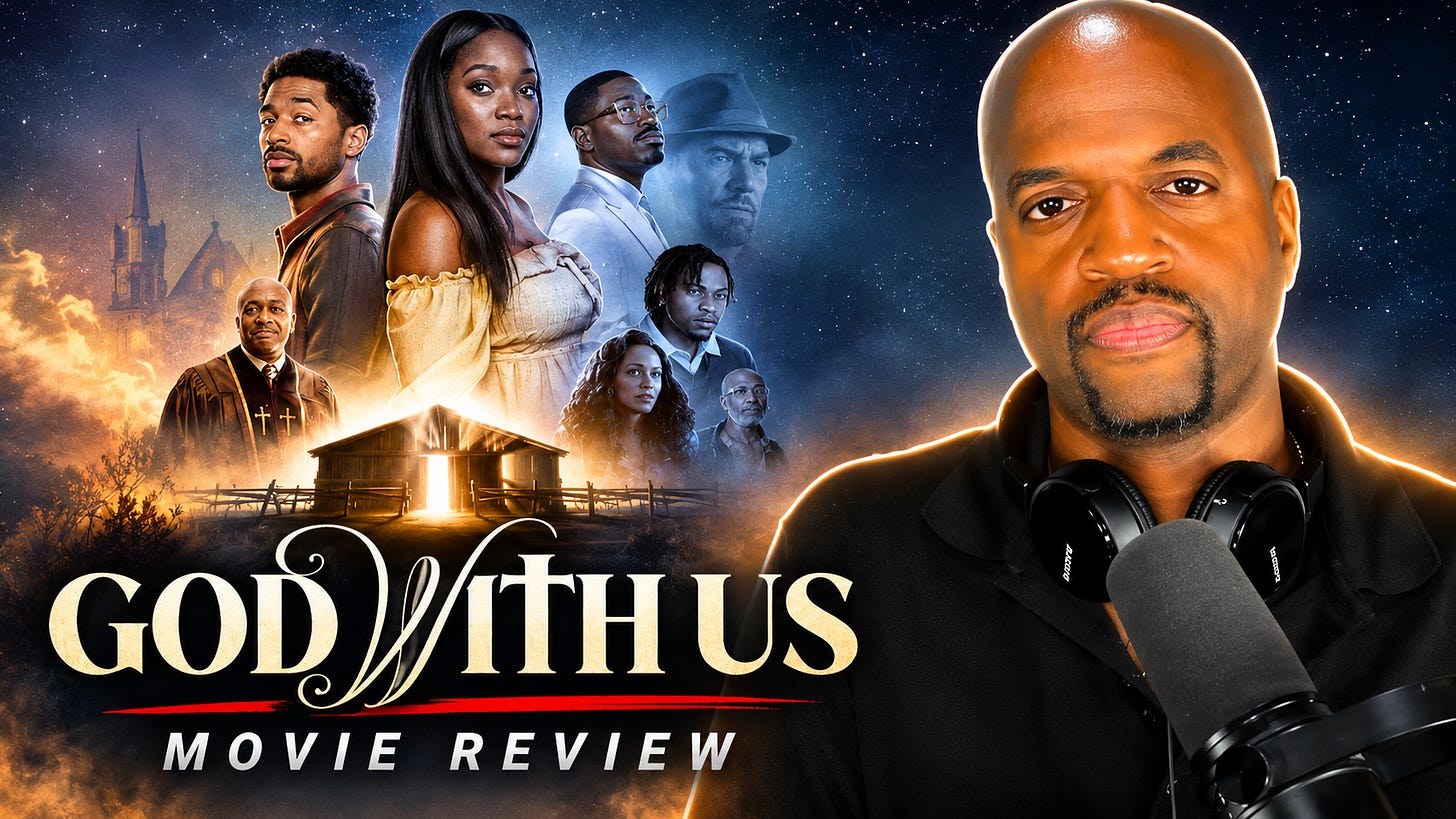
Movie Rating: ⭐⭐⭐ 3 out of 4 Stars | 13.75/20
Conservative TAKE Recommendation: 🟡 GO WITH CAUTION
Watch My Full Video Review of God With Us (2026) on YouTube
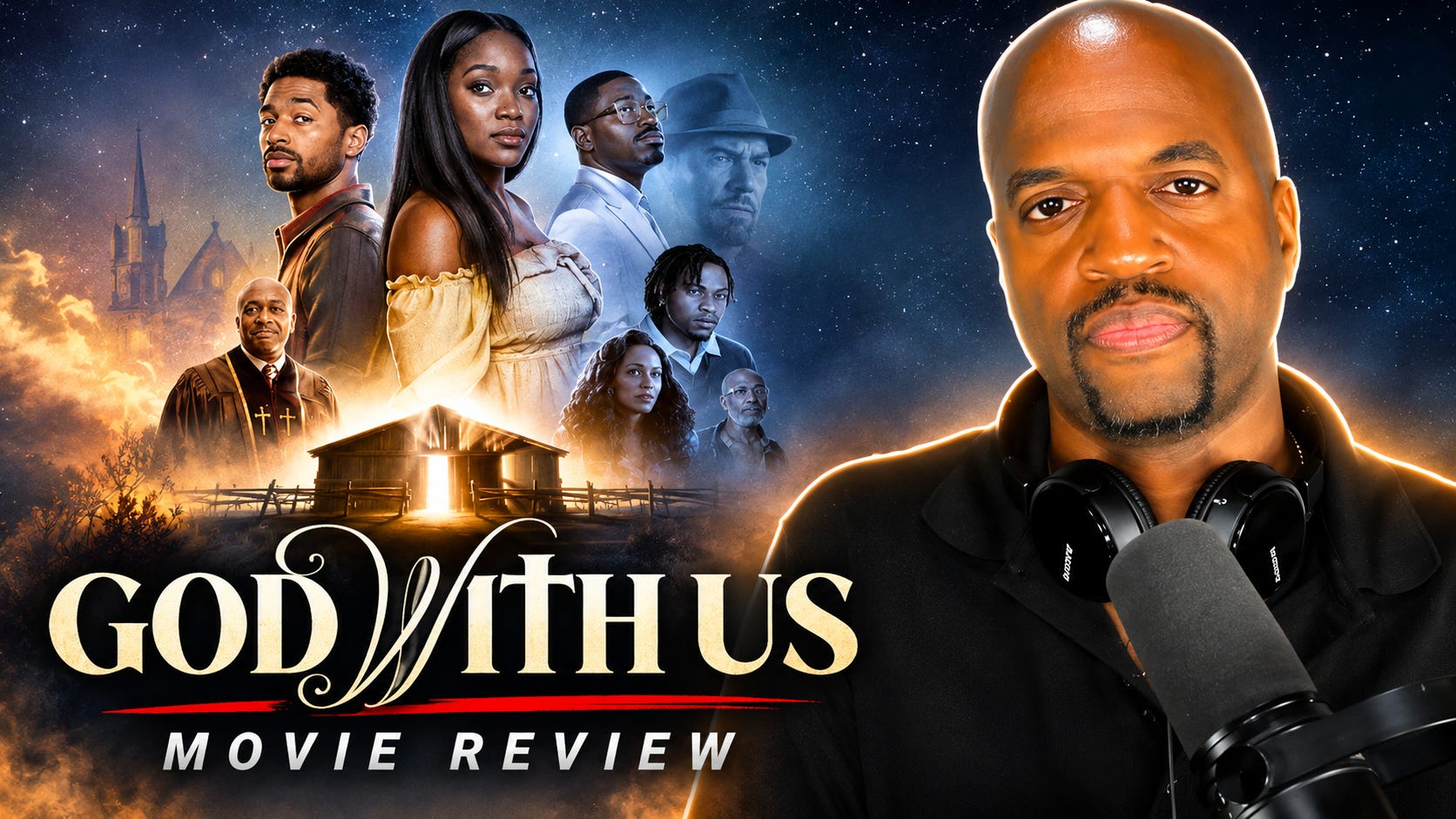
⭐⭐⭐ 3 out of 4 Stars | 13.75/20
Conservative TAKE Recommendation: GO WITH CAUTION
🎬 Watch My Full God With Us Movie Review on YouTube
A Different Kind of Christmas Story
What would happen if Jesus Christ had not been born more than 2,000 years ago? What if the prophecies of the Old Testament were still awaiting fulfillment, and the Messiah was about to arrive in a predominantly Black community in Maryland during the 1990s?
That’s the fascinating premise behind God With Us, the 2026 faith-based drama written and directed by Jimmy Jenkins.
I recently received an advance screener of the film, and I have to say, this one gave me quite a bit to think about. Not simply because of its Christian message, but because of the cultural, historical, and political questions it raises about faith, family, fatherhood, government dependency, church corruption, personal responsibility, and the challenges facing the Black community.
There is also a personal connection for me. I’m originally from Maryland, specifically Prince George’s County, and portions of the movie were filmed in Maryland, including areas familiar to me. The cultural environment depicted in the film reminded me of movies I watched growing up during the 1980s and 1990s. The church experience, humor, characterizations, neighborhood relationships, and social issues were recognizable, even when certain aspects were exaggerated.
Sometimes that familiarity worked exceptionally well. Other times, I thought the filmmakers leaned a little too heavily into familiar urban comedy and characterization. But overall, I understood what Jenkins was attempting to accomplish, and I believe he succeeded in making an ancient biblical story relatable to audiences who might otherwise have difficulty connecting with it.
What interested me most, however, was something that went beyond the filmmaking itself.
This movie celebrates several principles that I consider foundational to conservatism: faith, family, responsible fatherhood, personal accountability, religious liberty, and the sanctity of life.
Yet those same principles are often at the center of political disagreements within the communities the film depicts.
That raises a question I believe deserves serious consideration: Are we consistently connecting the dots between the values we celebrate and the political and cultural decisions we make?
Before exploring that question, let’s discuss the film.
What Exactly Is God With Us?
God With Us follows Mary Anne Thomas, played by Ashley Olivia Fisher, and Joseph “Junie” Love, played by Aspen Kennedy. The ensemble also includes Gregory Alan Williams as Dr. Amos, Lil Rel Howery as Gabe, Rotimi as Walter Moon, Roger Guenveur Smith as Boozer, and Ashley Rios as Rosa Lee.
The film is scheduled for theatrical release on November 13, 2026.
The story begins in 1973, moves into 1983, and eventually reaches approximately 1995, when much of the central narrative unfolds. In this alternate reality, the Messiah has not yet arrived, and the world is still awaiting the fulfillment of biblical prophecy.
Society has become increasingly hostile toward belief in God. A fictional newspaper called The Liberty Post reports on government efforts to remove references to God from America’s founding documents. Behind some of these efforts is a secret organization called the Stone Angels, whose members seek to undermine Christianity and prevent the fulfillment of the prophecies.
Meanwhile, Mary and Joseph grow up in a community struggling with many recognizable challenges, including drug abuse, poverty, unstable families, street violence, religious hypocrisy, and the consequences of destructive personal decisions.
The movie places the familiar Nativity story within this environment, exploring how ordinary people might react to extraordinary biblical events.
What impressed me immediately was the filmmakers’ decision to include a disclaimer at the beginning of the movie. They explain that the story is a modern parable, not an attempt to rewrite Scripture or replace the biblical account of Christ’s birth. The disclaimer also affirms the sufficiency of Christ’s work.
I appreciated that tremendously because the Nativity is not simply another historical story that can be casually reinterpreted without theological consequences. It is central to Christianity, and I believe filmmakers approaching such material have a responsibility to treat it with reverence.
By establishing that distinction from the beginning, Jenkins demonstrated an awareness of the concerns Christian audiences might reasonably have about this kind of creative adaptation.
It also helped me understand the purpose of the film. The filmmakers weren’t attempting to tell us what actually happened 2,000 years ago. They were asking us to imagine how the people involved might have experienced those events if they occurred in a world more familiar to us.
That is an important distinction, and I believe it makes the film considerably more effective.
The Inspiration Behind the Film
The movie’s unusual setting also has an interesting background. In an interview published by The Christian Post, Jenkins discussed an encounter with a teenager in juvenile detention who struggled with the belief that his crimes had placed him beyond God’s forgiveness.
That experience helped inspire the filmmaker’s desire to communicate the Gospel through circumstances familiar to people who may not relate easily to traditional biblical presentations.
Understanding that background makes the film’s creative approach more meaningful. The urban setting and contemporary cultural references aren’t simply attempts to make the Nativity look different. They’re part of an effort to reach an audience through a recognizable social and cultural environment.
And I think that intention deserves respect, even when some of the individual creative choices don’t work as well as intended.
My Official Movie Review
I evaluate movies using five categories: Story/Depth, Emotional Impact, Intangibles, Watchability, and my personal Movie Quality rating. Each category receives a score between 1 and 10, with my personal rating carrying additional weight in the final calculation.
Here is how God With Us performed.
CategoryScoreStory/Depth8/10Emotional Impact10/10Intangibles6/10Watchability7/10Movie Quality / My Rating6/10Final Score13.75/20Star Rating⭐⭐⭐ 3/4Conservative TAKEGO WITH CAUTION
The final score is calculated by averaging the first four categories and adding my personal Movie Quality rating.
That produces a score of 13.75 out of 20, which translates into three out of four stars.
What’s particularly interesting is the difference between my individual ratings. I gave the film a perfect 10 for Emotional Impact, but my overall Movie Quality rating was a 6.
Those numbers aren’t contradictory. They demonstrate something I’ve believed for a long time: a movie can be emotionally exceptional without being perfect in every aspect of its filmmaking.
And God With Us is a perfect example.
Story and Depth: 8/10
The story is ambitious, particularly considering its approximately 105-minute runtime. Jenkins attempts to combine a modern Nativity adaptation, family drama, biblical prophecy, organized opposition to Christianity, investigative journalism, street violence, and spiritual redemption.
That’s an enormous amount of material to fit into one movie, but I believe the filmmakers handled much of it effectively.
The relationship between Mary and Joseph is especially important because it gives the story an emotional foundation. Mary has experienced abandonment and hardship, while Joseph is presented as an intelligent, responsible young man with ambitions of entering an architectural profession. That career choice provides an interesting modern parallel to the biblical Joseph’s work as a craftsman.
The movie also gives several supporting characters meaningful spiritual struggles. Some question Christianity because of hypocrisy within religious institutions, while others struggle with guilt, anger, or the consequences of their own actions.
These storylines introduce substantial moral and theological questions. Although the combination of serious drama and broad comedy isn’t always seamless, the overall story is creative, thoughtful, and worthy of an 8 out of 10.
Emotional Impact: 10/10
This was the easiest category for me to score because the emotional impact of God With Us is extraordinary.
Several scenes involving Mary and Joseph are genuinely moving, particularly Joseph’s proposal, his encouragement of Mary when she struggles with feelings of inadequacy, and his reaction to learning about her pregnancy.
Aspen Kennedy effectively communicates Joseph’s emotional struggle, while Ashley Olivia Fisher delivers a performance that becomes particularly powerful during the film’s more difficult moments.
The movie also deals with trauma, religious betrayal, abandonment, and redemption in ways that connect emotionally with the audience. Familiar Christmas hymns are used effectively to reinforce the spiritual significance of several scenes.
What makes these moments successful is that the characters react like recognizable human beings rather than distant biblical figures whose decisions are already familiar to us.
The filmmakers allow us to experience their confusion, pain, uncertainty, and faith in a personal way.
For those reasons, I gave God With Us a perfect 10 out of 10 for Emotional Impact.
Intangibles: 6/10
My Intangibles category considers the special elements that elevate a film beyond its basic story. Exceptional acting, memorable music, outstanding scenes, strong directing, or unusual creative achievements can make a significant difference.
One of the movie’s greatest assets is Gregory Alan Williams, who portrays Pastor Amos. His performance is superb, and I believe he steals nearly every scene in which he appears. He brings authority, credibility, and emotional depth to a character responsible for communicating much of the film’s theological foundation.
I was also impressed with the production’s visual quality. The special effects were very good, the directing was effective, and the overall presentation had a professional polish that helped bring this ambitious story to life.
The film’s biblical apologetics are another important intangible. Rather than relying exclusively on emotional preaching, the screenplay includes substantial discussion of prophecy, Scripture, and the anticipated arrival of the Messiah.
However, certain elements didn’t work as well for me, particularly some of the broad comedy and exaggerated characterizations. Lil Rel Howery’s portrayal of Gabe, the film’s angelic messenger, sometimes reminded me of Chris Tucker’s comedic style. I understand what the filmmakers were attempting, but I occasionally found the humor distracting from the seriousness of the theological material.
The performances are also not uniformly strong, even though the film contains several outstanding individual moments.
For those reasons, my Intangibles score is 6 out of 10.
Watchability: 7/10
I believe God With Us is worth watching, especially for audiences interested in Christian storytelling, biblical prophecy, and contemporary discussions about faith and culture.
The film has enough emotional power and theological substance to encourage meaningful conversations after the credits roll. It may also inspire viewers unfamiliar with Scripture to read the biblical Nativity account for themselves.
However, this is not a conventional family Christmas movie. The story includes violence, sexual abuse, religious corruption, and emotionally intense situations that may be difficult for younger viewers or people sensitive to those subjects.
Despite those concerns, I believe the film deserves to be experienced and discussed.
Watchability: 7 out of 10.
Movie Quality: 6/10
My final Movie Quality rating reflects my overall assessment of the filmmaking.
I thought the directing, visual presentation, and special effects were good, and several performances were emotionally powerful. The screenplay is ambitious, and the filmmakers clearly approached the Christian material with seriousness and respect.
However, I also believe some of the comedy and characterization could have been handled differently, and the movie occasionally struggles to balance its many competing dramatic elements.
That doesn’t make it a bad film. According to my rating scale, a 6 means that I recommend the movie despite its imperfections.
My final score is 13.75 out of 20, or three out of four stars.
But the movie’s artistic score is only part of the discussion.
The larger cultural and theological questions are where things become particularly interesting.
⚠️ SPOILER WARNING
The following sections discuss major plot developments, character deaths, spiritual transformations, and the film’s theological themes.
If you haven’t seen God With Us and prefer to avoid spoilers, I recommend watching the film before continuing.
Joseph: A Positive Representation of Black Manhood
One of the most encouraging elements of God With Us is its portrayal of Joseph.
He’s intelligent, ambitious, hardworking, compassionate, and willing to accept responsibility. He has plans for his future, including an opportunity involving architecture, but his relationship with Mary reveals something even more important about his character.
Mary has experienced considerable hardship. Her biological mother struggled with drug addiction, and Mary has learning disabilities that affect her confidence and how others treat her.
She’s ridiculed, misunderstood, and sometimes made to feel inadequate.
Joseph sees beyond those difficulties.
He encourages her, protects her dignity, and reminds her that she’s worthy of love. One of the film’s most touching moments occurs when Joseph proposes to Mary after helping her overcome feelings of insecurity.
This is an important detail because Joseph demonstrates responsibility before the miraculous pregnancy creates a crisis.
When Mary later reveals that she’s pregnant, Joseph reacts with disbelief and anger. His reaction is painfully human because, from his perspective, the woman he loves appears to have betrayed him.
Even though he’s a man of faith, he struggles with what he’s hearing.
Eventually, an angel reveals the truth, and Joseph returns to Mary. He accepts the extraordinary circumstances and stands beside her.
To me, this is one of the strongest messages in the entire film.
A strong man isn’t simply someone who exercises authority. He’s someone willing to accept responsibility, demonstrate commitment, and sacrifice for the people he loves.
That’s the kind of masculinity I believe our culture should celebrate.
And it’s particularly encouraging to see a film with a predominantly Black cast portray strong Black male characters in such a positive way.
Both Joseph and Pastor Amos represent forms of leadership rooted in faith, commitment, and service rather than selfishness or domination.
Those are examples worth highlighting.
The Black Family and the Importance of Fatherhood
The movie’s emphasis on responsible fatherhood naturally leads to a larger conversation about the Black family.
Throughout God With Us, we encounter characters whose lives have been shaped by addiction, abandonment, unstable family relationships, abuse, and criminal activity.
These problems aren’t exclusive to Black Americans, but they have affected many communities, including the communities represented in the film.
Mary’s upbringing is one example. Her biological mother’s addiction contributes to circumstances in which Mary grows up without the stable parental support she needs. Walter’s experiences provide another example of how vulnerable young people can be harmed by adults who should be protecting them.
Against this backdrop, Joseph represents a different path.
He’s committed to Mary.
He takes responsibility seriously.
He wants to establish a future.
And he understands that loving someone involves more than simply expressing affection.
As a conservative, I believe stable families are foundational to strong communities. Children benefit from loving parents, positive role models, consistency, and adults willing to make sacrifices for their well-being.
That doesn’t mean single-parent households are incapable of raising successful children, nor does it diminish the extraordinary sacrifices many single mothers and fathers make.
But acknowledging those contributions shouldn’t prevent us from recognizing the importance of responsible fatherhood and stable family relationships.
We should be encouraging young men to become responsible husbands, fathers, and community leaders rather than treating those expectations as outdated or unnecessary.
The positive portrayal of Joseph reinforces that message, and it’s one of the reasons I appreciated the film.
The Political Contradiction: Are We Connecting the Dots?
Here’s where the movie raises questions that go beyond its fictional story.
God With Us strongly emphasizes several principles I associate with social conservatism: faith, family, marriage, responsible fatherhood, the protection of unborn life, personal accountability, religious liberty, and the consequences of destructive behavior.
These values aren’t exclusive to conservatives, and I don’t know the political affiliations of Jimmy Jenkins or the people involved in making the film.
Nevertheless, the movie celebrates principles that frequently appear in conservative discussions about the family, culture, and the role of government.
That raises a question I’ve considered for years.
Why do we sometimes celebrate traditional values in our religious and cultural lives while supporting policies that may undermine those same values?
I’m particularly interested in how this question applies to political decisions within communities where Christianity remains culturally influential.
Consider the importance of fatherhood.
If we believe fathers play an essential role in raising children, shouldn’t we examine whether our laws, economic incentives, and cultural institutions encourage responsible fatherhood?
Consider the sanctity of life.
If we believe human life has inherent value, shouldn’t we carefully consider how our political positions reflect that conviction?
And if we believe people should have opportunities to become financially independent, shouldn’t we ask whether government programs are encouraging that independence or unintentionally creating obstacles?
These questions shouldn’t be dismissed simply because they challenge a political party or long-standing voting tradition.
I also recognize that people who share the same moral values can disagree about the policies best suited to advancing them. Someone may strongly believe in marriage and family stability while supporting expanded public assistance because they believe it protects vulnerable households.
Another person may believe those same values are better supported through policies emphasizing employment, personal responsibility, and fewer financial penalties for marriage.
The disagreement doesn’t automatically mean either individual has abandoned their values.
But it does mean the policies deserve scrutiny.
Connecting the dots means examining whether our political choices actually produce the outcomes we say we want.
That principle should apply to Republicans, Democrats, conservatives, liberals, and everyone in between.
FDR, Redlining, and the Consequences of Government Policy
Because the film takes place in Maryland during the decades following major changes in American housing and economic policy, it reminded me of the historical forces that helped shape many Black communities.
One of those forces was redlining.
And this is where President Franklin Delano Roosevelt and the New Deal become part of the discussion.
During the Great Depression, Roosevelt’s administration established major federal housing initiatives intended to stabilize the mortgage market and expand access to homeownership.
The Home Owners’ Loan Corporation was established in 1933, followed by the Federal Housing Administration in 1934.
These programs changed American housing finance, but federal housing policy also incorporated and reinforced racial discrimination.
The FHA developed discriminatory underwriting practices that disadvantaged Black neighborhoods. Meanwhile, the Home Owners’ Loan Corporation produced residential security maps that classified neighborhoods according to perceived lending risk, with racial characteristics influencing those assessments.
Researchers distinguish the FHA’s actual lending and insurance practices from the effects of the HOLC maps, but the broader history of federally supported housing discrimination is well established.
These policies contributed to unequal access to homeownership and opportunities to build wealth.
That’s significant because homeownership has historically been one of the primary ways American families accumulate and pass down financial resources.
When government policies restrict access to those opportunities, the consequences can extend across generations.
As a conservative, I think this history illustrates an important principle.
Government programs should be judged by their actual consequences, not simply the intentions used to justify them.
A program may be introduced with promises of fairness, economic stability, or expanded opportunity, yet its implementation can produce outcomes that are discriminatory or harmful.
Acknowledging this history doesn’t conflict with personal responsibility.
We should recognize both the importance of individual choices and the consequences of discriminatory public policies.
In fact, government-sponsored discrimination is one of the strongest arguments for scrutinizing the exercise of government power.
And that brings us to another important period in American social policy.
Lyndon Johnson, the War on Poverty, and Welfare Dependency
In 1964, President Lyndon B. Johnson launched the War on Poverty, expanding federal efforts to address economic hardship through education, employment initiatives, community programs, and other forms of assistance.
The stated objective was to reduce poverty and expand opportunity.
Some of those initiatives have provided meaningful benefits to Americans facing difficult circumstances.
Nevertheless, conservatives have long questioned whether certain government assistance programs have also created unintended consequences, particularly regarding employment, marriage, and family stability.
One concern involves benefit structures that reduce assistance as household income increases.
These arrangements can create situations where people face steep financial penalties for earning more money or changing their household circumstances.
That raises legitimate questions about whether some assistance programs can unintentionally discourage work or marriage.
I believe government assistance should help individuals and families overcome hardship while encouraging greater independence whenever possible.
There are certainly circumstances where long-term assistance is necessary, including disability, illness, and other situations beyond an individual’s control.
But for people capable of achieving greater economic independence, public policy should encourage opportunity, employment, and stable family formation.
That means asking difficult questions about government programs.
Are they helping people escape poverty?
Are they supporting children?
Are they encouraging employment?
Are they creating unnecessary obstacles to marriage?
And are they achieving results that justify their cost?
It’s important to recognize that Johnson didn’t invent federal cash welfare and that the War on Poverty alone cannot explain the changes in American family structure over subsequent decades.
Major assistance programs existed before his presidency, and family trends have been influenced by economic change, employment opportunities, discrimination, incarceration, cultural developments, and other factors.
But recognizing that complexity doesn’t eliminate legitimate concerns about policy incentives.
My argument is that we should measure the success of government programs not simply by how much money they distribute, but by whether they produce stronger families, greater opportunity, and more independent communities.
That principle connects to the broader message I took from God With Us.
The film portrays individuals and families struggling with poverty, dependency, violence, and instability while also presenting faith, responsibility, and personal transformation as positive forces.
I don’t believe those fictional events prove a particular political argument.
But they certainly provide an opportunity to discuss how our public policies affect real families.
The Sanctity of Life and the Pro-Life Message
Another important element of God With Us is its treatment of Mary’s pregnancy.
Mary is young, vulnerable, and facing extraordinary challenges. She has experienced abandonment, struggles with learning disabilities, and faces rejection from people who should be supporting her.
Yet the film presents the child she carries as possessing inherent value and a divine purpose.
From my Christian perspective, that reinforces an important pro-life principle.
The value of unborn human life shouldn’t depend on whether the circumstances surrounding a pregnancy are convenient, socially acceptable, or easy.
Of course, Mary’s miraculous pregnancy is unique within Christian theology, and I wouldn’t suggest that the circumstances of the Nativity can simply be applied to every modern pregnancy.
Nevertheless, the story raises meaningful questions about the responsibilities of parents, families, and communities toward vulnerable mothers and unborn children.
This issue also has particular significance within Black American communities.
CDC abortion surveillance data have documented substantial racial disparities in abortion rates, with higher reported rates among non-Hispanic Black women than among non-Hispanic White women in participating reporting areas.
Those numbers deserve serious consideration, although they should be understood in the context of differences in healthcare access, economic circumstances, unintended pregnancy rates, and other contributing factors.
From my pro-life perspective, those disparities represent a concern about the loss of unborn life.
But I also believe serious pro-life advocacy must include genuine support for women facing difficult pregnancies.
That means more than simply opposing abortion.
It means encouraging responsible fatherhood, supporting mothers, strengthening families, expanding opportunity, and helping vulnerable people obtain practical assistance.
Joseph’s role in the film reinforces that responsibility.
He doesn’t merely profess his beliefs.
He demonstrates them by standing beside Mary.
And I believe that’s an important example.
The Black Church: When Religious Institutions Fail
One of the film’s most powerful themes involves people who have been damaged by religious institutions.
Walter Moon has experienced sexual abuse.
Rosa has become disillusioned by corruption and religious leaders who misuse resources.
Mary experiences rejection and mistreatment when she needs compassion.
These storylines confront an uncomfortable reality.
Churches are made up of imperfect human beings, and some religious leaders commit serious wrongdoing.
When that wrongdoing includes abuse, exploitation, or corruption, the consequences can be devastating.
Religious leaders have a responsibility to protect vulnerable people, not exploit them.
And churches should never use faith as an excuse to shield misconduct from accountability.
I appreciated that God With Us was willing to confront these issues rather than pretending every religious institution is trustworthy.
At the same time, the film makes an important distinction between the failures of religious leaders and the character of God.
Pastor Amos delivers one of the movie’s most memorable lines:
“Don’t let a bad church keep you from a good God.”
That statement captures an essential element of the Christian message.
The failures of people claiming to represent Christianity don’t automatically settle the question of Christianity’s truth.
Scripture itself repeatedly warns against hypocrisy, corruption, and false teachers.
Recognizing that distinction doesn’t minimize the suffering of victims or eliminate the responsibility of churches to confront wrongdoing.
It simply means we shouldn’t confuse the failures of human institutions with the character of God.
I believe that message will resonate with many viewers who have experienced disappointment or mistreatment within religious communities.
Biblical Apologetics: An Unexpected Strength
Another aspect of the movie I particularly appreciated was its serious treatment of biblical prophecy.
Gregory Alan Williams’ portrayal of Pastor Amos is central to this part of the story.
He isn’t simply a preacher delivering emotional sermons.
He’s a man who studies Scripture, understands the prophecies, and attempts to explain why the coming Messiah matters.
The movie includes discussions of Yahweh, Old Testament prophecy, and the anticipated fulfillment of God’s promises.
Rosa’s storyline is especially interesting because she approaches the claims surrounding Mary and Joseph from the perspective of an investigative journalist.
She examines documents, researches prophetic claims, and searches for inconsistencies.
As she continues investigating, her skepticism gradually gives way to faith.
I appreciate that the filmmakers chose to include this intellectual dimension.
Christianity shouldn’t be presented solely as an emotional experience.
Christians should understand what they believe and why they believe it.
They should be prepared to discuss biblical history, theology, and the foundations of their faith.
And they shouldn’t be afraid of sincere questions.
Faith and serious intellectual inquiry don’t have to be enemies.
The film deserves credit for presenting Christianity as something worthy of investigation rather than merely unquestioning acceptance.
Walter Moon and the Possibility of Redemption
Walter’s storyline provides one of the movie’s clearest examples of spiritual transformation.
He becomes involved with the Stone Angels, an organization determined to undermine Christianity and prevent the fulfillment of the prophecies.
His hostility toward religion is shaped partly by his history of abuse and betrayal.
Walter participates in efforts to infiltrate Pastor Amos’ church and ultimately attempts to kill the pastor.
But his gun fails, and later he survives a serious automobile accident.
Those events force Walter to confront his actions and reconsider his relationship with God.
Rosa becomes an important influence during his transformation, encouraging him to recognize that his life has been spared.
Eventually, Walter rejects the Stone Angels and renounces the authority they have exercised over him.
This storyline illustrates an important Christian principle.
No one is beyond the possibility of repentance and redemption.
That doesn’t mean criminal behavior should be excused or that forgiveness eliminates accountability.
But it does mean a person’s past doesn’t have to determine the rest of their life.
For someone who has experienced abuse, committed wrongdoing, or become deeply disillusioned with religion, that can be an incredibly powerful message.
Nugget, Street Violence, and the Urgency of Repentance
Another tragic storyline involves a character named Nugget.
Joseph attempts to share his faith with Nugget, who is caught in a dangerous environment and increasingly concerned about his own safety.
Nugget asks questions about Christianity but struggles with the belief that he needs to change his lifestyle before approaching God.
That’s a common misunderstanding of the Gospel.
Christianity doesn’t teach that people must first become morally perfect before seeking forgiveness.
The message is that people need grace precisely because they are imperfect.
Unfortunately, Nugget’s story ends tragically when he is killed in a shooting.
His death reinforces the film’s message about the uncertainty of life and the consequences of destructive environments.
It also brings up another issue that deserves serious attention: violence within American communities.
In the movie, a radio personality raises a question about why people should expect others to value their lives if they fail to value one another.
That question is uncomfortable, but it deserves consideration.
Every innocent life lost to violence is a tragedy.
Every child growing up in fear deserves better.
And every young person drawn into criminal activity represents a potential future being placed at risk.
Acknowledging violence within Black communities doesn’t mean ignoring discrimination or injustices committed by others.
We can demand fair treatment from government, accountability from law enforcement, and responsibility from individuals who commit crimes.
Those positions aren’t contradictory.
If we genuinely believe Black lives matter, then we should care about protecting those lives regardless of who threatens them.
That means being willing to discuss crime prevention, fatherhood, education, employment, community leadership, and personal accountability without reducing complex problems to political slogans.
The Stone Angels and the Spiritual Battle
The Stone Angels are one of the movie’s most interesting creative elements.
Within the fictional story, they’re a secret organization working to suppress belief in God and prevent the arrival of the Messiah.
The organization is connected to powerful political institutions, including the FBI, and engages in deception, surveillance, and violence.
I interpreted the Stone Angels as representing something larger than an ordinary conspiracy.
To me, they’re symbolic of the spiritual struggle between God’s purposes and the forces determined to oppose them.
That symbolism reminded me of Genesis 3:15, a passage many Christians interpret as an early prophecy pointing toward Christ’s ultimate victory over Satan.
The film’s conflict between the coming Messiah and those determined to prevent His arrival reflects that broader theological theme.
This is my interpretation of the symbolism rather than a confirmed statement about the filmmaker’s intentions.
The movie also raises questions about the relationship between government and religious freedom.
In its alternate reality, political authorities attempt to remove references to God from foundational American institutions.
These events are fictional and shouldn’t be confused with actual congressional legislation from 1973.
Nevertheless, the theme raises an important question about the limits of government power.
Can government eliminate religious belief through legislation or political pressure?
Governments can certainly restrict religious expression, punish believers, and suppress religious institutions.
But political coercion doesn’t necessarily eliminate personal conviction.
From my conservative perspective, this reinforces the importance of religious liberty.
Government shouldn’t dictate what people must believe about God, and religious freedom must protect believers and nonbelievers alike.
A free society should defend that principle even when people disagree about religion.
Bethlehem, Pennsylvania: Bringing the Nativity Home
One of my favorite creative decisions involves the journey to Bethlehem.
Rather than traveling to the biblical Bethlehem in Judea, Mary and Joseph make their way to Bethlehem, Pennsylvania.
It’s a clever adaptation that reinforces the filmmakers’ effort to translate the Nativity into an American setting.
But what makes the sequence effective isn’t simply the geographical reference.
It’s the emotional experience.
Mary and Joseph struggle to find somewhere they can safely welcome their child into the world.
They face rejection, uncertainty, and growing desperation.
Watching their circumstances become increasingly difficult is genuinely frustrating because, as an audience, we want someone to help them.
The scene provides another example of how the film successfully makes familiar biblical events feel immediate and personal.
We know the biblical story.
We know about the journey to Bethlehem and the circumstances surrounding Christ’s birth.
But the film encourages us to consider how frightening and exhausting those events might have been for the people experiencing them.
That emotional connection is one of its greatest achievements.
Mary’s Calling: A Child Born to Die
Perhaps the most powerful moment in the movie occurs when Mary learns that her child has been born with a destiny involving death.
As Christians, we celebrate Christmas by remembering the birth of Jesus Christ.
We sing hymns, exchange gifts, gather with loved ones, and reflect on the manger.
But the biblical story doesn’t end with the manger.
It ultimately leads to the cross.
Mary must confront the reality that the child she loves will suffer and die as part of God’s plan for redemption.
That’s an extraordinary emotional burden.
Imagine being a mother who learns that the child she’s carrying has a divine purpose but that fulfilling that purpose will involve tremendous suffering.
The film handles this revelation with considerable emotional power.
Joseph’s response is also important because he encourages Mary to trust God despite the difficulty of what they’ve learned.
This is another example of his spiritual leadership.
He cannot remove Mary’s pain or change the circumstances, but he can stand beside her.
That moment illustrates something important about faith.
Faith doesn’t mean life will be free of suffering.
It means trusting God even when circumstances are painful and difficult to understand.
For me, this scene represents one of the strongest reasons the film earned a perfect Emotional Impact score.
Black Culture, Authenticity, and the Film’s Creative Choices
Having grown up in Maryland, I recognized aspects of the cultural environment portrayed in God With Us.
The film’s humor, dialogue, personalities, and church dynamics reminded me of Black movies from the 1980s and 1990s.
In particular, some of the exaggerated comedy brought to mind the style associated with early Tyler Perry productions.
That style has an established audience and can be effective when used appropriately.
It can also create immediate familiarity for viewers who recognize the language, humor, and cultural references.
However, I sometimes felt the movie relied too heavily on exaggerated characterization.
Black American culture is not a single experience.
It includes people from different regions, backgrounds, religious traditions, educational levels, and economic circumstances.
A film centered on an urban Black community doesn’t represent every Black American experience, and it shouldn’t be expected to.
My criticism is simply that the movie occasionally feels more interested in familiar comedic conventions than in allowing certain characters to develop naturally.
That doesn’t undermine the film’s broader achievements.
I understand the creative approach, and I believe it will help the movie reach audiences who might not otherwise be interested in a Nativity adaptation.
But I still think some of those choices could have been handled with greater restraint.
Why God With Us Is More Conservative Than You Might Think
I want to return to the political and cultural question I raised at the beginning.
God With Us is not a political documentary or campaign advertisement.
It’s a Christian drama.
But its central themes align with many principles I associate with conservatism.
The movie emphasizes responsible fatherhood, family commitment, personal accountability, the value of unborn life, religious liberty, and the importance of faith.
It also portrays the destructive consequences of violence, addiction, corruption, and irresponsible behavior.
That doesn’t mean every conservative supports the same policies or that liberals don’t share these values.
Of course they can.
But the overlap between the movie’s message and traditional conservative principles is substantial.
And I believe that overlap deserves discussion, particularly when people make political decisions that may have consequences for the families and communities they care about.
Our responsibility isn’t simply to defend whatever our preferred political party supports.
It’s to evaluate whether our policies and cultural choices actually strengthen the principles we claim to value.
Does a policy encourage stable families?
Does it expand economic opportunity?
Does it protect individual liberty?
Does it promote responsible behavior?
And does it help vulnerable people build stronger futures?
Those are the questions I believe should guide our thinking.
The movie itself doesn’t answer all of them.
But it certainly provides an opportunity to start the conversation.
The Limits of Government and the Need for Personal Transformation
One final distinction deserves attention.
Throughout God With Us, characters experience suffering caused by both personal decisions and the failures of institutions around them.
Some have been abandoned.
Others have experienced abuse.
Some have become involved in violence or deception.
And others have lost faith because of the hypocrisy of religious leaders.
The film presents redemption as something that begins with a transformation of the individual.
That doesn’t mean government has no legitimate role in addressing social problems.
Government can protect rights, enforce laws, provide essential services, and assist people facing hardship.
But government cannot legislate genuine love, create responsible fathers, manufacture forgiveness, or produce authentic religious conviction.
It also cannot replace every responsibility traditionally carried by families, churches, and communities.
Lasting improvement requires more than government programs.
It requires strong institutions, responsible individuals, economic opportunity, effective education, and a willingness to confront destructive behavior.
From my Christian perspective, it also requires recognizing our need for repentance, grace, and redemption.
That’s something I appreciated about this movie.
It doesn’t present political power as the ultimate solution to humanity’s problems.
Its central message is spiritual.
People are imperfect.
Institutions can fail.
Families can suffer.
But God’s presence offers hope beyond those failures.
And that brings us back to the title.
God With Us. Emmanuel.
Why My Conservative TAKE Is GO WITH CAUTION
After all this discussion, I want to explain why my final recommendation is GO WITH CAUTION rather than simply GO.
My caution isn’t primarily about the movie’s Christian message.
In fact, I appreciated the reverence with which the filmmakers approached the Nativity and the effort they made to communicate biblical prophecy, repentance, and redemption.
The caution is primarily about the intensity of the material.
The film includes disturbing subjects such as sexual abuse, street violence, religious corruption, family instability, and death.
Some scenes are emotionally difficult, and the childbirth sequence is particularly intense.
There is also a camera angle during the birth that some parents might find suggestive. Personally, I thought the scene was acceptable within the context of the story, but I believe audiences should know about it before bringing younger viewers.
Interestingly, the film shows considerable restraint when portraying Mary and Joseph’s romantic relationship.
They hug, hold hands, and express affection, but they never kiss.
That’s worth noting because the movie deals with pregnancy and relationships without relying on explicit sexual content.
My recommendation would be for parents to consider whether the film is appropriate for children around 13 or 14 years old, depending on the individual child’s maturity and sensitivity to difficult subject matter.
That is my personal guidance, not an official age classification.
And I want to emphasize that GO WITH CAUTION should not be mistaken for a negative review.
I believe God With Us is worth seeing.
Its message is meaningful, its emotional impact is exceptional, and its creative approach provides a distinctive way to think about the birth of Christ.
My Final Verdict: An Imperfect Film With a Powerful Message
God With Us is an ambitious Christian film that attempts something unusual.
It takes one of the most familiar stories in Christianity and places it within an American community struggling with issues that remain recognizable today.
The movie combines biblical prophecy, family drama, comedy, spiritual warfare, and social commentary into a story intended to make the Nativity more relatable to a contemporary audience.
Not everything works perfectly.
Some of the comedy feels exaggerated, certain performances are uneven, and the film occasionally struggles to balance its different dramatic elements.
But the directing and special effects are impressive, Gregory Alan Williams delivers a standout performance, and the emotional connection between Mary and Joseph is exceptionally effective.
I particularly appreciated the filmmakers’ decision to establish from the beginning that the story is a modern parable rather than an attempt to rewrite Scripture.
That demonstrated an understanding of the seriousness of the subject matter.
I also appreciated the film’s emphasis on biblical apologetics, responsible fatherhood, personal accountability, redemption, and the importance of faith.
Most importantly, God With Us encourages viewers to consider what the people involved in the biblical Nativity might have experienced emotionally as they confronted circumstances beyond their understanding.
I believe that perspective can help audiences appreciate the biblical account in a new way.
And if the movie inspires people to open their Bibles, study the Gospel, and learn more about Jesus Christ, I consider that a worthwhile accomplishment.
For me, the movie also provided an opportunity to examine larger questions about the Black family, government policy, welfare dependency, religious institutions, and the relationship between cultural values and political choices.
I don’t expect everyone who sees the film to agree with my political conclusions.
But I do hope it encourages people to examine their beliefs and think critically about whether their decisions reflect the principles they claim to hold.
Because ultimately, that’s what we’re trying to accomplish here at the Conservative TAKE.
We’re not simply reacting to entertainment or political headlines.
We’re examining the culture, asking difficult questions, and encouraging people to think about the principles that shape their lives.
And God With Us, despite its imperfections, gives us plenty to think about.
Official God With Us (2026) Movie Review Scorecard
CategoryMy RatingStory/Depth8/10Emotional Impact10/10Intangibles6/10Watchability7/10Movie Quality / My Rating6/10FINAL SCORE13.75/20
⭐⭐⭐ 3 OUT OF 4 STARS
🟡 CONSERVATIVE TAKE: GO WITH CAUTION
I recommend God With Us for its powerful emotional storytelling, meaningful Christian themes, strong portrayal of responsible fatherhood, and thoughtful presentation of redemption and biblical prophecy.
My caution concerns the movie’s mature subject matter, including violence, abuse, and emotionally intense scenes that may be unsuitable for younger viewers.
My recommendation: Worth seeing, especially for audiences interested in Christian cinema and meaningful conversations about faith, family, and culture.
Watch My Full Video Review of God With Us (2026)
This article expands on the cultural, historical, political, and theological issues that I couldn’t fully explore in my video review.
In the video, I break down the film using my established five-category movie rating system, explain its strengths and weaknesses, and discuss the most important moments that influenced my final assessment.
You can watch the complete review on either platform:
▶ Watch on YouTube — God With Us (2026) Movie Review
▶ Watch on Rumble — God With Us (2026) Movie Review
I’d encourage you to watch the review and then join the conversation.
Did the film’s portrayal of Mary and Joseph work for you? What did you think about its treatment of biblical prophecy, the Black church, and the cultural issues facing the community?
And perhaps most importantly, are we willing to connect the dots between the values we celebrate and the decisions we make?
I believe those are conversations worth having, and I’d be interested in hearing your perspective.
Follow the Conservative TAKE for more movie reviews, cultural commentary, and conversations about the principles shaping America.
Shaping Culture. Defending Freedom.
Sources and Further Reading
The film analysis in this article reflects my personal observations from an advance screener and the commentary presented in my published video review. The historical and policy discussions are informed by the following sources.
Film and Production
God With Us — Official Movie Website
https://godwithusmovie.com/
God With Us — Official Cast and Crew
https://godwithusmovie.com/cast
The Christian Post — How an Incarcerated Teen Inspired Jimmy Jenkins’ God With Us
https://www.christianpost.com/news/how-an-incarcerated-teen-inspired-jimmy-jenkins-god-with-us.html
Redlining and Federal Housing Policy
Federal Reserve History — Redlining
https://www.federalreservehistory.org/essays/redlining
FDR Presidential Library and Museum — FDR and Housing Legislation
https://www.fdrlibrary.org/housing
Federal Reserve Bank of Chicago — Revisiting How Two Federal Housing Agencies Propagated Redlining in the 1930s
https://www.chicagofed.org/research/content-areas/mobility/policy-brief-federal-housing-programs-redlining
Abortion Statistics
Centers for Disease Control and Prevention — Abortion Surveillance, United States, 2022
https://www.cdc.gov/mmwr/volumes/73/ss/ss7307a1.htm
Biblical References
Genesis 3:15 — The conflict between the serpent and the woman’s offspring.
Judges 6:13 — Questions about God’s presence and promises.
Isaiah 7:14 — The prophecy concerning Immanuel.
Isaiah 8:10 — God’s purposes prevailing against opposition.
Matthew 1:18–25 — The miraculous conception and Joseph’s response.
Editorial note: This article combines firsthand film criticism, historical context, Christian interpretation, and political commentary. The movie’s alternate-history events are fictional. Discussions of historical government policies and cultural trends reflect the author’s analysis and should not be understood as conclusions established by the filmmakers.

.