Why the Skeptics Are Asking the Wrong Questions About Trump’s Iran Peace Deal
The critics keep asking whether Iran can be trusted.
It cannot.
And that is exactly why Trump’s Iran strategy matters.
The case for this framework was never built on the fantasy that Tehran suddenly found its inner Boy Scout. This is still the same regime with a long record of hostage-taking, proxy warfare, terror financing, threats against Israel and America’s Arab allies, nuclear deception, and brutal repression at home.
But peace through strength does not require trusting your enemy.
It requires making betrayal expensive.
That is the question critics should be asking. Not whether Iran deserves trust. It does not. Not whether one memorandum of understanding magically erases decades of hostility. It does not. The real question is whether American pressure changed Iran’s calculation enough to force a different set of choices.
That is why Part III matters.
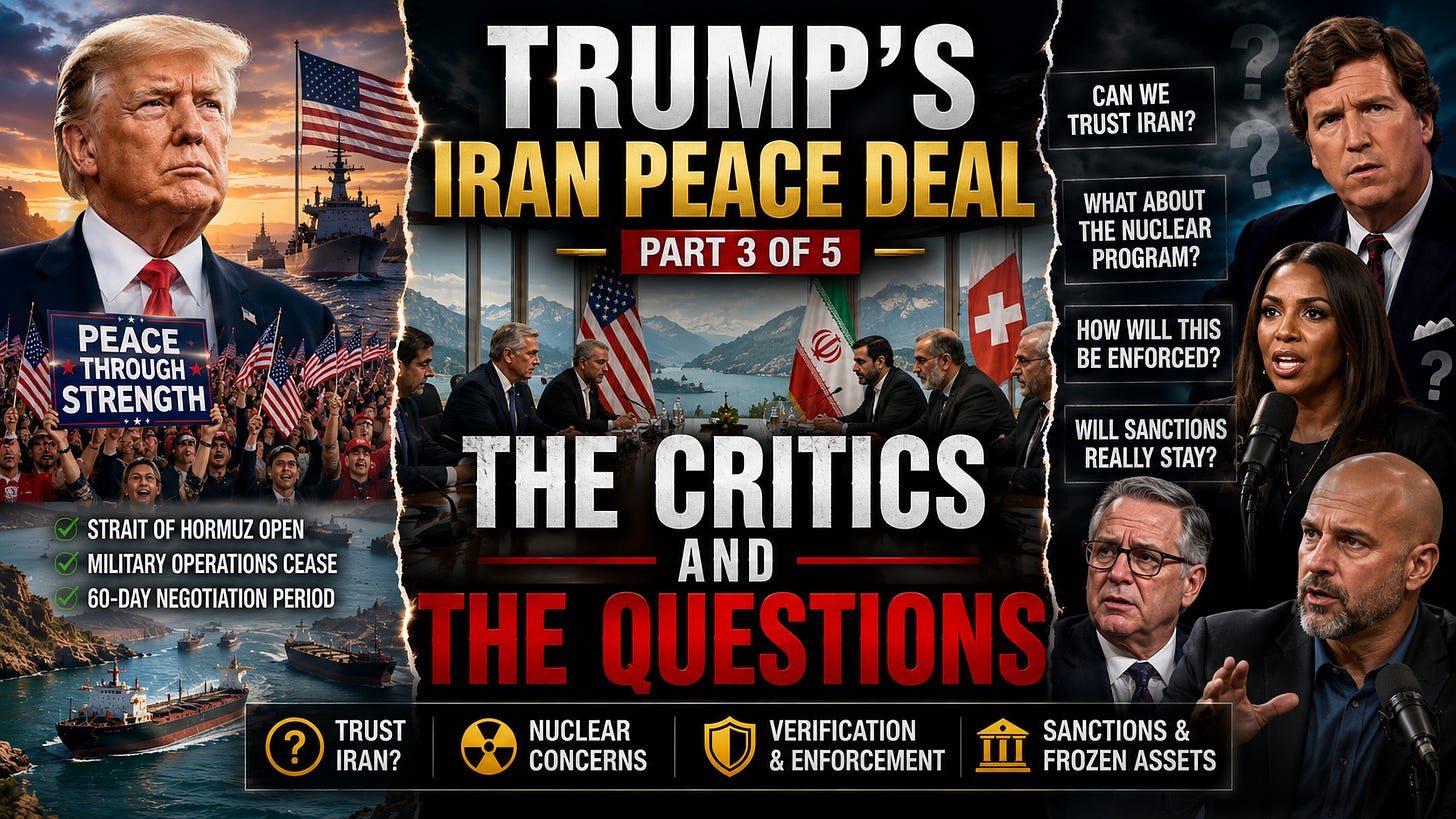
Yesterday, in Part II of this series, we examined why Trump’s Iran Peace Deal may represent one of the most significant American foreign-policy victories in decades. The argument was not that Iran became trustworthy. The argument was that pressure produced movement. Reuters reported that after Trump said the U.S. and Iran had signed an MOU aimed at ending the conflict and reopening the Strait of Hormuz, oil settled at a three-month low, with further talks expected over the next 60 days.
That does not settle every question.
It does prove the skeptics need to ask better ones.
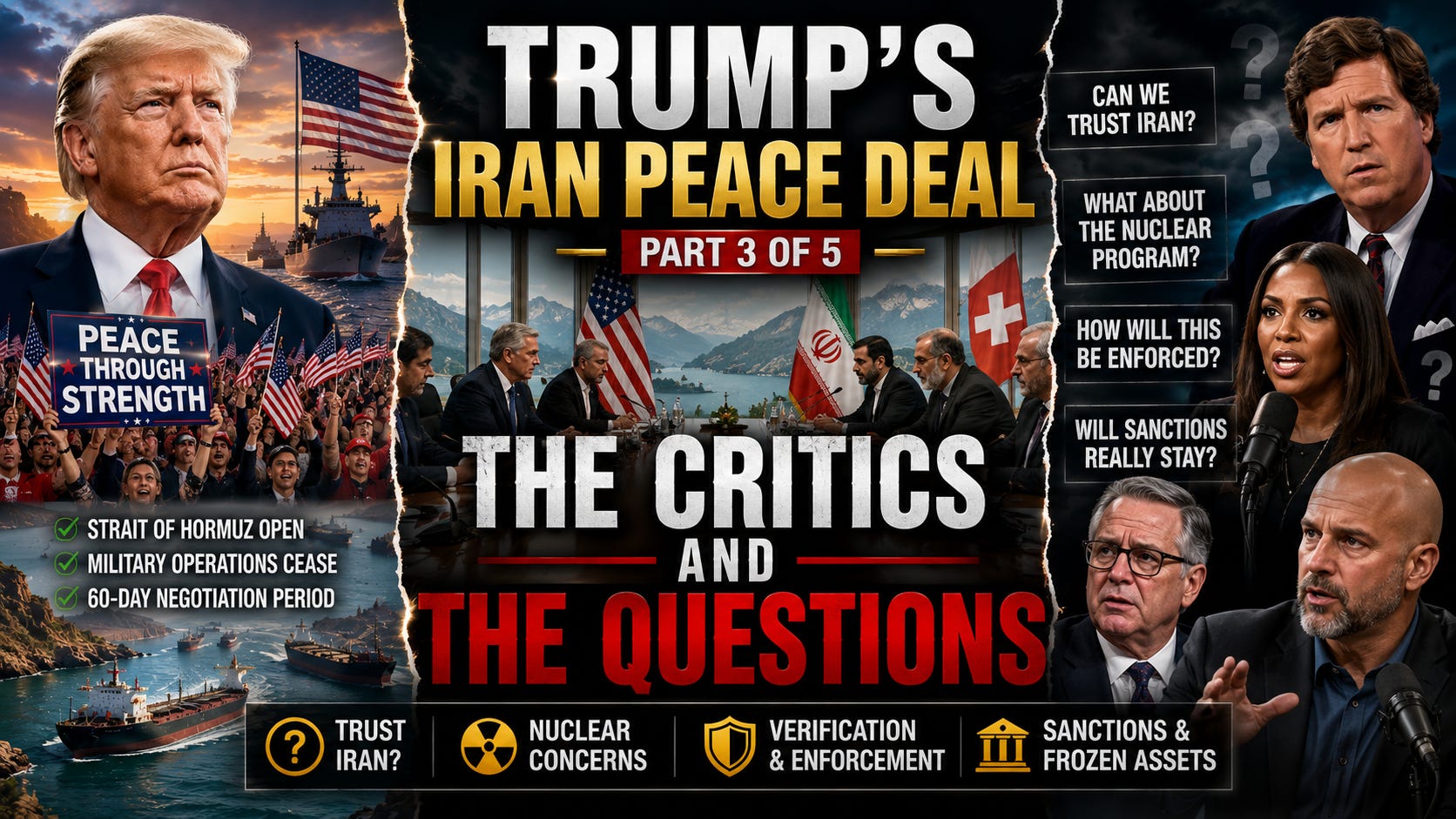
Iran Cannot Be Trusted. That Is the Point.
The most common objection to the agreement is also the easiest to understand: Iran cannot be trusted.
We agree.
Iran has not earned trust. This is a regime with a long record of hostage-taking, proxy warfare, attacks on American interests, threats against Israel and America’s Arab allies, brutal repression at home, and a nuclear program that could never be treated casually. That was the entire reason pressure was necessary in the first place.
The mistake is assuming that Trump’s strategy depends on trusting Iran. It does not. The whole peace-through-strength model is built on the opposite assumption. You do not negotiate with hostile regimes because you trust them. You negotiate when leverage, consequences, verification, and incentives force them into a narrower set of choices.
That is what critics keep missing. The question is not whether Iran deserves trust. It does not. The question is whether America has created enough leverage to make Iranian noncompliance costly.
We believe it has.
The Israel Question
Another criticism that has gained traction in some woke America First circles is the claim that this conflict was never really about American interests at all. According to this view, the United States was merely acting on behalf of Israel, and the entire confrontation with Iran should be understood through that lens.
The problem is that this explanation leaves out too much.
Israel certainly has its own reasons for viewing Iran as a threat. For decades, Iranian leaders have funded organizations committed to attacking Israel, threatened Israeli security, and openly called for policies that Israelis view as existential dangers. No serious observer can understand Israeli decision-making without acknowledging that reality.
But it does not follow that America’s interests and Israel’s interests are identical, nor does it follow that the United States was acting as anyone’s proxy.
The American case against Iran existed long before the current conflict. Iran’s support for terrorist organizations, attacks on U.S. interests, threats against global shipping routes, missile development, hostage-taking, and pursuit of nuclear capabilities all affected American interests directly. The Strait of Hormuz matters to the global economy whether Israel exists or not. A nuclear-armed Iran would alter the strategic balance of the Middle East whether Israel exists or not. American service members have been targeted by Iranian-backed groups regardless of Israeli policy.
In other words, the argument for confronting Iran does not depend on Israel.
It depends on American national interests.
Ironically, some of the same commentators who insist on an America First foreign policy often end up framing every Middle East development through Israel alone. That approach oversimplifies a much larger geopolitical reality. America has its own interests. Israel has its own interests. Sometimes those interests overlap. Sometimes they do not.
In fact, one of the more overlooked aspects of this conflict has been President Trump’s willingness to publicly pressure allies when he believed their actions could undermine broader strategic goals. Throughout his presidency, Trump repeatedly demonstrated that he was willing to challenge friends and adversaries alike if he believed American interests required it. The idea that the United States simply surrendered its decision-making authority to another nation is difficult to reconcile with that record.
The better way to understand the situation is not as America serving Israel, but as two allies confronting the same threat for different reasons.
America Didn’t Need Permission
Another criticism raised throughout the conflict was that America lacked sufficient international backing. Critics pointed to disagreements with European governments, reluctance from traditional allies, and the absence of a broad multinational coalition.
But that criticism misunderstands the central premise of America First foreign policy.
The goal was never to obtain unanimous international approval.
The goal was to protect American interests.
For decades, American foreign policy often became trapped in a cycle where action depended upon international consensus. The result was frequently delay, paralysis, or watered-down responses designed to satisfy competing interests rather than solve underlying problems.
This situation demonstrated a different model.
Whether one supported the policy or opposed it, the United States acted based upon its own assessment of the threat. It did not wait for approval from Brussels. It did not require unanimous agreement from Paris. It did not depend upon every European capital reaching the same conclusion.
And despite those disagreements, the outcome speaks for itself:
-
Iran entered negotiations.
-
The Strait of Hormuz reopened.
-
Markets stabilized.
-
The risk of a broader regional war diminished.
That does not prove every decision was correct. It does demonstrate that American leadership remains capable of shaping events even when international consensus is absent.
For supporters of the agreement, that lesson extends far beyond Iran.
It is a reminder that America’s strength has never come from waiting for permission. It comes from the ability to identify its interests, pursue them confidently, and create outcomes that others eventually adapt to.
That is not isolationism.
It is leadership.
This Is Not 2015
A lot of skepticism sounds like a warning against repeating past mistakes. That concern is understandable. Americans remember previous diplomatic efforts that promised moderation, inspections, and stability, only for Iran’s regional behavior and nuclear ambitions to remain central concerns.
But this is not the same strategic environment.
As we argued in our earlier Conservative TAKE article, What Changed Since 2011? Trump’s Decision on Iran Explained, the world did not freeze in 2011. Iran’s nuclear capacity advanced, proxy attacks intensified, missile capabilities expanded, shipping lanes were threatened, and the cost of delay kept rising. Policy has to respond to present conditions, not old assumptions.
That point matters here. Trump is not entering this moment from a posture of apology or weakness. This framework comes after months of pressure, military degradation, economic strain, and Iran’s loss of leverage around Hormuz.
That makes this fundamentally different from diplomacy built on hope.
“It’s Only a Framework” Is Not the Knockdown Argument Critics Think It Is
Another objection is that this is not really a final peace framework. Critics point out that what currently exists appears closer to a memorandum of understanding or framework than a fully completed settlement.
That may be technically correct.
But it misses the point.
A framework can still be strategically meaningful if it reveals who has leverage. The reopening of the Strait of Hormuz, the pause in military operations, and the movement toward a 60-day negotiation window all tell us something important: Iran came to the table after pressure, not before it.
That is why we should not dismiss the framework just because it is not the final word. The final word comes later. The framework is the evidence that the pressure campaign produced movement.
And that movement matters.
What If Iran Violates the Deal?
This is another fair question, but it does not weaken the case for the agreement as much as critics think.
If Iran violates the framework, then Iran proves exactly why the pressure campaign was necessary. It would not mean Trump was wrong to apply leverage. It would mean the regime remains what we said it was: hostile, deceptive, and dangerous.
The proper response to that possibility is not cynicism. It is enforcement.
No one should be talking about blank checks, unconditional sanctions relief, or American taxpayer-funded rebuilding of Iran. Trump already rejected the idea that the United States would be pouring money into Iran, calling that rumor ridiculous. Any future economic opening should be conditional, regional, traceable, reversible, and tied to compliance.
That is the difference between naïve diplomacy and America First diplomacy.
The Nuclear Question Is Not Solved Yet
The nuclear issue remains the most important unresolved question.
We should be honest about that.
The agreement does not end the entire nuclear problem by announcement alone. It does not automatically dismantle enrichment, remove stockpiles, eliminate centrifuges, or guarantee long-term compliance. Those issues belong at the center of the next phase.
But critics are wrong to treat that as proof that nothing has been accomplished. The purpose of pressure was to create a moment where those issues could be forced onto the table under better conditions. Without pressure, Iran had every incentive to stall, threaten, enrich, and hide behind the possibility of Hormuz disruption.
Now the equation is different.
The nuclear question has not disappeared. But America may finally be negotiating from a position where Iran has fewer cards to play.
The Real Risk Was Doing Nothing
This is where critics often lose the plot.
They focus almost entirely on the risks of acting, negotiating, pressuring, or entering a framework. Those risks exist. But they rarely give equal weight to the risks of doing nothing.
What happens if Iran’s nuclear program keeps advancing? What happens if proxy networks keep expanding? What happens if missile capabilities improve? What happens if the regime regains the ability to threaten Hormuz whenever it wants leverage over the world economy?
Those questions are not theoretical. They are the same questions we raised at the beginning of this conflict, when we argued that delay can become its own form of danger. Inaction is not neutrality. Sometimes inaction simply allows the threat to mature.
That is why we give Trump the benefit of the doubt here. Not because Iran deserves trust, but because the pressure campaign has already produced results that old diplomacy failed to produce.
The Narrative Problem
There is one more issue underneath all of this: the media narrative.
Back in March, we argued in America Is Winning, The Media Just Won’t Admit It that the gap between observable reality and media interpretation was widening. Iran was weakening, its military capacity was being degraded, and yet much of the commentary still framed events as chaos or failure.
We are seeing a version of that same pattern again.
Oil has fallen. Markets have responded. Hormuz is reopening. Iran is entering talks. The threat of wider war has been reduced. Yet the immediate instinct from many critics is to search for the downside before acknowledging the achievement.
Caution is wise.
Cynicism is not.
The Better Way to Understand This Deal
The right way to understand Trump’s Iran framework is not as a sudden act of trust.
It is a test of leverage.
America applied pressure. Iran lost options. The Strait of Hormuz reopened. Negotiations began. Markets responded. Now the next phase will determine whether Iran complies or exposes itself again.
That is not weakness.
That is strategy.
The critics are right that Iran’s history demands caution. They are right that verification matters. They are right that the nuclear issue cannot be waved away. They are right that any economic relief must be conditional and enforceable.
But they are wrong to treat those concerns as proof that the deal itself is a mistake.
The better conclusion is this: Trump created an opportunity where one did not exist before.
And in foreign policy, that matters.
Tomorrow, in Part IV, we move beyond Washington and Tehran to examine the global stakes: oil prices, inflation, shipping lanes, energy markets, and why this agreement could reshape the world economy if peace holds.