There’s something almost predictable about what happens in Washington after a major election. The winning party begins celebrating its newfound power, political commentators immediately declare the losing side finished, and everyone starts predicting what the next two years will look like as though American politics has suddenly become predictable.
If Tuesday’s midterm elections taught us anything, it should be that predicting the future of American politics is a dangerous business.
Democrats have won control of both chambers of Congress, delivering a substantial political setback to Republicans and setting the stage for two years of divided government. For conservatives, the immediate concerns are understandable. Democratic committee chairs will have subpoena authority, congressional investigations will become more aggressive, presidential appointments will face new obstacles, and the legislative priorities Republicans hoped to pursue through 2028 will become considerably more difficult to advance.
But there is one rather important detail getting lost in all the excitement surrounding the Democratic victory.
Donald Trump is still president of the United States.
And if history teaches us anything about divided government, it’s that controlling Congress and controlling the presidency are two very different things.
In our previous article, we examined the 25 reasons Republicans appeared positioned to win the midterms, the assumptions that failed to predict the election, and the historical tendency of Americans to punish whichever party happens to occupy the White House. Those lessons matter, and Republicans would be making a serious mistake by ignoring them.
But the question now is what happens next. Does losing Congress mean Trump’s America First agenda is effectively finished, or does it simply mean the president must pursue that agenda through a different political and constitutional strategy?
The answer may surprise those who believe Tuesday’s election brought the Trump presidency to an early conclusion.
Not only does Trump retain considerable executive authority, but reporting suggests his administration has spent months preparing for precisely this scenario. And if congressional Democrats mistake their victory for an unlimited mandate to investigate, obstruct, and politically punish the president, they may discover that their greatest political opportunity could become their greatest political liability.
The next two years won’t be easy for Republicans, but they could prove considerably more consequential than the immediate election headlines suggest.
The Stockdale Paradox: Accepting Reality Without Abandoning Hope
The late Rush Limbaugh understood something about political movements that remains especially relevant today. He recognized that enduring political setbacks requires more than enthusiasm, outrage, or blind optimism. It requires the ability to acknowledge difficult circumstances without surrendering confidence in the principles you believe will ultimately prevail.
That idea is closely associated with what became known as the Stockdale Paradox, named after Admiral James Stockdale, the American naval officer who endured years of captivity during the Vietnam War.
Stockdale’s experience illustrates a deceptively simple principle: successful endurance requires confronting the most difficult facts of your present circumstances while maintaining faith that you can eventually overcome them.
The distinction is important because optimism and denial are not the same thing.
Republicans lost Congress. Democrats will possess significant institutional authority beginning in January, including the ability to conduct investigations, block legislation, and obstruct presidential appointments. Those are serious political consequences, and pretending otherwise would serve no useful purpose.
But accepting those facts doesn’t require concluding that the conservative movement has failed or that Trump’s remaining presidency has become irrelevant.
Political movements are rarely built or destroyed by a single election. They endure through changing circumstances, competing political coalitions, and the willingness of supporters to remain engaged when the political environment becomes difficult.
Rush frequently reminded his audience that conservatives were not alone, that millions of Americans shared their convictions, and that political setbacks should never be confused with the disappearance of those beliefs.
That perspective matters now.
The question isn’t whether Republicans face difficult circumstances. They clearly do. The question is whether they can acknowledge those circumstances, adapt their strategy, and continue pursuing their objectives without allowing temporary political disappointment to become permanent political defeat.
And when we examine the constitutional powers Trump retains, there are substantial reasons to believe the next two years could offer opportunities that many Democrats are currently overlooking.
Losing Congress Doesn’t Mean Losing the Presidency
One of the most common assumptions surrounding divided government is that a president becomes essentially powerless when the opposing party controls Congress.
History demonstrates otherwise.
Bill Clinton spent six of his eight years in office dealing with Republican congressional majorities. Following the Republican Revolution of 1994, many political observers believed Clinton’s presidency had been permanently weakened. Instead, he adapted to the new political environment, negotiated with congressional Republicans when necessary, and ultimately won reelection in 1996.
Barack Obama provides another example. Republicans captured the House in 2010 and gained control of the Senate in 2014, yet Obama continued pursuing consequential foreign policy initiatives throughout his presidency. His administration negotiated the Iran nuclear agreement, restored diplomatic relations with Cuba, and participated in the Paris climate agreement despite facing significant congressional opposition.
Conservatives may disagree strongly with those policies, but that doesn’t change the underlying constitutional lesson. Presidents possess considerable authority that does not disappear simply because Congress changes hands.
The executive branch continues administering federal law, directing national security policy, managing diplomatic relationships, overseeing federal agencies, and exercising powers delegated by Congress. Those responsibilities remain part of the presidency regardless of the political composition of the legislative branch.
Now, that doesn’t mean Congress is irrelevant. Far from it. Congress controls appropriations, writes legislation, exercises oversight, and plays an essential role in confirming presidential nominees. Democrats will have considerable opportunities to challenge Trump and restrict portions of his agenda.
But there is a fundamental difference between making a president’s job more difficult and preventing him from governing altogether.
Congressional defeat is not presidential paralysis.
And according to recent reporting, the White House appears to understand that distinction very well.
Trump’s Strategy Has Two Parts: Defense and Offense
The next phase of Trump’s presidency may ultimately be defined by a relatively straightforward strategy: use the presidential veto to defend existing priorities while employing lawful executive authority to continue advancing the administration’s agenda.
The defensive side became apparent almost immediately following the election.
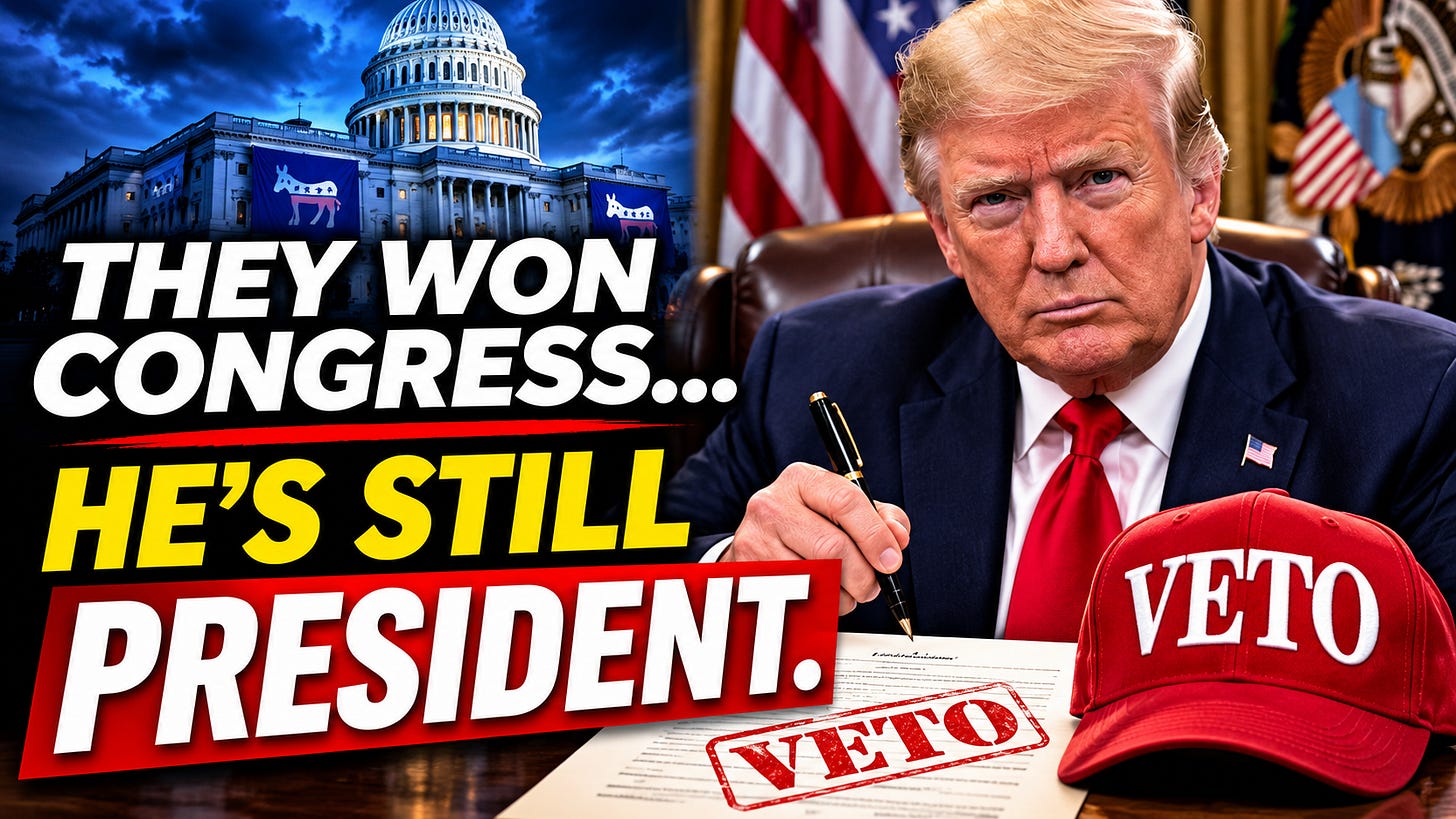
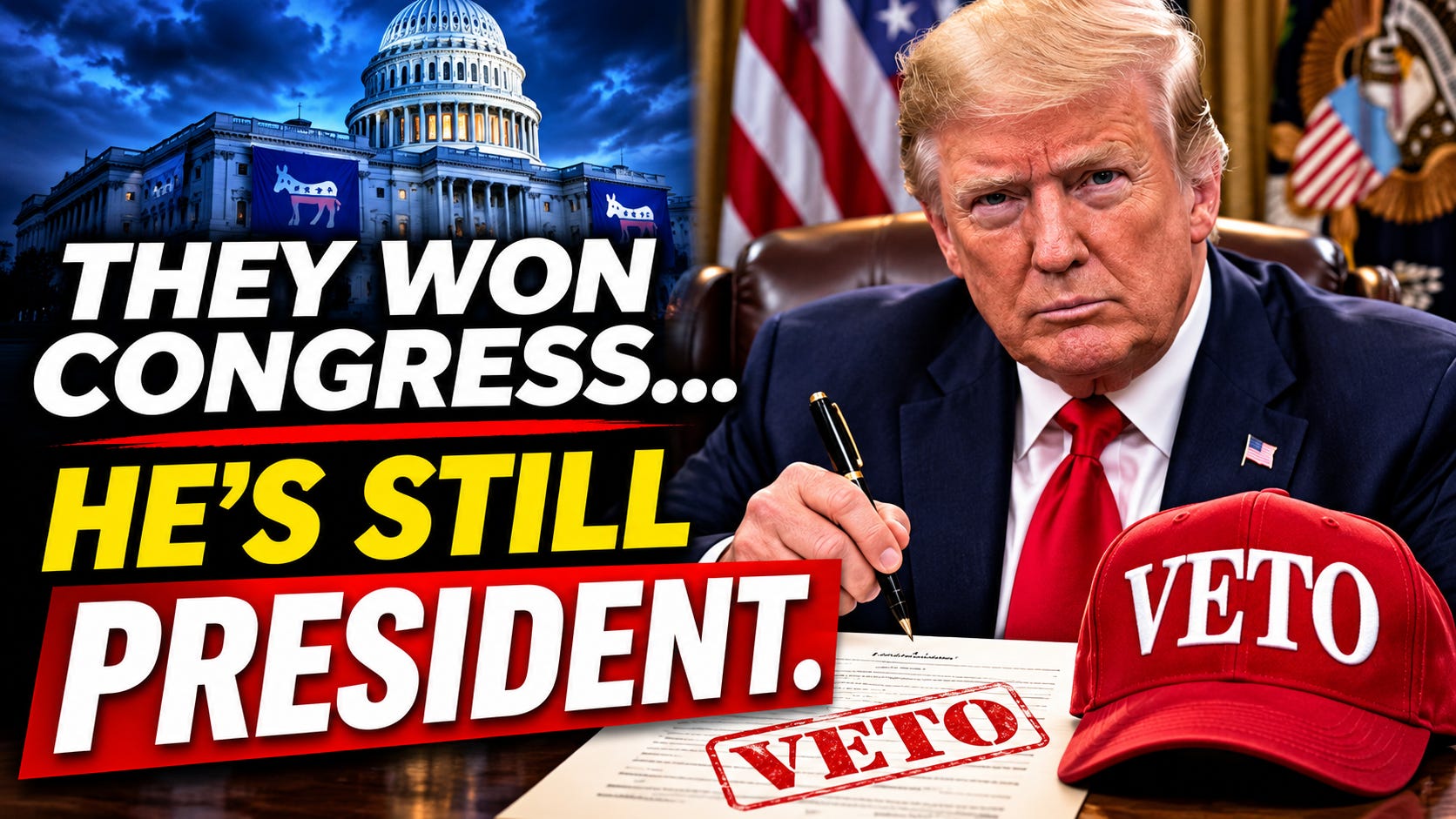
Trump shared an image of a red baseball cap displaying a single word: VETO.
It was a characteristically simple political message, but its constitutional significance is substantial. Trump has also discussed the possibility of becoming known as “Mr. Veto,” suggesting that repeated legislative confrontations could eventually encourage Democrats to negotiate.
The reason is straightforward.
Passing legislation through Congress is not the same thing as turning that legislation into law. Under Article I, Section 7 of the Constitution, a presidential veto generally requires a two-thirds vote in both the House and Senate to override.
That is not a simple congressional majority, nor is it merely the 60 votes generally associated with overcoming a Senate filibuster.
It is a much higher constitutional threshold.
Democrats may possess the votes necessary to pass legislation through both chambers, but that doesn’t automatically mean they possess the supermajorities required to overcome Trump’s objections.
This creates a significant defensive advantage for the president. He can reject legislation that conflicts with his administration’s priorities, preserve existing policies where continued implementation remains legally authorized, and force congressional Democrats to negotiate if they want their legislative proposals enacted.
Of course, the veto does not allow Trump to accomplish everything he wants. A president cannot enact new legislation through a veto, and Congress can use its appropriations authority to constrain executive priorities.
But the constitutional balance of power works in both directions.
And that brings us to the offensive component of the administration’s emerging strategy.
The White House Was Apparently Preparing for This Months Ago
Perhaps the most important development for conservatives is that the administration reportedly began preparing for a potential Democratic takeover long before Election Day.
According to Reuters reporting published November 1, senior White House officials have spent months examining executive actions Trump could pursue without obtaining new congressional approval.
The effort reportedly began in April and involved Deputy Chief of Staff Stephen Miller, Office of Management and Budget Director Russell Vought, and attorneys working with the White House Counsel’s Office.
The discussions reportedly focused on immigration enforcement, tariffs, housing affordability, federal spending, and the scope of existing executive authority. Federal agencies were asked to identify potential administrative actions, while legal advisers examined how those proposals might withstand judicial scrutiny.
That distinction matters.
The White House was not necessarily waiting until Republicans lost Congress to begin determining how the president could govern under divided government. According to the reporting, officials were already evaluating potential legal authorities and preparing contingency plans.
Among the proposals reportedly under consideration were tighter restrictions involving temporary employment opportunities for international students, tariffs affecting certain critical minerals and wind turbines, and administrative measures intended to address housing and construction costs.
These are proposals under consideration, not a finalized package of presidential directives. Some may never become policy, and others could face substantial legal or political challenges.
Nevertheless, they offer a glimpse into the administration’s thinking.
Rather than depending exclusively on Congress to enact new laws, Trump could increasingly rely on existing statutory authority, federal agency rulemaking, and presidential directives to pursue policy objectives.
That’s an important distinction because Congress has already delegated considerable responsibility to the executive branch through legislation enacted over many decades.
Presidents cannot simply invent new legal authority, but they can exercise powers that existing laws and the Constitution already provide.
And an administration that has spent months identifying those authorities may be better prepared to navigate the inevitable legal challenges than one attempting to improvise its strategy after losing Congress.
For Democrats who believe their new congressional majorities will automatically bring Trump’s policy agenda to a standstill, that could become an unpleasant surprise.
The Supreme Court Has Already Changed the Executive Power Equation
There is another development that could have significant consequences for Trump’s remaining presidency.
On June 29, 2026, the Supreme Court issued its decision in Trump v. Slaughter, a case involving the president’s authority to remove commissioners from the Federal Trade Commission.
In a six-to-three decision, the Court ruled that statutory protections restricting the president’s ability to remove FTC commissioners violated the constitutional separation of powers.
The decision strengthened presidential removal authority over officials exercising executive responsibilities within that agency and overturned the longstanding precedent that had supported those particular removal protections.
For an administration that has made reducing the influence of the permanent federal bureaucracy a central political priority, the ruling represents an important constitutional development.
The practical argument is straightforward. If the president is constitutionally responsible for executing federal law, there are limits to how completely Congress can insulate certain executive officials from presidential supervision.
That doesn’t mean Trump now possesses unlimited authority over every federal agency or that all statutory restrictions on executive action have disappeared.
The ruling concerns presidential removal authority, and the scope of executive power remains subject to constitutional, statutory, and judicial limitations.
But it does provide the administration with an important legal foundation for exercising greater supervision over officials responsible for implementing federal policies.
The political consequences could become particularly significant under divided government.
While Democrats may use Congress to challenge administration priorities, Trump may simultaneously exercise greater control over portions of the federal bureaucracy responsible for carrying those priorities out.
In other words, the election may have changed who controls Congress, but it did not reverse the Supreme Court’s constitutional interpretation of presidential removal authority.
And that could become an important factor in the administration’s ability to continue governing.
Federal Spending Could Become Another Major Battlefield
Executive orders and presidential vetoes will probably attract the most media attention, but another significant struggle could develop over the federal government’s existing spending authority.
Reuters reported that Russell Vought has been examining which administration priorities might proceed using funds Congress has already appropriated. The reported discussions also included potential changes to grant procedures that could give political appointees greater influence over certain funding decisions.
This may sound like an obscure administrative matter, but the implications are substantial.
Congress exercises constitutional authority over federal spending, yet agencies frequently possess varying degrees of discretion in administering programs that Congress has authorized and funded.
The important question becomes how much discretion existing laws provide.
Where Congress has delegated authority, an administration may be able to adjust implementation priorities, modify administrative procedures, or exercise lawful flexibility without obtaining new legislation.
Where Congress has imposed mandatory requirements, however, the executive branch remains obligated to follow them.
Trump cannot simply disregard appropriations statutes or redirect money wherever he wishes. Courts can intervene when executive officials exceed their authority or violate applicable spending laws.
But within the boundaries of existing law, the administration may possess more opportunities to pursue its objectives than congressional Democrats would prefer.
That is another reason why gaining control of Congress does not automatically mean gaining control of the entire federal government.
The legislative and executive branches possess different constitutional responsibilities, and those responsibilities frequently overlap in ways that require negotiation, litigation, or both.
The next two years could provide Americans with a particularly vivid demonstration of how those competing powers operate.
The Senate Will Still Present Serious Problems for Trump
For all the constitutional tools available to the president, there is one area where losing congressional control could be especially consequential.
Presidential appointments.
The Constitution requires Senate advice and consent for many executive positions and federal judicial appointments. A Democratic Senate majority could make confirming Trump’s nominees substantially more difficult.
That includes appointments to federal appellate courts, important executive branch positions, and potentially the Supreme Court if a vacancy arises before the end of Trump’s presidency.
Unlike the presidential veto, which allows Trump to reject legislation, the appointments process requires affirmative Senate participation.
The president cannot simply bypass the normal confirmation process whenever senators oppose his preferred candidates.
There are limited constitutional mechanisms involving temporary appointments, but they are not a general substitute for Senate confirmation.
This creates a meaningful obstacle to the administration’s longer-term personnel and judicial priorities.
Congressional oversight presents another challenge.
Democratic committee chairs will possess subpoena authority and the ability to investigate administration decisions, request documents, and hold hearings. Congressional Democrats have already discussed possible investigations involving the president and senior administration officials.
According to reporting, White House lawyers have been preparing for those confrontations by examining legal responses to subpoenas, document requests, and potential executive privilege disputes.
That suggests the administration anticipates a prolonged institutional struggle rather than a brief period of political disagreement.
And conservatives should understand that such confrontations can produce real consequences.
Executive privilege is not absolute. Congressional investigations cannot always be dismissed simply because the White House considers them politically motivated. Courts may ultimately have to resolve disputes over access to documents, testimony, and the limits of congressional oversight.
None of those challenges should be minimized.
But the existence of congressional oversight does not eliminate the president’s constitutional authority to govern.
It means both branches will have to operate within a more adversarial political environment.
Democrats Could Overplay Their Hand
This is where the next two years become particularly interesting.
Democrats have won control of Congress, but they may be approaching one of the most consequential political decisions they will face before 2028.
What exactly do they intend to do with their newfound power?
The election was shaped by substantial public frustration over affordability, the economy, the Iran conflict, and the overall direction of the country. Democrats benefited from that dissatisfaction, but benefiting from public anger is not necessarily the same thing as receiving an unlimited endorsement of a party’s entire agenda.
Many voters wanted change.
But what kind of change?
That question matters enormously.
If Democrats spend the next two years prioritizing investigations, impeachment proceedings, political retaliation, and constant confrontation with Trump while doing little to address the economic concerns that motivated voters, they could find themselves confronting the same frustrations that hurt Republicans.
And that creates an opportunity for the president.
Trump can use his constitutional authority to challenge legislation he opposes while continuing to advocate for the policies he believes will improve the country.
But his greatest political opportunity may come from presenting himself as the person attempting to govern while congressional Democrats become increasingly consumed by political warfare.
That contrast will only be persuasive if the administration actually produces results.
Americans who are struggling with housing costs, grocery bills, or financial uncertainty are unlikely to reward endless political confrontation from either party.
But if Trump can demonstrate progress on the issues voters care about while Democrats become focused primarily on investigations and partisan battles, the political environment could shift considerably.
We’ve seen presidential recoveries under divided government before.
Bill Clinton regained political momentum following the Republican congressional victory of 1994. Barack Obama won reelection after Democrats suffered substantial losses in 2010.
Neither outcome guarantees that Trump or Republicans will experience the same recovery.
But both demonstrate that a midterm defeat does not necessarily determine the political future.
Democrats would be making a serious mistake if they assumed Tuesday’s victory gave them a permanent mandate.
After all, Republicans just discovered how dangerous political assumptions can become.
Republicans Cannot Depend on Democratic Overreach to Save Them
There is another side to this argument, and it’s one Republicans would be wise to remember.
Hoping your opponents make mistakes is not the same thing as developing a strategy for winning.
If Democrats overplay their hand, Republicans may benefit politically. But that possibility cannot become the entire Republican recovery plan.
The party needs to examine why voters rejected Republican candidates in so many places and why the coalition that elected Trump in 2024 failed to deliver the same level of support in 2026.
Better candidates matter. Disciplined leadership matters. Competent administration matters. And holding Republican officials accountable for their own mistakes matters just as much as criticizing Democratic politicians.
One of the mistakes political movements frequently make is convincing themselves that voters must support them simply because the alternative is worse.
We made a version of that argument in our original assessment of the midterms.
We believed Democratic unpopularity would help protect Republicans.
The voters demonstrated otherwise.
That should serve as a reminder that political loyalty cannot simply be demanded. It must be maintained through persuasion, credible leadership, and results.
Republicans also need to understand that voters judge the economy according to the circumstances they experience, not merely the statistics politicians emphasize.
Slowing inflation does not automatically reverse years of higher prices.
A household that has absorbed substantial increases in grocery bills, housing costs, insurance premiums, and other expenses may not feel meaningful improvement simply because inflation has moderated.
The administration needs to demonstrate progress in terms ordinary Americans recognize: paychecks stretching further, housing becoming more attainable, and essential expenses consuming a smaller share of household income.
Those are the measurements that will ultimately matter to many voters.
Foreign policy presents a similar challenge.
The continuing conflict involving Iran requires clear objectives, consistent communication, and a credible explanation of what a successful resolution would look like.
Americans can recognize legitimate national security threats while still expecting their government to explain the costs, strategy, and intended outcome of military involvement.
Vague promises and contradictory messages are unlikely to rebuild confidence.
The lesson from the midterms is not that conservative policies necessarily lack merit.
It’s that political arguments must be connected to results the electorate can understand and evaluate.
And if Republicans want a comeback in 2028, they will need to demonstrate that connection.
Executive Orders Are Powerful, but They Are Not Permanent
One of the greatest strengths of presidential executive authority is also one of its most important limitations.
It can change with the occupant of the White House.
Executive orders are not the same thing as statutes enacted by Congress, and many presidential directives can be modified or revoked by future administrations.
Federal regulations may offer greater durability, but even formally adopted agency rules can often be amended or repealed through the legally required procedures.
That means Trump’s ability to continue implementing his agenda through executive authority does not automatically guarantee that those policies will survive beyond his presidency.
A future administration could attempt to reverse many of them.
That is why the distinction between exercising power and establishing a lasting political legacy matters so much.
The White House may be able to advance important priorities over the next two years without obtaining new legislation.
But making those policies durable could ultimately require congressional cooperation, statutory changes, favorable court decisions, and continued public support.
A Republican victory in 2028 would likely provide an opportunity to extend many of the administration’s priorities.
But Tuesday’s results should eliminate any temptation to assume that another Republican presidential victory is inevitable.
Winning the next election will require the party to earn the confidence of the American people.
And that confidence cannot be built through executive orders alone.
It requires successful governance, credible political leadership, and a persuasive explanation of why voters should support the continued implementation of the administration’s policies.
There is a difference between preserving a policy for the next two years and ensuring that it becomes part of America’s long-term political direction.
Republicans will need to think seriously about both.
The Real Opportunity Is Bigger Than the Next Two Years
For all the discussion about vetoes, executive orders, Supreme Court decisions, and congressional investigations, the larger question is what Republicans intend to accomplish with the political opportunity they still possess.
Trump remains president.
His administration retains substantial authority to implement existing law, pursue executive priorities, and negotiate with Congress.
His political movement continues to possess a large and engaged base of supporters.
And the next presidential election remains two years away.
Those are not insignificant advantages.
But the future of the America First movement cannot depend entirely on Donald Trump exercising presidential authority until January 2029.
If the movement is going to endure, it must demonstrate that its principles can be translated into successful government and communicated effectively to Americans who may not consider themselves committed Republicans.
That means developing credible leaders, building stronger local political organizations, and making the case for conservative policies in ways that address ordinary voters’ concerns.
It also means recognizing that legitimate criticism of Republican leadership does not automatically constitute opposition to conservative principles.
A political movement that refuses to acknowledge mistakes eventually loses its ability to correct them.
And a movement that spends too much time explaining why voters should support it without demonstrating why they benefit from its leadership risks repeating the very mistakes that produced this election.
The opportunity before Republicans is not simply to survive the next two years.
It is to rebuild the political confidence necessary to govern effectively beyond them.
Democrats may help create that opportunity if they overreach.
But Republicans must still be prepared to earn it.
The Final TAKE: Democrats Won Congress, but They Haven’t Written the Ending
The 2026 midterms changed the political landscape in Washington, and the consequences will be significant.
Democrats now have congressional majorities that will allow them to challenge the administration, conduct investigations, influence federal spending, and obstruct presidential appointments.
Those powers matter, and conservatives should not pretend otherwise.
But the election did not remove Donald Trump from the White House, eliminate presidential veto authority, or erase the constitutional responsibilities of the executive branch.
And perhaps most importantly, it did not settle the political questions that will shape the 2028 election.
Trump retains considerable authority to govern, and recent reporting suggests his administration has been preparing for divided government for months.
The White House appears positioned to pursue a combination of defensive legislative strategy and offensive executive action, relying on existing legal authorities where appropriate while preparing for congressional investigations and legal challenges.
That approach could allow significant portions of the administration’s agenda to continue despite Democratic control of Congress.
But the real test will not be how many executive orders Trump signs or how many Democratic bills he vetoes.
The test will be whether the administration can turn the power it retains into results that restore public confidence.
Can Trump demonstrate meaningful progress on affordability? Can the administration communicate a clear foreign policy strategy? Can Republicans hold their own leadership accountable while preparing for the next election? And can the conservative movement develop a political coalition capable of sustaining its principles beyond Trump’s presidency?
Those questions matter more than any single congressional confrontation.
Democrats, meanwhile, face a challenge of their own.
They can use their congressional majorities to address the concerns that brought voters to the polls, or they can become consumed by investigations and political warfare.
If they choose the latter, they may discover that the electorate’s frustration with Washington is not exclusively directed at Republicans.
And Trump may have an opportunity to stand in the gap, using his constitutional authority to resist genuine congressional overreach while demonstrating a willingness to govern.
As America marks its 250th anniversary, there is something particularly appropriate about revisiting the importance of constitutional checks and balances.
The Founders never intended political power to rest permanently with one party or one branch of government.
They created a system in which competing institutions would restrain one another, forcing elected officials to operate within constitutional limits while remaining accountable to the people.
That system does not stop functioning when elections produce divided government.
In many respects, divided government demonstrates precisely why the system was designed the way it was.
For conservatives, that should provide perspective.
Republicans lost Congress, but they did not lose their principles, their constitutional rights, or their ability to participate in shaping the country’s future.
Donald Trump still has two years remaining in his presidency, and how he uses that time could prove consequential for both the country and the political movement he leads.
But the greatest opportunity may not come from defeating Democrats in congressional investigations or successfully vetoing their legislation.
It may come from demonstrating that the America First agenda can deliver results that persuade Americans to support it again.
Preserving an agenda, improving people’s lives, and rebuilding a political majority are three different responsibilities. The next two years will require all three.
Democrats won Congress.
They did not win the presidency.
And they certainly have not written the final chapter of American politics.
The story is far from over.
Shaping Culture. Defending Freedom.
— the Conservative TAKE