It’s not often that you get the opportunity to admit you were wrong. It’s even less often that you get to do it 25 times in the same article. But apparently, the American electorate decided we needed a little humility this November, and if nothing else, we’re going to give the voters credit for making their point abundantly clear.
Back on May 21, we published an article titled “25 Reasons the GOP Remains Positioned to Win in 2026.” We examined congressional maps, voter registration trends, Donald Trump’s influence, economic indicators, demographic shifts, fundraising advantages, and just about every other piece of evidence suggesting Republicans were in a strong position heading into the midterms. We weren’t simply throwing out predictions. We were making what we believed was a reasonable argument based on the political landscape at the time.
As it turns out, the American people had other ideas.
The November 3 election delivered a substantial Democratic victory, with the Associated Press calling control of both the House and Senate for Democrats. Republican losses extended into states and districts that few observers would have considered likely Democratic victories earlier in the year. Texas, South Carolina, and Kansas were among the states where Democrats won Senate races, while Republicans lost more than two dozen House districts, including some that Donald Trump had carried comfortably just two years earlier. The final margins are still being determined, but the direction of the election is unmistakable.
Now, before everyone starts writing political obituaries or declaring the conservative movement finished, there’s a much more interesting conversation worth having. The election exposed some significant weaknesses in our assumptions, but it also reinforced a few lessons about American politics that we probably should have taken more seriously in the first place.
Our biggest mistake may have been assuming that voters would approach this election the way we did. We believed Americans would look beyond temporary frustrations, evaluate the broader consequences of returning congressional power to Democrats, and ultimately vote according to what we considered their long-term interests. In other words, we assumed voters would think through the larger political picture rather than simply react to whatever happened to be upsetting them at the moment.
Perhaps we gave the electorate too much credit. Or perhaps we gave ourselves too much credit for understanding what voters considered important. After all, Americans don’t necessarily define their best interests according to our political priorities, and a family struggling with everyday expenses isn’t particularly interested in hearing how favorable the congressional map looks for Republicans.
We also underestimated something that has shaped American elections for generations: the tendency of voters to take their frustrations out on whichever party happens to control Washington. Republicans benefited from that anger in 1994, 2010, and 2022. Democrats benefited in 2006 and 2018. We recognized the pattern in our original analysis but convinced ourselves that the political advantages Republicans possessed would somehow overcome it.
They didn’t, and that’s worth examining rather than explaining away.
But here’s the important part: recognizing that our predictions were wrong doesn’t mean abandoning the principles behind them. It doesn’t mean the conservative movement has suddenly lost its purpose, and it certainly doesn’t mean that the constitutional system our Founders established has stopped working. Political parties win elections, political parties lose elections, and the country continues forward. That’s not a weakness of the American system. It’s one of its greatest strengths.
So rather than spend the next several weeks complaining about voters, blaming the media, or pretending we saw all of this coming, we’re going to do something a little different. We’re going to revisit all 25 of our original arguments, acknowledge where our analysis fell short, and consider what these results actually mean for the next two years.
And when we’re finished, I think conservatives might discover that there’s considerably more reason for encouragement than the headlines would have us believe.
1. We Thought the House Math Was on Our Side
Our original analysis started with what appeared to be an incredibly favorable congressional map. According to the ratings we cited at the time, Republicans were positioned to hold approximately 217 House seats, leaving them needing only one additional victory among the remaining competitive races. Democrats, meanwhile, appeared to need an almost perfect election to reclaim the majority.
What we failed to appreciate was that congressional ratings are snapshots, not guarantees. A district rated as likely Republican in May can become competitive in November if voters grow dissatisfied with the governing party. We treated favorable projections as though they represented a nearly permanent structural advantage, when in reality those projections depended on an electoral environment that was still changing.
The Democrats didn’t need to win according to our May calculations. They needed to win according to the political conditions that existed when voters actually cast their ballots. And those conditions turned out to be substantially different from what we anticipated.
2. We Thought Trump’s Dominance of the Republican Base Would Carry the Party
Donald Trump’s influence over Republican voters remains one of the defining characteristics of modern American politics. His ability to shape primary elections, influence the party’s direction, and mobilize committed supporters is extraordinary. Our mistake wasn’t necessarily recognizing that influence; it was assuming that influence would automatically translate into Republican victories in a midterm election.
Trump wasn’t personally on the ballot, and the coalition that elected him in 2024 wasn’t guaranteed to show up for every Republican congressional candidate in 2026. The voters who participate in Republican primaries are also not representative of the entire electorate. Independents, less committed Republicans, and motivated Democratic voters all play a much larger role in general elections.
We confused Trump’s influence within the Republican Party with the broader electorate’s willingness to reward that party. Those are two very different measurements of political strength.
3. We Thought Republican Unity Meant Republican Strength
We pointed to the political decline of prominent anti-Trump Republicans as evidence that the party had largely resolved its internal divisions. Figures who once challenged Trump’s leadership had either left office, lost primaries, or become less influential within Republican politics. From our perspective, the days of a Republican Party fighting itself appeared to be largely behind us.
What we overlooked was that party unity doesn’t necessarily translate into electoral appeal. A political movement can become increasingly unified around its preferred candidates and policies while simultaneously becoming less attractive to people outside that movement. It can also become more difficult to recognize weaknesses when fewer people within the party are willing to challenge prevailing assumptions.
Republicans may have spent less time fighting one another, but that didn’t mean they had persuaded the voters necessary to maintain congressional control. Winning internal arguments and winning general elections require different strategies.
4. We Thought Redistricting Would Protect Republicans
Republican-led redistricting efforts appeared to provide another significant advantage heading into November. We looked at congressional maps in states such as Texas, Florida, North Carolina, and Ohio and concluded that Republicans had built a meaningful layer of protection against an unfavorable national environment.
But favorable district boundaries can only accomplish so much. A map may give a party an advantage under normal political conditions, but it cannot prevent voters from changing their minds. When dissatisfaction becomes widespread enough, even districts drawn to favor one party can become competitive.
Our mistake was assuming that structural advantages could overcome almost any shift in public sentiment. The election reminded us that the voters still have the final say, regardless of how carefully politicians draw the districts.
5. We Thought Democrats Needed a Perfect Election
One of our strongest arguments was that Democrats needed nearly everything to go right. They required strong turnout, favorable independent support, competitive candidates, improving electoral prospects in swing districts, and an economic environment that worked against Republicans. We looked at that combination and concluded that the odds were overwhelmingly against them.
But we failed to recognize that these weren’t necessarily independent circumstances. They could all emerge from the same political reality: a dissatisfied electorate looking for an opportunity to punish the party in power.
When voters become frustrated enough, opposition turnout increases, independent voters reconsider their choices, and competitive races begin moving in the same direction. What looked to us like an unlikely combination of Democratic advantages turned out to be the characteristics of a national political wave.
6. We Thought Republican Voter Registration Gains Would Deliver Victory
We spent considerable time examining voter registration trends in states such as Pennsylvania, North Carolina, Florida, and Nevada. Republicans had made meaningful gains in several of these states, and we believed those trends demonstrated a broader movement away from the Democratic Party.
The problem is that voter registration doesn’t tell us how enthusiastic people are about voting, whether they intend to participate, or whether they still support the party listed on their registration. A registered Republican can stay home, vote for a Democrat, or choose a third-party candidate without changing party affiliation.
We treated registration gains as evidence of future election results rather than one piece of a much larger political puzzle. The lesson is simple: having voters registered under your party’s name doesn’t mean you’ve earned their vote.
7. We Thought the Working-Class Realignment Was Permanent
Donald Trump’s success among working-class voters, Hispanic voters, younger men, and other groups that had historically leaned Democratic was one of the most important developments of the 2024 election. We believed those gains represented a lasting political realignment that would continue benefiting Republicans in 2026.
What we missed was that political coalitions must be maintained. Voters who supported Trump in 2024 didn’t necessarily become lifelong Republican voters, and they weren’t obligated to overlook economic frustrations or political disagreements simply because they had changed their voting preferences two years earlier.
Early election reporting suggests that younger voters and Hispanic voters moved away from Republicans compared with 2024. That doesn’t automatically mean those voters have permanently returned to the Democratic Party, but it certainly challenges the assumption that their support could be taken for granted. Republicans will need to earn those votes again rather than assume they are now permanently part of the conservative coalition. (apnews.com)
8. We Thought Voters Would Remember the Trump Economy
We believed Americans would compare their economic experiences under Trump with the inflation and affordability problems associated with the Biden administration. We expected that comparison to favor Republicans, particularly among working families who had experienced years of rising prices.
What we underestimated was the importance of the present. Voters weren’t being asked whether they preferred the economy of 2019 to the economy of 2022. They were evaluating their financial circumstances in November 2026. And when families remain frustrated with grocery bills, housing costs, insurance premiums, and everyday expenses, reminding them that things were worse under a previous administration isn’t necessarily persuasive.
The governing party receives credit when voters believe conditions are improving, but it also receives blame when voters believe things aren’t moving in the right direction. We spent too much time thinking about economic comparisons and not enough time considering how voters actually felt about their finances.
9. We Thought Gas Prices Wouldn’t Matter Enough
Our original article argued that gasoline prices alone rarely determine election outcomes. We believed voters would consider wages, tax policies, employment, retirement accounts, and the broader economy rather than allowing one particularly visible expense to dominate their political decisions.
That may be a reasonable argument in theory, but it overlooked how people experience the economy. Gas prices are visible reminders of financial pressure, and they influence transportation expenses, household budgets, and the cost of moving goods throughout the economy. For many voters, rising prices at the pump can reinforce a broader belief that everyday life is becoming less affordable.
We treated gasoline prices as an isolated political issue. Many voters likely viewed them as part of a larger affordability problem, and that distinction matters.
10. We Thought Tax Savings Would Outweigh Increased Household Expenses
We cited an analysis suggesting that many taxpayers could receive financial benefits from Republican policies that exceeded the additional costs associated with higher gasoline prices. On paper, the argument appeared persuasive. If a household saved more through tax policy than it spent on increased fuel costs, wouldn’t that household recognize the overall benefit?
Apparently, household finances don’t work quite that neatly in the minds of voters. Projected tax savings can be difficult to recognize, especially when people are dealing with immediate increases in food, insurance, housing, and other expenses. More importantly, our original comparison was too narrow to capture the full range of financial pressures facing American families.
We were focused on what the calculations suggested people should be experiencing. Voters were focused on what they believed they were actually experiencing. Those two things aren’t always the same.
11. We Thought Domestic Energy Production Would Reduce Economic Anxiety
Expanded domestic energy production and deregulation were central elements of our original economic argument. We believed increased American energy capacity would help offset international instability and eventually reduce pressure on consumers.
But the United States doesn’t operate in isolation from global energy markets. International conflict, transportation disruptions, supply expectations, and geopolitical instability can affect American energy prices regardless of domestic production levels.
We also underestimated the political difficulty of explaining long-term energy policy to voters experiencing short-term financial pressure. A policy that supporters believe will deliver future benefits may still face opposition if voters are dissatisfied with current conditions.
The lesson isn’t necessarily that the original energy policy argument was wrong. It’s that we overestimated how much political protection that argument would provide.
12. We Thought Voters Would Distinguish Iran From Iraq
Our original article argued that Americans could recognize the dangers associated with Iran’s nuclear ambitions without automatically equating the conflict with Iraq or Afghanistan. We believed voters would understand the national-security arguments behind confronting Iran and would separate those concerns from their understandable frustration with previous military interventions.
What we failed to appreciate was how deeply Americans remain concerned about prolonged foreign conflicts. A voter can believe Iran represents a legitimate security threat while simultaneously questioning the strategy, costs, objectives, and potential consequences of American military involvement.
The Iran war became part of a broader political environment in which voters were already anxious about economic conditions and the direction of the country. We assumed that agreement with a national-security objective would produce political support for the administration pursuing it. That assumption did not hold. (axios.com)
13. We Thought Trump’s Endorsement Record Would Predict General-Election Success
Trump’s endorsement power has helped shape Republican primary elections for years. We pointed to that influence as evidence that the party’s political machinery remained strong and capable of delivering victories.
But primary elections and general elections serve very different purposes. Republican primary voters are deciding which candidate best represents their political preferences. General-election voters are deciding among candidates from competing parties, often with very different priorities and expectations.
A candidate who performs extremely well among committed Republican voters may struggle to persuade independents or moderate voters. We placed too much emphasis on Trump’s ability to help candidates win nominations and not enough on their ability to win broader electorates.
14. We Thought Democrats Needed a Better Message
We argued that Democrats lacked a compelling national message capable of competing with Republican positions on immigration, economic nationalism, border security, and cultural issues. Their internal disagreements between moderates and progressives seemed likely to undermine their effectiveness.
But an opposition party doesn’t always need a comprehensive governing philosophy to win a midterm election. Sometimes the most effective political message is simply that voters are unhappy with the people currently in charge.
Democrats didn’t necessarily need to persuade every voter that their policies were superior. They needed enough voters to conclude that Republicans deserved to lose power. We underestimated how effectively dissatisfaction with the governing party could overcome disagreements within the opposition.
15. We Thought Immigration Would Remain a Republican Advantage
Immigration and border security have been among the Republican Party’s strongest political issues in recent elections. We believed the public’s concerns about illegal immigration, border enforcement, and national sovereignty would continue providing Republicans with a substantial advantage.
What we overlooked was that voters can agree with a party’s general position on an issue while disagreeing with particular policies or enforcement practices. They can also consider an issue important without making it their highest priority when deciding how to vote.
Early election research indicates that affordability and concerns about government corruption were particularly important to voters in 2026. Republicans may have retained support for certain immigration policies, but that didn’t necessarily mean immigration would outweigh other concerns at the ballot box. (axios.com)
16. We Thought Republicans Had Too Much Structural Momentum to Lose
Looking back, this may have been our biggest analytical mistake. We combined redistricting, registration trends, Trump’s endorsement influence, party unity, fundraising, economic nostalgia, and other favorable indicators into one overarching argument that Republicans possessed overwhelming structural momentum.
The problem was that several of those indicators were closely related. Republican registration gains, MAGA consolidation, Trump’s influence, and conservative grassroots enthusiasm weren’t necessarily four independent sources of political strength. In many cases, they were different measurements of the same underlying Republican coalition.
By treating those advantages as separate and cumulative, we made the party’s electoral position appear stronger than the available evidence justified. We also allowed those favorable indicators to overshadow the historical tendency of voters to punish the party occupying the White House.
17. We Thought Democrats Were Losing Too Many Voters
We cited reports suggesting that registered Democrats were switching to the Republican Party in substantial numbers across several states. Those trends seemed to reinforce our belief that the Democratic coalition was weakening while Republicans were expanding their political reach.
But voter registration changes don’t necessarily predict the outcome of a particular election. Some shifts reflect long-term demographic changes, local political conditions, or people updating registrations that no longer represent how they have been voting.
We also failed to adequately consider the possibility that voters could remain registered Republicans while becoming dissatisfied with Republican leadership. Party affiliation tells us something about a voter’s political identity, but it doesn’t guarantee that voter’s support in every election.
18. We Thought Registration Trends Were More Reliable Than Polling
We gave considerable weight to analysts who argued that voter registration patterns were better election predictors than traditional public polling. Registration figures seemed concrete, while polls fluctuated and often produced contradictory results.
But registration statistics and polling measure different things. Registration tells us how voters identify with political parties, while polling attempts to measure political preferences, opinions, and voting intentions. Neither provides a complete picture on its own.
Our mistake was placing too much confidence in the indicators that supported our preferred conclusion while discounting information suggesting Republicans faced a difficult election. That’s a textbook example of confirmation bias, and it’s something every political commentator should guard against.
19. We Thought Republican Gains in Swing States Would Protect the Party
Florida’s Republican registration advantage, North Carolina’s changing party affiliation numbers, and Pennsylvania’s narrowing Democratic registration edge all appeared to demonstrate that Republicans were gaining strength in politically important states.
But a state’s long-term political trajectory doesn’t guarantee the outcome of every election within it. North Carolina, for example, produced a Democratic Senate victory despite the registration trends we had emphasized. Republicans also suffered losses in states that appeared much more secure than traditional battlegrounds.
We underestimated the ability of a national political environment to overcome local partisan trends. States may gradually become more Republican or Democratic over time, but voters still respond to the circumstances of individual elections.
20. We Thought the Senate Map Was Too Difficult for Democrats
Of all our predictions, this one deserves particular attention. We believed Republicans had a substantial advantage in the Senate because Democrats faced a difficult electoral map and needed to win races in states that appeared increasingly unfavorable to their party.
Instead, Democrats secured control of the Senate through victories that included Texas, South Carolina, Kansas, Iowa, Ohio, Maine, and North Carolina. Some of these results would have seemed extraordinarily unlikely when we published our original article in May.
We didn’t merely underestimate a handful of competitive races. We underestimated the extent to which a national political wave could reach into states that Republicans had good reason to believe would remain safely in their column. (nypost.com)
21. We Thought Republican Senate Incumbents Were Too Strong
Our original analysis emphasized the strength of Republican incumbents and candidates in states such as Texas, Iowa, Ohio, Alaska, and Maine. We believed name recognition, fundraising advantages, established political organizations, and favorable state electorates would protect Republican candidates.
But incumbency provides advantages, not immunity. Voters can become dissatisfied with familiar political figures, and candidate-specific controversies can compound broader national problems.
The election demonstrated that Republicans couldn’t simply rely on a state’s historical voting patterns or an incumbent’s established political position. Even in favorable territory, candidates still had to persuade voters that they deserved another term.
22. We Thought Electoral Geography Would Protect Republicans
Republicans have developed considerable political strength across rural communities, smaller towns, exurban counties, and regions that often receive less attention from national political organizations. We believed that geographic distribution would provide an important advantage in congressional elections.
But political geography only matters in relation to the voters living within it. Strong Republican support in rural communities cannot automatically offset Democratic gains in suburbs, competitive districts, or statewide elections.
We correctly recognized that electoral geography influences political outcomes. What we failed to recognize was how quickly those advantages could diminish when voters across different regions moved in the same political direction.
23. We Thought Republican Fundraising Would Make the Difference
We highlighted Trump’s fundraising network, Republican political organizations, conservative donors, and the expanding financial capabilities of Republican campaigns. Our argument was straightforward: money matters in modern elections, and Republicans appeared well positioned to compete.
That remains true as far as campaign operations are concerned. Fundraising helps candidates communicate, organize volunteers, run advertisements, and reach voters. But money doesn’t guarantee that voters will like what they hear.
A well-funded campaign operating in an unfavorable political environment can still lose. We focused too heavily on the resources Republicans could deploy and not enough on whether voters were receptive to the arguments those resources would communicate.
24. We Thought Democratic Unpopularity Would Translate Into Republican Victory
We spent considerable time discussing the Democratic Party’s favorability problems. Polling and public commentary suggested that Democrats were struggling with their own image, and we interpreted those difficulties as an advantage for Republicans.
But voters don’t have to love the opposition party to vote against the governing party. They can dislike both political parties, distrust elected officials generally, and still decide that the people currently holding power deserve to lose.
This may be one of the most important lessons of the election. We assumed dissatisfaction with Democrats would translate into support for Republicans, when the more relevant question was whether voters were satisfied with Republican leadership. Those are not necessarily the same thing.
25. We Thought Election Administration Would Provide a Republican Advantage
Our final argument emphasized Republican control over election administration in several states and the expansion of voter identification requirements, voter-roll maintenance, absentee-ballot restrictions, and other election-security measures.
But we made a mistake in treating election administration as a potential partisan advantage rather than a fundamental responsibility of constitutional government. Election laws should exist to protect the integrity, accuracy, and lawful administration of elections, regardless of which political party benefits from the results.
Whatever one’s position on specific election-security policies, those policies do not guarantee Republican victories. Nor should a Republican loss automatically be interpreted as evidence that an election was improperly conducted. Fair elections require accepting that voters sometimes choose an outcome we strongly oppose.
And in November 2026, voters delivered an outcome we clearly did not anticipate.
The Lesson We Should Have Remembered: Americans Vote Their Frustrations
After revisiting all 25 arguments, one conclusion becomes difficult to avoid. We spent too much time analyzing the political advantages Republicans possessed and not enough time examining the frustrations Americans were experiencing.
That doesn’t mean every Republican policy was wrong or every Democratic criticism was justified. It means the political environment was shaped by circumstances that mattered more to voters than the structural advantages we believed would determine the election.
History should have prepared us for this possibility. In 1994, voters gave Republicans control of Congress during Bill Clinton’s presidency. In 2006, Democrats regained both chambers as dissatisfaction with George W. Bush’s administration grew. In 2010, Republicans delivered a major congressional defeat to Barack Obama, and in 2018, Democrats reclaimed the House during Trump’s first presidency. Republicans subsequently regained the House under Joe Biden in 2022.
There is a recurring pattern here, and it doesn’t require a degree in political science to understand. When Americans are frustrated with the direction of the country, they frequently punish the party currently responsible for governing it. Sometimes that frustration is rooted in economic conditions, sometimes in foreign policy, and sometimes in a broader sense that political leaders simply aren’t listening.
This year, affordability concerns, dissatisfaction with the administration, and anger about the direction of the country played significant roles. Reuters reported that approximately half of voters viewed the election as an opportunity to rebuke Trump, while roughly three-quarters described themselves as angry or dissatisfied with the nation’s direction. Those findings help explain why the election moved so decisively against Republicans. (investing.com)
We believed voters would consider the consequences of divided government and recognize what we saw as the long-term advantages of maintaining Republican control. We thought they would look beyond current frustrations, evaluate the alternatives, and make a calculated decision about which party was better positioned to protect their interests.
But voters don’t necessarily approach elections like political analysts. A family concerned about its mortgage payment, grocery budget, or job security may have very little interest in congressional projections or partisan registration statistics. They want to know whether their circumstances are improving, and when they believe the answer is no, they often decide it’s time for a change.
That doesn’t mean voters are unintelligent. It means their priorities may differ considerably from the priorities of those of us who spend our time following politics.
Perhaps the greatest mistake we made was assuming that because we believed Republican policies represented the better long-term choice, voters would necessarily reach the same conclusion. Political commentary should be willing to defend a position strongly, but it should also recognize that disagreement doesn’t automatically demonstrate ignorance.
And if Republicans want to regain congressional power, they’ll need to understand those disagreements rather than simply dismiss the people expressing them.
A Difficult Election Doesn’t Mean a Failed Presidency
Now comes the question that matters most to conservatives looking toward the next two years: What happens next? Democrats have secured control of Congress, but winning power and exercising it wisely are two very different things. If they interpret this election as a mandate for endless investigations, impeachment proceedings, and political obstruction rather than addressing the concerns that motivated voters, they could quickly discover that the same frustration that brought them into power can just as easily turn against them.
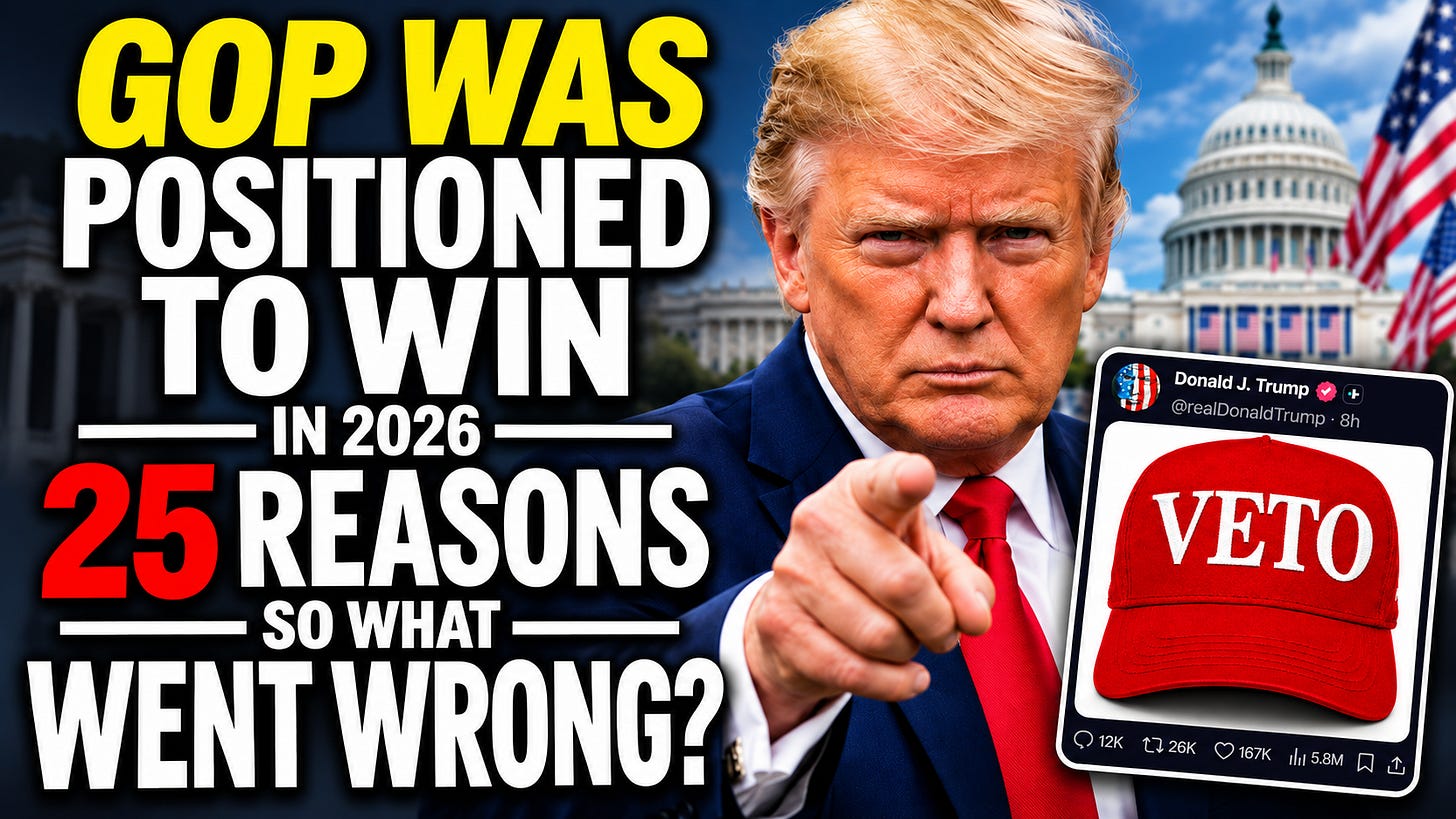
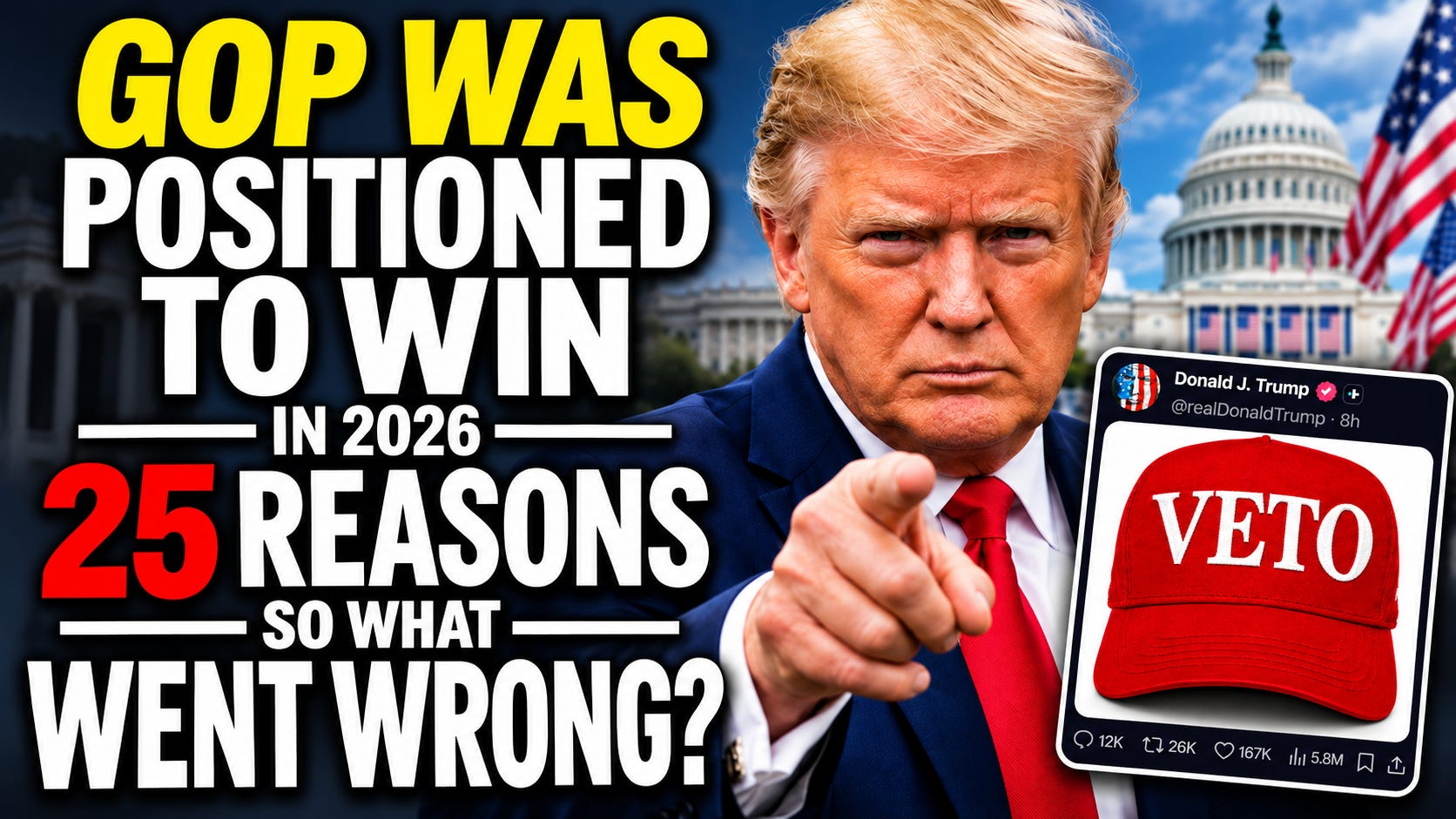
This is where Donald Trump has an opportunity to stand in the gap. While Democrats control the legislative branch, Trump remains president, with constitutional powers that do not disappear simply because the opposition wins an election. Following the election, he shared an image of a red hat bearing a single word: VETO. It wasn’t exactly a lengthy constitutional lecture, but the message was unmistakable. Trump had also emphasized his veto authority in a November 3 interview with CBS News, signaling his willingness to challenge legislation he opposes. Under Article I, Section 7 of the Constitution, overriding a presidential veto requires a two-thirds majority in both chambers of Congress, a significant hurdle for Democrats.
But Trump’s greatest opportunity may be political rather than legislative. By standing against genuine congressional overreach while remaining focused on governing, he can offer Americans a clear contrast if Democrats become more interested in political warfare than addressing the country’s problems. We’ve seen this dynamic before. Bill Clinton recovered politically after Republicans captured Congress in 1994, and Barack Obama won reelection after his party’s devastating losses in 2010. Divided government doesn’t automatically mean a failed presidency, and it can sometimes create opportunities for presidents who demonstrate effective leadership.
Of course, Trump will still be accountable for his own decisions, and Congress retains significant authority over spending, legislation, and oversight. But Democrats should be careful not to mistake a midterm victory for a blank check. Many voters were expressing frustration with the direction of the country, not necessarily endorsing two years of partisan spectacle. If Democrats overplay their hand, Trump has an opportunity to become the constitutional and political counterweight Americans may come to appreciate.
The same electorate that surprised Republicans in 2026 could surprise Democrats in 2028. And if Democrats mistake a protest vote for a permanent political realignment, they may find themselves making the very same assumptions we just spent 25 sections admitting were wrong.
And About That Inevitable Impeachment Talk…
It probably won’t take long for the political conversation to turn toward impeachment. Given Trump’s history with congressional Democrats and the intensity of opposition to his administration, the possibility of another impeachment effort should surprise absolutely no one.
But before anyone begins treating impeachment as synonymous with removal from office, it’s worth reviewing what the Constitution actually requires.
The House of Representatives possesses the sole power of impeachment. A simple majority can approve articles of impeachment against a president, which means a Democratic-controlled House would have the constitutional authority to initiate that process.
But impeachment itself does not remove a president from office. It sends the charges to the Senate for trial, where the Constitution requires a two-thirds vote of the senators present to convict. If all 100 senators participate, that means 67 votes.
That requirement matters enormously. Even with their newly won Senate majority, Democrats would need significant support beyond their own party to convict and remove Trump. Unless the political circumstances changed dramatically, assembling such a coalition would be exceptionally difficult.
The Senate has acquitted Trump in two previous impeachment trials, and while past outcomes cannot guarantee future results, the constitutional threshold remains the same. A third impeachment effort, should one occur, would still face that requirement. (senate.gov)
None of this means Democrats are powerless. Congressional committees can conduct investigations, request documents, hold hearings, and exercise oversight. They can also challenge administration policies through the legislative process and use their institutional authority to influence the political debate.
But congressional oversight, impeachment, conviction, and removal from office are distinct constitutional processes. Treating them as interchangeable creates unnecessary confusion and fear.
Conservatives should take potential investigations seriously without assuming that every congressional confrontation represents an existential threat to the presidency.
The next two years may be politically contentious, but disagreement between Congress and the president is hardly unprecedented in American history.
The Founders Anticipated Moments Like This
One of the more interesting aspects of this election is that it arrives during America’s 250th anniversary year. As we reflect on the founding of the United States, we’re also witnessing another example of the constitutional system operating under significant political tension.
The Founders understood that political factions would compete for power. They understood that elected officials would disagree, that public opinion would shift, and that no political party or individual could be trusted with unlimited authority.
That understanding shaped the separation of powers between Congress, the presidency, and the federal judiciary. It also explains why the Constitution establishes different requirements for ordinary legislation, veto overrides, impeachment, and other consequential government actions.
The system was never designed to guarantee that one political movement would control every branch of government indefinitely. It was designed to make the exercise of power accountable to multiple institutions and ultimately to the American people.
For conservatives who believe in limited government and constitutional restraint, that principle should remain important even when the political results are disappointing.
We cannot argue that the Constitution is essential when Republicans are winning and then lose confidence in the constitutional system when Democrats regain power. The principles must matter regardless of who occupies the majority.
And that’s part of what makes the American experiment so remarkable. Elections can produce dramatic changes in political leadership without requiring the country to abandon its governing framework.
The same constitutional structure that allowed Trump to return to the presidency in 2025 now provides the framework within which a Democratic Congress and Republican president must govern together.
There will be disagreements, investigations, and political battles. Some may be consequential, while others will amount to little more than the familiar theater of Washington politics.
But the republic has endured far more serious political divisions than the outcome of a single midterm election.
And it will continue to endure so long as Americans remain committed to the constitutional principles that sustain it.
Republicans Have an Opportunity to Learn Something
There is another reason conservatives shouldn’t treat the election as the end of the political world: the Republican Party now has an opportunity to examine what went wrong and determine how to improve before the next presidential election.
That process doesn’t require abandoning conservative principles or pretending that every Democratic criticism is correct. It does require distinguishing between policies that voters genuinely oppose, policies they may misunderstand, and policies whose promised benefits have not yet become apparent in their daily lives.
Republicans should be particularly interested in understanding why voters who supported Trump in 2024 declined to support Republican congressional candidates in 2026. Those voters could provide valuable insight into the strengths and weaknesses of the coalition that elected the president two years ago.
Were they disappointed with economic conditions? Did they disagree with specific administration decisions? Were they dissatisfied with Republican congressional leadership? Did Democratic candidates successfully communicate concerns that Republicans failed to address?
Those questions deserve serious answers.
The party should also examine whether its candidates were sufficiently focused on local economic concerns and whether national political arguments overshadowed issues that mattered to voters within individual districts.
A strong national movement cannot substitute for credible local leadership, and a popular presidential candidate cannot personally carry every congressional race.
There is also an important distinction between defending the administration and refusing to criticize it. Conservatives should be capable of supporting policies they believe are beneficial while identifying decisions they believe should be reconsidered.
A movement that cannot acknowledge its mistakes eventually loses the ability to correct them.
We learned that lesson rather directly this week.
Two Years Is an Eternity in American Politics
It’s easy to forget how quickly American political circumstances can change.
Following Barack Obama’s victory in 2008, Democrats controlled the White House and both chambers of Congress. Two years later, Republicans delivered one of the most significant congressional victories in modern history.
After Trump’s victory in 2016, Republicans entered Washington with unified control of the federal government. By 2018, Democrats had reclaimed the House.
Following Joe Biden’s victory in 2020, Democrats held the presidency and congressional majorities. Republicans regained the House in 2022, and Trump returned to the White House after winning the 2024 election.
Each of those elections produced confident predictions about the future of American politics. Political commentators declared that coalitions had permanently shifted, that certain parties were incapable of winning particular states, and that individual political movements had exhausted their appeal.
Then the voters changed their minds again.
The lesson isn’t that electoral outcomes are meaningless. Elections have consequences, and those consequences can be substantial. The lesson is that political fortunes are rarely permanent.
The Democratic Party now has an opportunity to demonstrate what it intends to accomplish with congressional power. Its leaders will face questions about legislation, spending, investigations, and whether they can work with a Republican president to address issues affecting the country.
Republicans, meanwhile, will have an opportunity to reconsider their political strategy, develop candidates, evaluate policy priorities, and prepare for 2028.
Both parties will be judged by the American people.
And if recent history tells us anything, the electorate is perfectly capable of changing its opinion again.
One More Thing: We Still Believe in the Principles
It’s worth making one distinction before bringing this discussion to a close.
We were wrong about how the election would unfold. That doesn’t automatically mean every policy argument or political principle discussed in our original article was wrong.
A Republican defeat doesn’t establish that border security is unimportant, that constitutional limits on government are obsolete, or that Americans should stop debating how best to protect individual liberty.
Likewise, the election doesn’t prove that every Democratic policy proposal is correct or that every Republican administration decision was justified.
Elections determine who receives political authority for a period of time. They don’t settle every underlying policy question, and they certainly don’t eliminate the need for thoughtful public debate.
That is why we intend to keep examining the issues that matter to the country, challenging political narratives, and defending the principles we believe are essential to American self-government.
But we’re also going to be more careful about distinguishing what we believe should happen from what the available evidence suggests is likely to happen.
Those aren’t always the same thing.
And if there’s one lesson this election has reinforced, it’s that political conviction should never become an excuse for analytical overconfidence.
We can believe strongly in conservative principles while admitting that voters may disagree with our priorities, our candidates, or our assessments of political circumstances.
In fact, acknowledging those disagreements is necessary if we want to understand the country we’re trying to influence.
The Final TAKE: Sometimes Losing an Argument Teaches You More Than Winning One
We started this article by acknowledging something that political commentators rarely enjoy doing: admitting that we got an election wrong.
Twenty-five times, apparently.
There are probably easier ways to demonstrate intellectual humility, but the American electorate wasn’t particularly interested in giving us one.
Still, there is something valuable about confronting an outcome you didn’t anticipate. It forces you to question assumptions, reconsider evidence, and distinguish between the political future you hoped to see and the political environment that actually existed.
That’s what we’re doing here.
We underestimated the historical disadvantage facing the president’s party. We overestimated the electoral value of voter registration gains, redistricting, fundraising, and internal Republican unity. We assumed the political coalition that supported Trump in 2024 would remain sufficiently engaged and supportive to protect Republican congressional majorities two years later.
Most importantly, we underestimated the power of voter frustration.
Those were mistakes worth acknowledging, and they should influence how we evaluate political developments moving forward.
But conservatives should also recognize what this election did not accomplish.
It did not erase the presidency. It did not eliminate the constitutional separation of powers. It did not make impeachment convictions automatic, remove the president’s veto authority, or settle the debates over the proper role of government.
And it certainly did not eliminate the ability of Americans to participate in the political process, advocate for their beliefs, and influence the country’s future.
As America celebrates 250 years since the Declaration of Independence, perhaps that is the most important perspective we can maintain. Our constitutional republic was never supposed to depend on one political party winning every election. It was built around the idea that political power should be limited, contested, and ultimately accountable to the people.
That’s a principle worth defending whether Republicans control Congress, Democrats control Congress, or the two parties are forced to share power.
So, yes, we got the election wrong. We underestimated the opposition, overestimated our advantages, and gave insufficient attention to the historical forces working against the Republican Party.
But there’s no reason to confuse that political miscalculation with the end of the conservative movement or the future of the country.
We still have a Constitution worth defending, principles worth discussing, political leaders worth holding accountable, and an American electorate that will have another opportunity to make its voice heard.
And if we learned anything from this experience, perhaps it’s that we should approach the next election with a little more humility and a lot more attention to what voters are actually telling us.
Because political predictions come and go, congressional majorities change, and the American people have a remarkable ability to surprise just about everyone.
Including us.
Twenty-five reasons we thought we had it figured out. Twenty-five reminders that we didn’t. And one very good reason to remain optimistic: the future of America has never depended on getting every election prediction right.
The work continues.
Shaping Culture. Defending Freedom.
— the Conservative TAKE