Introduction
In an age shaped by viral media, outrage culture, and social division, society is increasingly confronted with speech designed to provoke emotional reactions, generate attention, challenge cultural norms, and expose perceived contradictions within the public square. One modern example is the online figure known as “Chat the Builder,” a white content creator known for publicly using the racial slur commonly referred to as the N-word for shock value, controversy, and online engagement.
At first glance, the issue appears simple: many people hear the word, view it as hateful and offensive, and believe its use should carry social consequences. Yet beneath the surface lies one of the more complicated modern debates surrounding free expression, morality, culture, individual liberty, social standards, hypocrisy, provocation, and the boundaries of acceptable speech in a free society. The controversy surrounding Chat the Builder forces society to wrestle with difficult questions that do not lend themselves to easy or emotionally satisfying answers.
Can a society consistently condemn a word while simultaneously commercializing and normalizing variations of it in entertainment, music, and everyday speech? Can offensive language be both socially harmful and legally protected at the same time? Does defending someone’s right to speak imply moral approval of what is being said? Do private businesses and platforms possess the right to remove speech they believe harms their environment, even while broader constitutional principles protect offensive expression from government suppression? And perhaps most importantly, should moral standards be rooted in emotional reaction, evolving cultural norms, biblical truth, or some combination of all three?
Part of what makes this issue uniquely difficult is that multiple motivations are often conflated together. Some individuals defend provocative speech from a principled belief in liberty and free expression. Others react emotionally because of the historical pain associated with the language. Others see the issue primarily through the lens of cultural hypocrisy and inconsistent standards. Still others intentionally provoke outrage in order to challenge norms, gain attention, expose contradictions, or attempt to shift future cultural boundaries by repeatedly violating current ones.
This paper recognizes that many people (including some who support or sympathize with Chat the Builder’s broader arguments) do so for very different reasons. Not all motivations are biblical. Not all are constitutional. Not all are morally grounded. Some are driven by conviction, some by emotion, some by resentment, some by provocation, and some by a genuine concern over inconsistent social standards and selective outrage. Untangling these competing motivations is part of what makes this issue such an important and revealing cultural study.
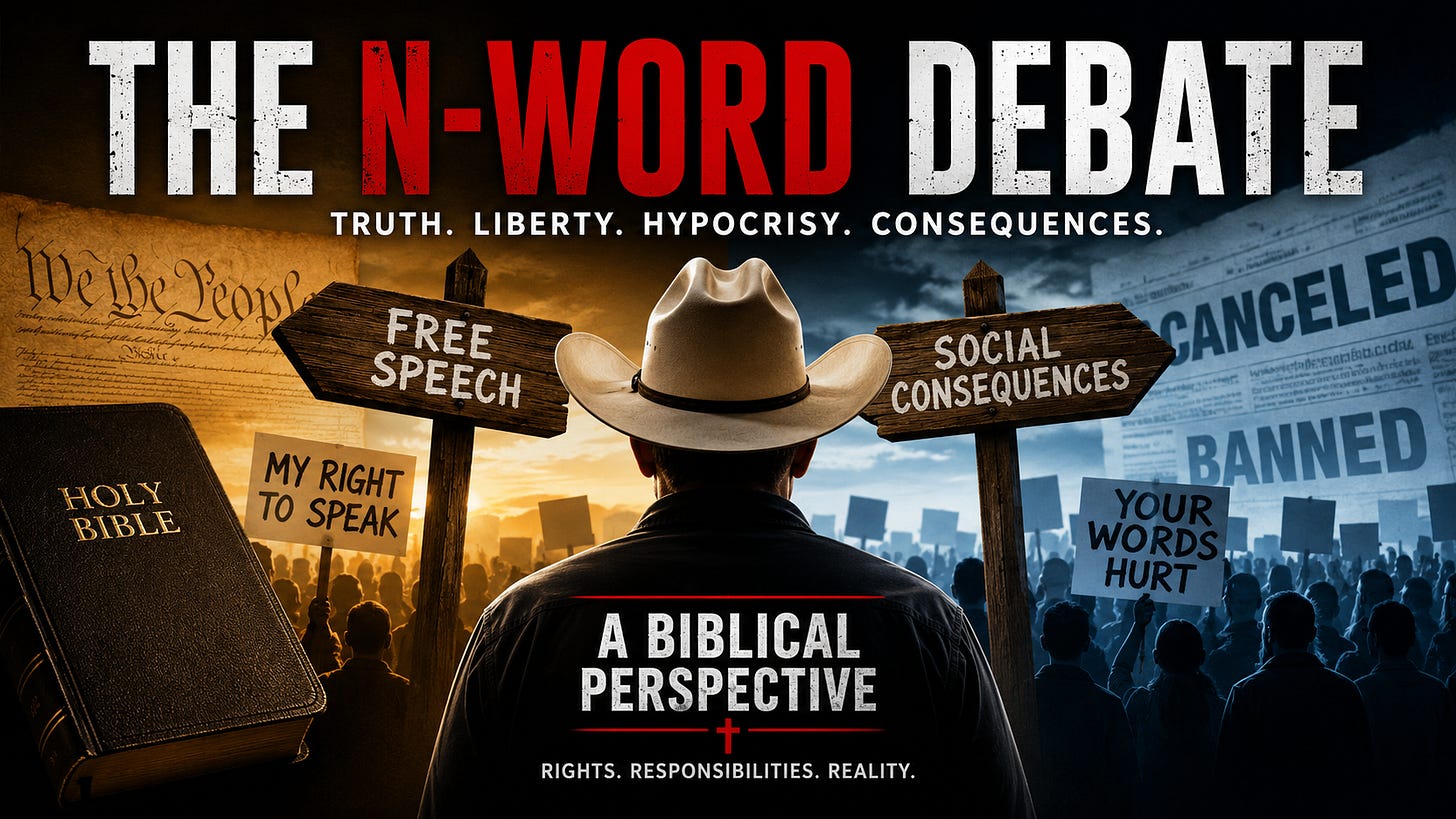
Accordingly, this paper seeks to establish a principled position rooted in biblical truth, constitutional liberty, moral consistency, and cultural accountability. It neither endorses racially inflammatory behavior nor embraces censorship as the primary solution to offensive speech. Instead, it approaches the issue honestly and carefully, recognizing that a free society must balance liberty with responsibility, truth with consistency, and the right to speak with the right of others to reject, criticize, or disassociate from speech they believe undermines the culture they wish to preserve.
I. A Biblical Foundation: Words Carry Moral Weight
Scripture teaches that words are powerful and morally consequential.
“Death and life are in the power of the tongue: and they that love it shall eat the fruit thereof.” — Proverbs 18:21
The Bible repeatedly warns against speech intended to degrade, humiliate, provoke hatred, or stir division among people made in the image of God.
“Let no corrupt communication proceed out of your mouth, but that which is good to the use of edifying, that it may minister grace unto the hearers.” — Ephesians 4:29
From a biblical perspective, racial contempt, mockery, or speech designed to inflame hostility violates the command to love one’s neighbor and honor the dignity inherent in every human being.
The historical “ER” version of the N-word carries undeniable associations with slavery, segregation, racial humiliation, and dehumanization. Those origins are morally evil and historically inseparable from the suffering attached to the term. Christians should not trivialize that history.
At the same time, modern culture has introduced complexity into the issue. The “GA” variation of the word has become normalized within portions of music, entertainment, and casual speech. This creates a cultural tension that many recognize but struggle to address consistently.
Some therefore argue that society has created a double standard: one group may publicly use a term while another group is condemned absolutely for uttering it. Figures like Chat the Builder appear to exploit this contradiction deliberately (both for attention and to expose what they perceive as cultural inconsistency).
Recognizing this contradiction, however, does not require endorsing the behavior itself.
II. Free Speech and Moral Responsibility
A free society must distinguish between what is legal and what is wise.
The principle of free speech exists precisely to protect unpopular, offensive, or controversial expression. Defending someone’s legal right to speak does not require agreement with the content of that speech.
This distinction is critical.
A person may have the constitutional liberty to say offensive things, while others simultaneously retain the liberty to criticize, avoid, remove, demonetize, or disassociate from that person.
Freedom of speech is not freedom from consequences.
From a constitutional perspective, the government should exercise extreme caution before restricting speech merely because it is offensive. The First Amendment was designed to protect speech that society dislikes, not merely speech that society approves.
However, private communities, businesses, platforms, and individuals also possess associational rights. If a platform, venue, or audience concludes that a person’s behavior is disruptive, inflammatory, or harmful to the environment they wish to cultivate, they may choose not to host or support that individual.
This is not necessarily censorship in the constitutional sense; it is often a social or institutional judgment about standards and community expectations.
III. The Cultural Reality of Provocation
Provocative speech generates clicks, attention, emotional reactions, and financial incentives. Public figures who intentionally use inflammatory language often understand that controversy itself has become a form of currency.
In many cases, the goal is not meaningful dialogue but escalation.
This does not excuse the conduct, but it explains why such behavior proliferates online.
The deeper issue is not merely one man using a word. It is a culture increasingly addicted to outrage, tribalism, and spectacle.
A society that commercially rewards provocation should not be surprised when provocateurs emerge.
IV. A Consistent Principle
The position expressed here is grounded in the following principles:
-
Every person possesses inherent dignity because all people are created in the image of God.
-
Speech intended primarily to demean, inflame racial hostility, or provoke division is morally irresponsible and socially destructive.
-
The historical “ER” racial slur carries uniquely painful historical associations that should not be dismissed lightly.
-
Society should honestly acknowledge the cultural contradictions surrounding selective normalization of racial language.
-
Defending free speech means defending even offensive speech from government suppression.
-
Defending free speech does not obligate private individuals, businesses, audiences, or communities to support, platform, or celebrate that speech.
-
Citizens possess both the liberty to speak and the liberty to disassociate.
V. An Analogy for Understanding the Position
A useful analogy is the principle of fire.
Fire can provide warmth, light, and utility. But when used recklessly or maliciously, it can also damage people and communities.
A free society allows people to possess fire because liberty carries risk. Yet communities also establish boundaries when someone uses fire irresponsibly in crowded spaces.
Likewise, speech in a free society includes the possibility of offense. Protecting liberty means tolerating speech we may strongly dislike. But communities are also justified in responding when speech appears intentionally inflammatory, disruptive, or harmful to social order.
The existence of consequences does not negate freedom. Rather, freedom and responsibility coexist.
VI. the Conservative TAKE and Biblical Perspective
From a biblical worldview, every human being is created in the image of God and possesses equal dignity and moral value before Him. Scripture teaches that God “…hath made of one blood all nations of men for to dwell on all the face of the earth…” (Acts 17:26), meaning humanity is fundamentally one people under God rather than permanently divided into categories of human worth based upon appearance, ethnicity, or cultural identity. Christians therefore should reject hatred, favoritism, tribalism, and partiality in every form. The ultimate standard for truth is not social outrage, political ideology, or internet culture, but biblical truth itself.
The controversy surrounding Chat the Builder highlights a deeper contradiction within modern American culture. On one hand, the N-word(particularly the “ER” version) is treated as one of the most offensive words in the English language because of its historical association with slavery, segregation, humiliation, and racial hatred. On the other hand, society simultaneously normalizes variations of the same word in music, entertainment, comedy, and everyday speech depending upon who is saying it. This creates an inconsistent moral framework where the acceptability of language is determined less by the word itself and more by the perceived racial identity of the speaker. From a biblical and logical standpoint, moral standards should be impartial and consistent. Either degrading language is wrong for everyone, or society must acknowledge that the issue is culturally conditional rather than morally absolute.
This contradiction is part of what provocative figures like Chat the Builder appear to be exposing. A widely circulated clip demonstrates this tension clearly. In the video, Chat the Builder approaches an older man wearing a cowboy hat outside a venue and explains that he is being removed because of statements he made online involving use of the N-word. The older man responds calmly, explaining that he has Black family members or loved ones and that he understands why the establishment would not want such behavior associated with its environment. Chat the Builder then repeats the slur directly to the man’s face, after which the older man calls security to have him removed. As he is escorted away, Chat the Builder remarks, “People like this is why the country is the way that it is.”
Ironically, the clip itself demonstrates the very principle at the center of this debate: freedom of speech and freedom of association coexist together. Chat the Builder had the legal ability to say what he said. But the business, the patrons, and the individuals around him equally possessed the right to reject, remove, and disassociate from behavior they viewed as inflammatory, disruptive, or offensive. Freedom of speech does not guarantee public approval, private platform access, or immunity from social consequences.
At the same time, terms should be defined carefully and responsibly. In modern discourse, the word “racist” is often used broadly and emotionally, sometimes applied to anyone who violates a cultural boundary or uses racially insensitive language. Historically and morally, racism is better understood as genuine hatred, contempt, or belief in superiority or inferiority based solely upon ethnicity or physical appearance. Not every offensive, provocative, or attention-seeking act necessarily proves deep racial hatred. There is a meaningful distinction between someone who genuinely despises another group of people and someone intentionally provoking outrage, challenging social norms, or exposing perceived hypocrisy for reaction and attention. Society should be careful not to collapse every controversial act into the harshest moral category automatically.
At the same time, Scripture teaches that all people are flawed and capable of prejudice, resentment, tribalism, and partiality apart from moral restraint and truth. No ethnic or cultural group is morally exempt from this reality. Christians therefore should reject collective guilt, racial hostility, and selective moral outrage wherever they appear.
Biblically, liberty does not remove responsibility. Ephesians 4:29 commands believers to avoid corrupt speech and instead use words that edify others. Proverbs 18:21 teaches that “death and life are in the power of the tongue.” Therefore, while the principle of free speech should be defended and government censorship approached cautiously, Christians are not obligated to celebrate speech whose primary purpose is humiliation, outrage, provocation, or division for attention and profit.
Ultimately, the biblical position is not censorship, racial tribalism, or selective outrage. It is truth, consistency, equal standards, personal responsibility, and human dignity under God. Christians should reject genuine hatred wherever it appears, acknowledge cultural hypocrisy honestly, preserve lawful liberty, and remember that words carry both freedom and consequence. A healthy society requires both the right to speak freely and the right of others to walk away, reject, or disassociate from speech they believe harms the culture they wish to uphold.