Why Trump’s Iran Peace Deal May Become One of the Most Significant American Foreign-Policy Victories in Decades
Yesterday, we ended Part I with a promise.
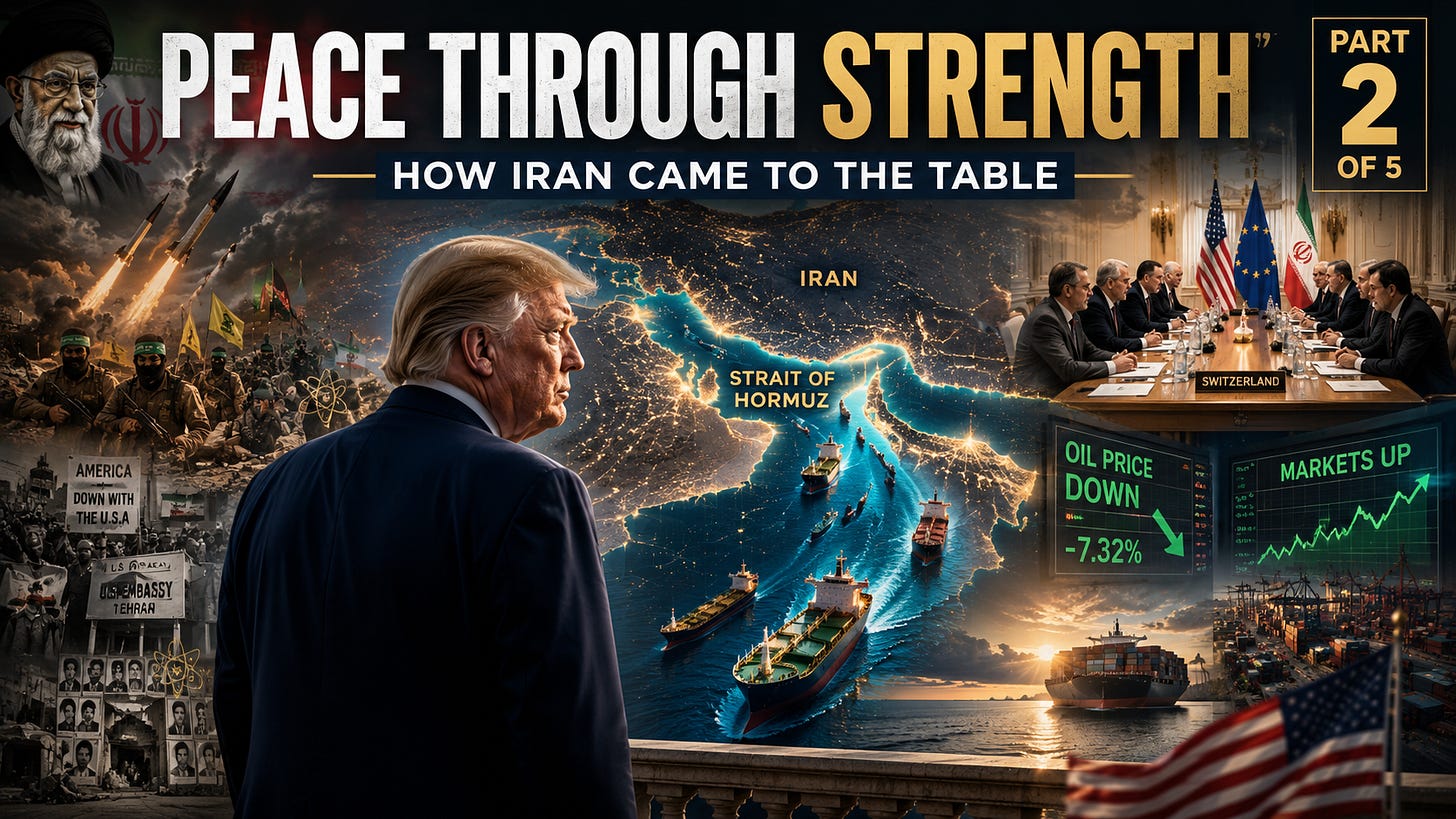
Today, we would examine why supporters of Trump’s Iran Peace Deal believe it may represent one of the most significant American foreign-policy victories in decades—and why they see it as peace through strength in real time.
To answer that question, we have to do something that is increasingly rare in modern political commentary.
We have to zoom out.
Too often, major geopolitical events are treated as isolated moments. A peace agreement is announced, and the debate immediately becomes whether it is good or bad. A military strike occurs, and the conversation instantly shifts to whether it was justified or reckless. Lost in the process is the broader story that made the event possible in the first place.
This agreement did not emerge overnight.
In many ways, it did not even begin this year.
If you’ve been reading the Conservative TAKE throughout this conflict, you’ll recognize that today’s discussion is really the continuation of arguments we’ve been making since February.
The Deal Didn’t Happen Overnight
Back in March, we published an article titled America Is Winning, The Media Just Won’t Admit It.
At the time, that conclusion was not particularly popular. The dominant narrative focused on uncertainty, escalation, and the possibility of a wider regional war. Critics argued that events were spiraling out of control and that America was becoming increasingly vulnerable to a prolonged conflict.
Yet when we stepped back from the headlines and examined the broader picture, we saw something different.
Iran’s military infrastructure was being degraded. Its ability to project power throughout the region appeared to be shrinking. Key capabilities that had allowed Tehran to exert influence through proxies and intimidation were coming under increasing pressure. Most importantly, the gap between what was happening on the ground and what was being reported in much of the media seemed to be growing wider by the week.
At the time, we argued that military operations alone were not the real story.
The real story was leverage.
The United States was systematically reducing Iran’s options.
Three months later, the existence of a peace framework raises an obvious question: What if that pressure campaign was accomplishing exactly what its supporters believed it was designed to accomplish?
Why Pressure Was Necessary
To understand why many Americans support this agreement, you first have to understand why they believed pressure was necessary in the first place.
One of the biggest mistakes people make when discussing Iran is treating it as though it were simply another nation pursuing ordinary geopolitical interests. Whether one agrees with every American response over the last forty-seven years or not, Iran’s relationship with the United States has never resembled a normal rivalry between competing powers. Since the Islamic Revolution in 1979, the regime has consistently defined itself through opposition to the United States, Israel, and much of the Western world.
That hostility has repeatedly moved beyond rhetoric.
The historical record includes:
-
The 1979 hostage crisis
-
The murder of 241 American service members in the Beirut barracks bombing
-
Decades of support for Hezbollah, Hamas, the Houthis, and other militant groups
-
Attacks on American forces and interests throughout the region
-
Threats against Israel and America’s Arab allies
-
Attempts to disrupt critical shipping routes
-
Brutal repression of its own citizens
-
The pursuit of advanced missile programs
-
A nuclear program moving increasingly closer to weapons capability
For supporters (like us) of the pressure campaign, these are not isolated events. They are pieces of a larger pattern.
The concern was never simply that Iran held hostile views toward America. Plenty of governments around the world hold hostile views toward one another. The concern was that Iran appeared to be accumulating more tools with which to act on those ambitions. Every advancement in missile technology, every expansion of proxy networks, and every increase in nuclear capability altered the strategic balance of the region.
That is why many supporters reject the idea that this conflict emerged from nowhere.
In their view, it was the result of decades of unresolved tensions that eventually reached a point where the costs of inaction began to outweigh the risks of action.

The World Did Not Freeze in 2011
Back in February, at the beginning of this conflict, we published another article titled What Changed Since 2011? Trump’s Decision on Iran Explained.
The central argument was straightforward.
The world did not freeze in 2011.
A surprising amount of commentary surrounding this conflict relied on political arguments that were more than a decade old. Critics pointed to statements, tweets, and policy debates from another era as though nothing meaningful had happened in the intervening years.
But a lot happened.
Over the last fifteen years, Iran’s nuclear capabilities advanced significantly. Enrichment levels increased. Inspection access narrowed. Missile programs expanded. Proxy attacks intensified. Regional instability grew. Shipping lanes faced repeated threats. Meanwhile, diplomatic efforts repeatedly failed to produce a permanent solution to the underlying problem.
That changing reality matters.
Foreign policy cannot be evaluated as though time stands still. Decisions have to be judged according to the circumstances that actually exist, not the circumstances that existed fifteen years ago.
Supporters of the pressure campaign believed the strategic environment had fundamentally changed.
The question was no longer whether conflict was desirable.
The question was whether delaying action would eventually make the situation more dangerous.
The Nuclear Clock Was Ticking
At the center of that debate was one issue above all others: Iran’s nuclear program.
Much of the public conversation focused on whether Iran would ever actually use a nuclear weapon if it acquired one. Supporters argued that this was the wrong question. The more important question was what happens once a hostile regime gains the ability to operate behind the protection of a nuclear deterrent.
History shows that nuclear capability changes calculations.
It changes negotiations.
It changes military planning.
It changes the willingness of adversaries to challenge aggressive behavior.
And once that threshold is crossed, options that existed before may no longer exist at all.
Supporters believed time was not neutral. Every year that passed increased Iran’s leverage. Every advancement in enrichment narrowed available options. Every delay brought the region closer to a reality in which Iran’s strategic position would become far more difficult to challenge.
From that perspective, the objective was never war.
The objective was preventing a future in which meaningful options no longer existed.
The Hormuz Concession
For supporters of the agreement, the most important part of the deal is not what America gained on paper.
It is what Iran gave up.
For decades, the Strait of Hormuz functioned as one of Iran’s most powerful strategic assets. A substantial percentage of the world’s oil supply passes through that narrow corridor. Because of that reality, even the threat of disruption carried enormous influence over markets, governments, and international negotiations.
That leverage shaped nearly every major discussion involving Iran.
The possibility of a Hormuz disruption was always sitting in the background. Policymakers understood it. Energy traders understood it. Military planners understood it. The threat did not need to be acted upon to be effective.
That is why supporters see the reopening of Hormuz as much more than a technical provision inside a peace agreement.
They see it as evidence that Iran’s strongest bargaining chip no longer carries the same weight it once did.
For decades, many analysts assumed no American administration would ever apply enough pressure to challenge Iran’s leverage over Hormuz.
Supporters believe that assumption has now been tested—and perhaps broken.
Pressure Changes Calculations
The phrase “peace through strength” is often dismissed as a slogan.
But supporters of the agreement view it as a description of how negotiations actually occur.
Countries rarely negotiate because they suddenly become friends. They negotiate because their incentives change. They negotiate because the costs of continuing one path become greater than the costs of pursuing another.
That is the argument supporters are making today.
They believe Iran entered negotiations after months of economic strain, military setbacks, declining leverage, sanctions pressure, and increasing internal challenges. In their view, Iran did not come to the table because it was winning.
It came to the table because the strategic calculation changed.
Whether one agrees with that assessment or not, it forms the foundation of the peace-through-strength argument.
Strength created leverage.
Leverage created negotiation.
And negotiation created an opportunity that did not appear to exist only months ago.
America First Foreign Policy
Supporters also point to what happened immediately after the announcement.
Markets responded positively. Oil prices moved lower. Investors reacted to the possibility that one of the world’s most dangerous flashpoints might be moving away from escalation and toward stability. Commercial shipping began returning to critical trade routes, and the threat of a broader regional conflict appeared to diminish.
Those developments matter because foreign policy is not just about diplomacy.
It is also about outcomes.
Lower energy prices affect families. Stable shipping routes affect businesses. Reduced geopolitical uncertainty affects investment, economic confidence, and long-term growth.
For supporters, that is why this agreement fits within an America First framework.
Not because it seeks conflict.
But because it seeks results that directly benefit American interests.
The Cost of Doing Nothing
Every foreign-policy decision involves risk.
What often gets overlooked is that inaction carries risks as well.
Much of the debate surrounding Iran focused on the dangers of acting. Those concerns were legitimate and deserved discussion. But supporters believed there was another side of the equation that was receiving far less attention.
What happens if Iran’s nuclear program continues advancing?
What happens if proxy networks continue expanding?
What happens if missile capabilities continue improving?
What happens if a regime with a nearly half-century history of hostility gains even greater leverage over the region?
Those were the questions driving support for pressure long before the peace agreement was announced.
The debate was never between risk and safety.
It was between two different kinds of risk.
And supporters believed the greater danger was waiting.
The Test of the Thesis
None of this means the story is over.
The agreement still must be implemented. The next sixty days still matter. Verification still matters. Future negotiations still matter.
But supporters believe the central thesis has already been strengthened.
Back in February, we argued that the strategic environment had changed and that delaying action carried its own dangers. Back in March, we argued that America was winning even when much of the media refused to acknowledge it.
Today, the existence of a peace framework suggests those arguments deserve another look.
Whether this agreement ultimately succeeds or fails will be determined by what happens next. But supporters believe one thing has already become clear: pressure accomplished something that years of conventional diplomacy could not.
Tomorrow, in Part III, we’ll examine the other side of the story. We’ll look at the critics, the skeptics, and the unanswered questions surrounding the agreement. This will include whether Iran can be trusted, whether the concessions are real, and whether this framework represents a lasting peace or merely a temporary pause before the next confrontation.