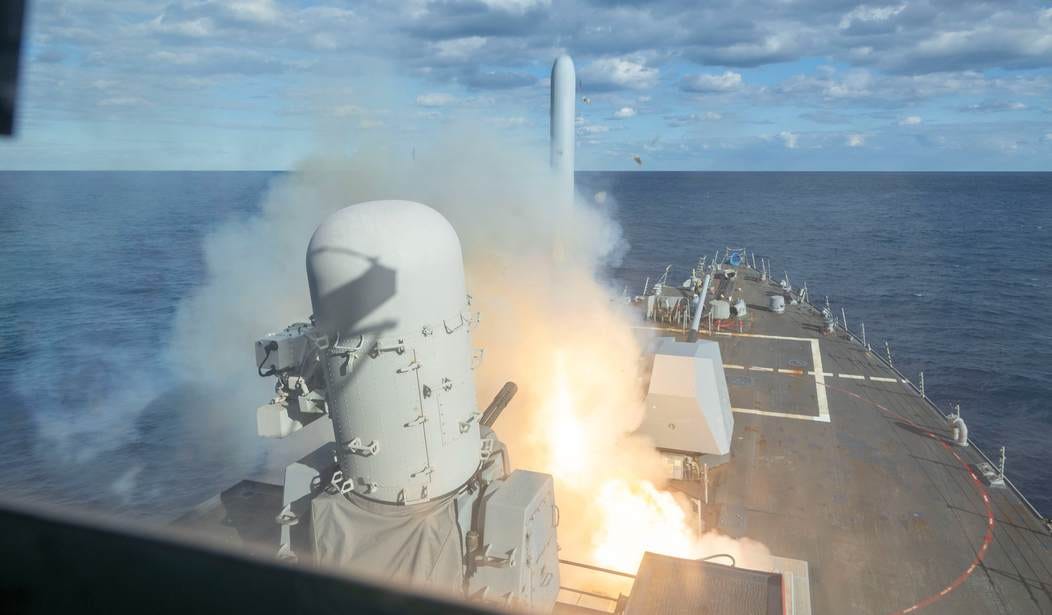
A video surfaced with no explanation, just a series of massive explosions over Iran, visible even from space. No commentary. No spin. Just reality.
Within hours, the meaning became clear: the United States is executing a highly effective military campaign. And yet, if you rely on much of the media, you would think the situation is uncertain, unstable, or even failing.
That disconnect is not accidental. It reveals something deeper about our moment: America can be winning decisively, and still be told it isn’t. The task for citizens in a constitutional republic is to separate fact from narrative, and to judge events according to reality, not rhetoric.
What Success Actually Looks Like
When we step back and examine the facts, a consistent pattern emerges.
The United States has systematically degraded Iran’s military capabilities, its air defenses, missile infrastructure, and command networks. This is not random escalation. It is coordinated, deliberate, and effective.
Even more telling is the speed and precision. Iranian retaliatory strikes are detected almost immediately and neutralized within minutes. That level of control reflects planning, discipline, and technological superiority.
In simple terms: this is what winning looks like in modern warfare.
The Founders would have recognized the importance of this kind of capability. The Constitution explicitly tasks the federal government with providing for the common defense. That responsibility assumes competence, not chaos.
But it also assumes something else, restraint.
The Constitutional Lens: Power With Limits
From an originalist perspective, military success does not excuse constitutional neglect.
Article I, Section 8 gives Congress the power to declare war. The president, under Article II, commands the military, but does not possess unlimited authority to initiate prolonged conflict.
James Madison warned that war is the greatest threat to liberty because it concentrates power in the executive. That is precisely why the Framers divided authority.
So even as the campaign appears effective, the constitutional question remains: Has the people’s branch been fully engaged?
A strong America is not one that simply wins wars. It is one that conducts itself within the framework of law and structure. Power without order leads to the very instability we claim to oppose.
Order, properly understood, is not restrictive. It is foundational. It reflects design, intention, and limits. The same principles that govern a well-ordered society must also govern its use of force.
Why the “Mosaic Defense” Signals Weakness
One of the key developments in this conflict is the activation of Iran’s “mosaic defense,” a strategy that breaks its military into semi-independent regional units so they can continue fighting even if central leadership is destroyed.
At first glance, it may appear resilient, units continuing to operate independently after leadership disruption. But in reality, this system is designed for collapse scenarios.
When command and control break down, fragmented units continue acting without coordination. That’s not strength. That’s a system operating without a center.
The Framers rejected this kind of disorder. They understood that a functioning republic requires both local action and central authority. Remove one, and the system fails.
In this case, the fragmentation of Iranian forces points not to endurance, but to disintegration.

The Media Narrative Problem
So why does the public conversation feel so disconnected from these realities?
Because much of the media still operates within a framework shaped by past failures, long wars, unclear goals, and costly outcomes. That framework assumes American action abroad is likely misguided or ineffective.
When events don’t fit that pattern, the response is not always recalibration. Sometimes, it is resistance.
This creates a gap between what is happening and what is being reported. And increasingly, Americans are recognizing that gap.
Polling indicates strong public confidence that the United States is succeeding in this campaign. That confidence is not driven by blind loyalty. It reflects observable outcomes.
In a self-governing republic, that distinction matters. Citizens are not meant to passively absorb narratives. They are meant to evaluate evidence.


America First Means Clear Objectives
One of the more notable aspects of this campaign is its clarity of purpose.
The objectives are straightforward:
-
Prevent nuclear capability
-
Eliminate proxy threats
-
Neutralize missile infrastructure
These are not abstract ideals. They are concrete national interests tied directly to American security.
This is what an America First approach looks like in practice. It does not seek to remake foreign societies or impose ideological systems. It focuses on defined outcomes that protect American citizens.
Historically, the United States has struggled when it has drifted beyond those limits, when missions expand, objectives blur, and timelines stretch indefinitely.
Clarity is not just a strategic advantage. It is a constitutional one. It keeps the government aligned with its primary duty: defending the nation.
The Two Likely Outcomes
Looking ahead, the situation appears to be narrowing toward two possible outcomes.
Either the current Iranian regime fractures internally, giving rise to a more pragmatic leadership, or it is replaced altogether through internal pressure.
In either case, the existing hardline structure appears unsustainable.
The key for the United States will be discipline. Success should not lead to overreach. The temptation to expand objectives, politically, militarily, or ideologically, has historically been where victories turn into burdens.
The Founders cautioned against entanglements for a reason. A republic must know not only how to act, but when to stop.
Order, Reality, and a Self-Governing People
There is a broader lesson here that goes beyond military strategy.
Americans are being asked, once again, to decide whether they will trust observable reality or mediated interpretation. That is not a small question.
A society grounded in truth recognizes patterns: order leads to stability, clarity leads to results, and disciplined action produces measurable outcomes.
These are not abstract ideas. They reflect the structure of the world itself, one that operates according to design, not randomness. When systems align with that order, they function. When they don’t, they break down.
We are seeing both sides of that principle play out in real time.
Winning the Right Way
America appears to be achieving its objectives in this campaign. That matters. But how we achieve those objectives matters just as much.
Are we acting within constitutional bounds?
Are we maintaining clear, limited goals?
Are we avoiding the trap of endless engagement?
If the answer remains yes, then this moment represents more than a military success. It reflects a nation acting with purpose and discipline.
The United States does not need to control the narrative to succeed. It needs to remain grounded in reality, guided by its founding principles, and focused on the interests of its people.
That is how a republic wins, and stays worthy of winning.
the Conservative TAKE…
America’s strength has never depended on headlines. It has depended on clarity, of purpose, of structure, and of truth. When those are aligned, results follow, whether acknowledged or not.
Right now, the facts point in one direction: the Iranian regime is weakening. Its command structure is fragmenting. Its responses are becoming scattered and reactive. Even its own leadership is beginning to distance itself from the very institutions that once held power together. That is not what strength looks like. That is what collapse looks like.
There are only two realistic paths forward. Either a more pragmatic faction emerges from within the regime, or the regime itself is replaced. In either case, the old hardline structure is not holding. It is giving way under sustained pressure.
And yet, much of the media continues to suggest the opposite, that Iran will somehow emerge stronger after losing its ability to project power. That claim does not hold up under basic scrutiny. A system does not become more powerful as its core capabilities are dismantled. That is not analysis. It is contradiction.
This is where judgment matters. A self-governing people cannot rely solely on filtered narratives. We have to look at outcomes, at patterns, at what is actually happening.
The broader point is simple. When America acts with clear objectives and discipline, results follow. When we stay within our constitutional design and focus on real national interests, not abstract ambitions, we tend to succeed.
The challenge now is to remain grounded, to resist both exaggeration and denial, and to recognize reality for what it is. Because in the end, the truth does not depend on whether it is acknowledged.