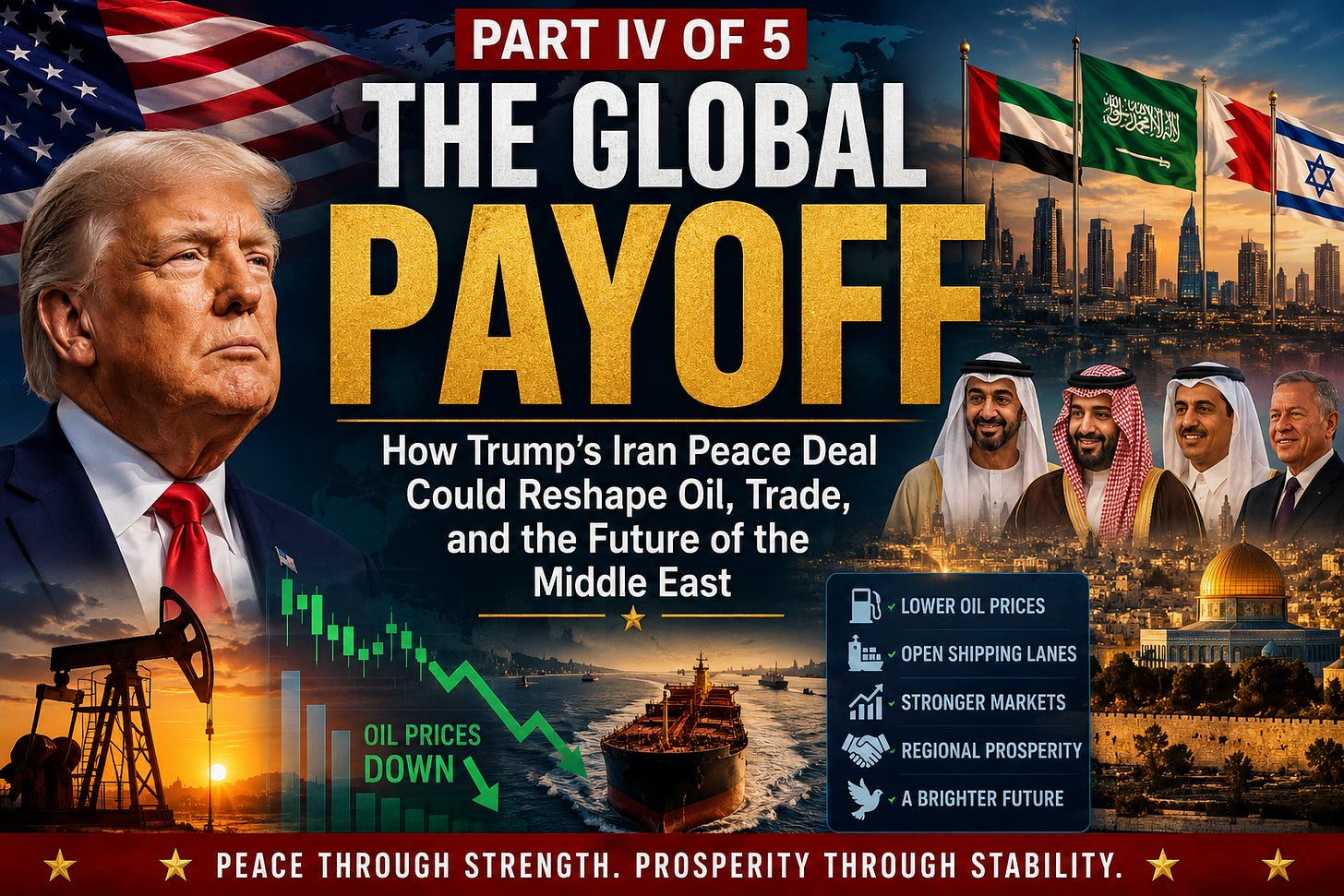
Editor’s Note: Since this series began, additional details have clarified that the current U.S.-Iran arrangement is best understood as a framework or Memorandum of Understanding, with key provisions beginning to move forward while larger issues remain subject to further negotiations. This article focuses on the broader economic and strategic implications if that framework holds.
Why Trump’s Iran Peace Deal Could Reshape More Than Just the Middle East
Yesterday, in Part III , we examined the critics, the skeptics, and the questions surrounding Trump’s Iran Peace Deal.
Those questions still matter.
But today we need to zoom out.
Because if the framework holds, the biggest story may not be political at all.
The biggest story may be economic.
Most Americans will never visit the Strait of Hormuz. Many could not locate it on a map. Yet this narrow stretch of water has influenced everything from gasoline prices to grocery bills, shipping costs, inflation, and global trade.
That is why the world paid attention when tensions escalated.
And it is why the world is paying attention now.
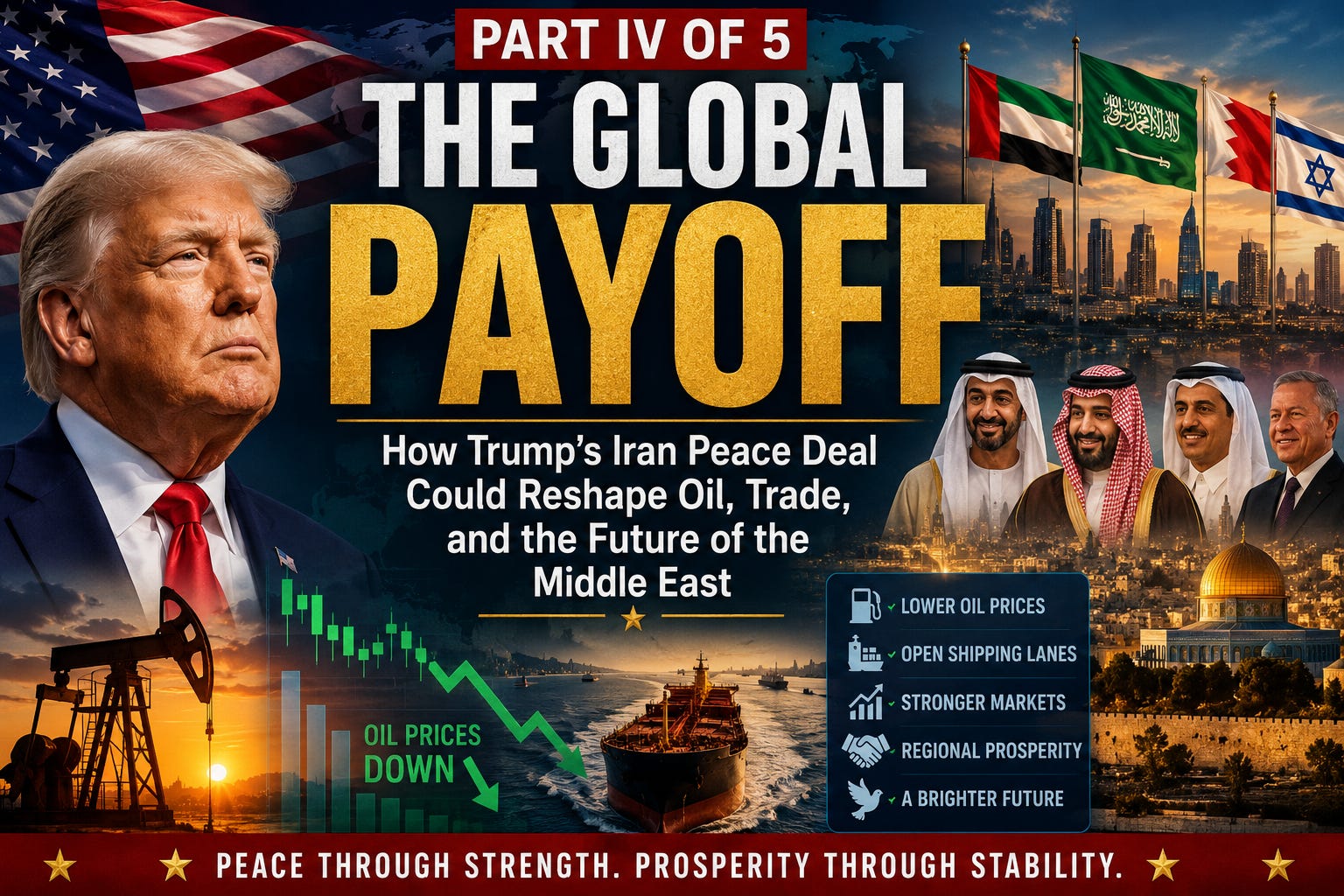
Why Hormuz Matters to Everyone
One of the challenges of discussing foreign policy is that many of the most important issues feel distant from everyday life. It is easy to hear phrases like “shipping lanes” or “energy markets” and assume they only matter to governments, investors, or multinational corporations.
In reality, they affect everyone.
For decades, the Strait of Hormuz has served as one of the most important energy corridors on earth. A substantial portion of the world’s oil supply passes through this narrow waterway connecting the Persian Gulf to global markets. When there is uncertainty surrounding Hormuz, that uncertainty spreads quickly. Oil prices rise. Shipping costs increase. Businesses face higher expenses. Consumers eventually feel those costs through inflation and higher prices.
That is why even the possibility of disruption carries enormous consequences.
Markets do not wait for missiles to fly.
They react to risk.
And for years, Iran understood that reality better than anyone.
The Markets Voted First
One of the most interesting aspects of the peace announcement was how quickly markets responded.
Before television panels could debate the implications. Before political commentators could frame competing narratives. Before social media could decide whether the agreement was a triumph or a disaster.
The markets voted.
Oil prices moved lower. Investors responded positively. The possibility of a wider regional conflict suddenly appeared less likely. The risk premium attached to one of the world’s most volatile regions began to shrink.
That reaction tells us something important.
Markets do not care about partisan politics.
Markets care about probabilities.
When investors believe the odds of disruption are falling, they adjust accordingly. Whether one supports the agreement or opposes it politically, the initial market reaction suggested that many participants viewed the framework as reducing risk rather than increasing it.
That matters because economic confidence is not just a Wall Street issue.
It eventually reaches Main Street.
The Return of Stability
The economic implications extend far beyond the United States.
Europe remains heavily dependent upon stable global energy markets. Asia relies on uninterrupted shipping routes. Manufacturing economies throughout the world depend upon predictable access to energy and transportation.
When uncertainty enters the system, everyone pays.
Businesses delay investment. Companies become more cautious. Governments prepare for worst-case scenarios. Insurance costs rise. Shipping becomes more expensive. Growth slows.
In many ways, uncertainty functions like a hidden tax on the global economy.
The less certainty businesses have about tomorrow, the more expensive today becomes.
This is why peace matters even to countries that have little direct involvement in the conflict itself.
Stability has value.
And the possibility of greater stability is one reason the agreement attracted immediate global attention.
The Bigger Prize: A Different Middle East
There is another potential consequence that receives far less attention.
For decades, much of the Middle East has been organized around conflict. Regional rivalries, ideological battles, proxy wars, and sectarian divisions often consumed resources that might otherwise have been directed toward economic development and cooperation.
The Abraham Accords represented an attempt to change that equation.
Rather than organizing the region around old grievances, they encouraged nations to focus on mutual interests. Trade. Investment. Technology. Tourism. Security cooperation. Economic growth.
The idea was not complicated.
Countries that make money together are generally less interested in fighting one another.
That does not solve every problem. It does not eliminate historical disputes. But it does create incentives that favor stability over confrontation.
Iran has long stood apart from that vision.
Its revolutionary model emphasized resistance, proxy influence, and regional pressure rather than economic integration. Many of its neighbors viewed that approach as a direct threat to the kind of stability required for long-term prosperity.
That is why this moment could prove significant.
If Iran’s ability to intimidate its neighbors continues to diminish, other countries may feel increasingly comfortable pursuing economic partnerships, regional cooperation, and normalization efforts that were previously considered politically risky.
The biggest prize may not be a signed agreement.
The biggest prize may be a Middle East that increasingly chooses commerce over confrontation.
America First Does Not Mean America Alone
One of the most persistent criticisms of America First foreign policy is the claim that it is isolationist.
But events like these illustrate something different.
America First was never supposed to mean America ignores the world. It was supposed to mean that American leaders evaluate global events through the lens of American interests rather than international approval.
That distinction matters.
The objective was not to secure unanimous support from every European government. The objective was not to satisfy international institutions. The objective was not to win praise from foreign policy experts.
The objective was to protect American interests.
Secure shipping routes benefit American businesses.
Lower energy costs benefit American consumers.
Reduced regional instability benefits American security.
And if those outcomes also benefit other countries, that is a feature rather than a flaw.
Successful American leadership often produces benefits that extend beyond America’s borders.
China and the Global Chessboard
There is another dimension to this story that receives far less attention than it deserves.
For years, China has sought to expand its influence across strategic trade routes, energy corridors, and critical infrastructure around the world. Access to Middle Eastern energy has been a central component of that strategy.
A stronger Iran gave Beijing additional leverage in one of the most important energy regions on the planet. A more unstable Middle East often created opportunities for outside powers to expand their influence.
That is one reason this agreement matters beyond the region itself.
If the Strait of Hormuz remains open, if regional stability improves, and if the Abraham Accords continue expanding, the result could be a Middle East that is increasingly connected to a U.S.-aligned economic framework rather than one dominated by rival powers.
From an America First perspective, that is significant.
The objective is not empire. The objective is to create conditions where America’s interests, America’s allies, and America’s economic position are strengthened while reducing the ability of hostile powers to use instability as leverage.
In that sense, the agreement is about much more than Iran.
It is about the future balance of power in the twenty-first century.
The Abraham Accords Were Always About More Than Israel
One of the most important developments of the last decade was the realization that peace in the Middle East did not have to wait for every historical dispute to be resolved. That was the insight behind the Abraham Accords.
For generations, the region was organized around old grievances, ideological rivalries, and the assumption that conflict was inevitable. The Abraham Accords proposed something different. Instead of organizing the region around hostility, countries could organize around shared interests. Trade. Technology. Investment. Security cooperation. Economic growth.
The underlying logic was simple: nations that are building together are less likely to fight each other.
Iran represented one of the largest obstacles to that vision. Its support for proxy organizations, its regional influence campaigns, and its ability to threaten neighboring states created a constant source of instability. Many governments in the region wanted to move toward prosperity and integration but were forced to calculate around the possibility of Iranian retaliation.
That is why this agreement may have implications far beyond Washington and Tehran.
If Iran’s ability to intimidate its neighbors continues to diminish, the Abraham Accords could evolve from a diplomatic breakthrough into a genuine regional architecture for peace and prosperity. Countries that once viewed one another primarily through the lens of security may increasingly view one another through the lens of commerce, infrastructure, tourism, and investment.
That is a very different Middle East than the one the world has known for the last half century.
A New Regional Balance
For years, much of the Middle East operated under a simple reality: Iran possessed enormous leverage.
Its influence stretched through proxy organizations, regional militias, missile programs, and the ever-present threat of escalation. Whether countries supported Iran or opposed it, they were forced to account for its ability to disrupt trade, threaten infrastructure, and destabilize neighboring governments.
That leverage shaped decision-making throughout the region.
What appears to be changing now is not simply a diplomatic relationship. It is the balance of power itself.
If Iran’s ability to project force continues to weaken, countries that previously acted cautiously may feel increasingly comfortable pursuing economic partnerships, regional cooperation, and normalization efforts that were once considered too risky. The result could be a Middle East that is defined less by confrontation and more by competition for investment, innovation, and growth.
That shift would benefit not only America’s allies but also the millions of people throughout the region who are far more interested in jobs, opportunity, and stability than endless geopolitical conflict.
The biggest payoff of this agreement may not be what it prevents.
It may be what it makes possible.
The Real Test
It would be a mistake to pretend that peace is guaranteed. Iran still faces difficult choices, negotiations still need to continue, verification still matters, and the next sixty days remain critical.
But if the framework holds, the economic impact may ultimately prove larger than the diplomatic impact. Oil markets could stabilize. Trade routes could remain open. Investment could increase. Regional cooperation could expand. A part of the world that has spent decades defined by conflict could move, however gradually, toward a model built more around prosperity than confrontation.
That possibility is worth taking seriously because the real story may not be the framework itself. The real story may be what it makes possible.
If Iran’s leverage continues to weaken, if Hormuz remains open, and if the Abraham Accords vision gains momentum, the payoff could extend far beyond Washington and Tehran. It could reach energy markets, global trade routes, America’s strategic position, and the future of the Middle East itself.
Tomorrow, in Part V, this series concludes by looking at the signing, the risks still ahead, and whether this moment becomes a temporary pause or the beginning of a new chapter in the Middle East.
Part I: The Deal That Stopped the War
Part 2: Peace Through Strength
Part 3: The Critics and the Questions