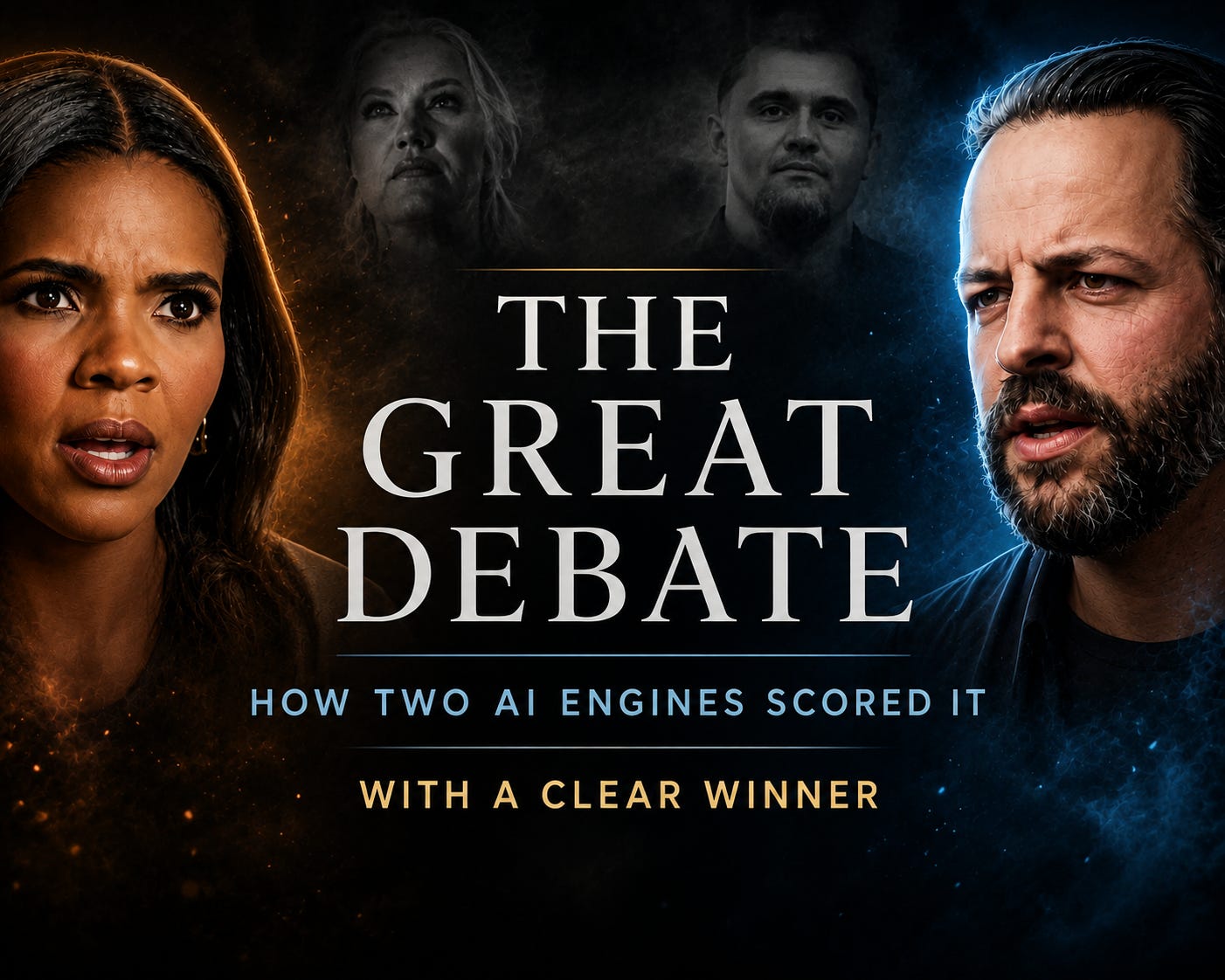
The Candace Owens–Andrew Wilson debate was nearly four hours long. It covered the physical evidence, the rifle, DNA and fingerprint questions, alleged text-message confessions, surveillance evidence, the Utah preliminary hearing, hearsay rules, foreign-involvement theories, Turning Point USA, Erika Kirk, the explosive-microphone theory, timeline questions, and much more.
Rather than judge the debate by clips, personalities, audience reaction, political loyalties, or who produced the best viral moment, the Conservative TAKE took the complete transcript and submitted it independently to two different AI systems for structured debate adjudication: ChatGPT and Grok.
The instructions were deliberately neutral.
Neither system was asked which person it liked, which political faction it preferred, or which narrative it found emotionally compelling.
They were asked to evaluate the debate.
That meant examining such things as:
-
evidence and factual support;
-
logical validity;
-
whether conclusions actually followed from the evidence presented;
-
burden of proof;
-
direct rebuttal;
-
unanswered arguments;
-
internal consistency;
-
concessions;
-
comparative weighing;
-
straw men;
-
red herrings;
-
burden shifting;
-
arguments from possibility;
-
unsupported high-confidence assertions;
-
appeals to intuition;
-
ad hominem attacks;
-
poisoning the well;
-
interruptions;
-
evasiveness;
-
and other non-argumentative tactics.
The two models used different scoring systems and somewhat different analytical frameworks.
They nevertheless reached substantially the same conclusion.
The Headline Result
Both ChatGPT and Grok concluded that Andrew Wilson won the debate.
Not because Candace Owens raised no legitimate questions.
She did.
Not because the government’s case was proven beyond reasonable doubt.
It was not.
Not because Andrew Wilson answered every objection.
He did not.
The central finding from both analyses was more specific:
Candace Owens did a considerably better job demonstrating that there are unanswered questions than she did proving the much stronger proposition she agreed to defend: that Tyler Robinson was not the shooter and was instead set up as a patsy.
That distinction became decisive in both analyses.
ChatGPT’s Result
The complete transcript was analyzed by ChatGPT using GPT-5.6 Sol, operating under a structured debate-adjudication framework designed to separate substantive argument from debate conduct.
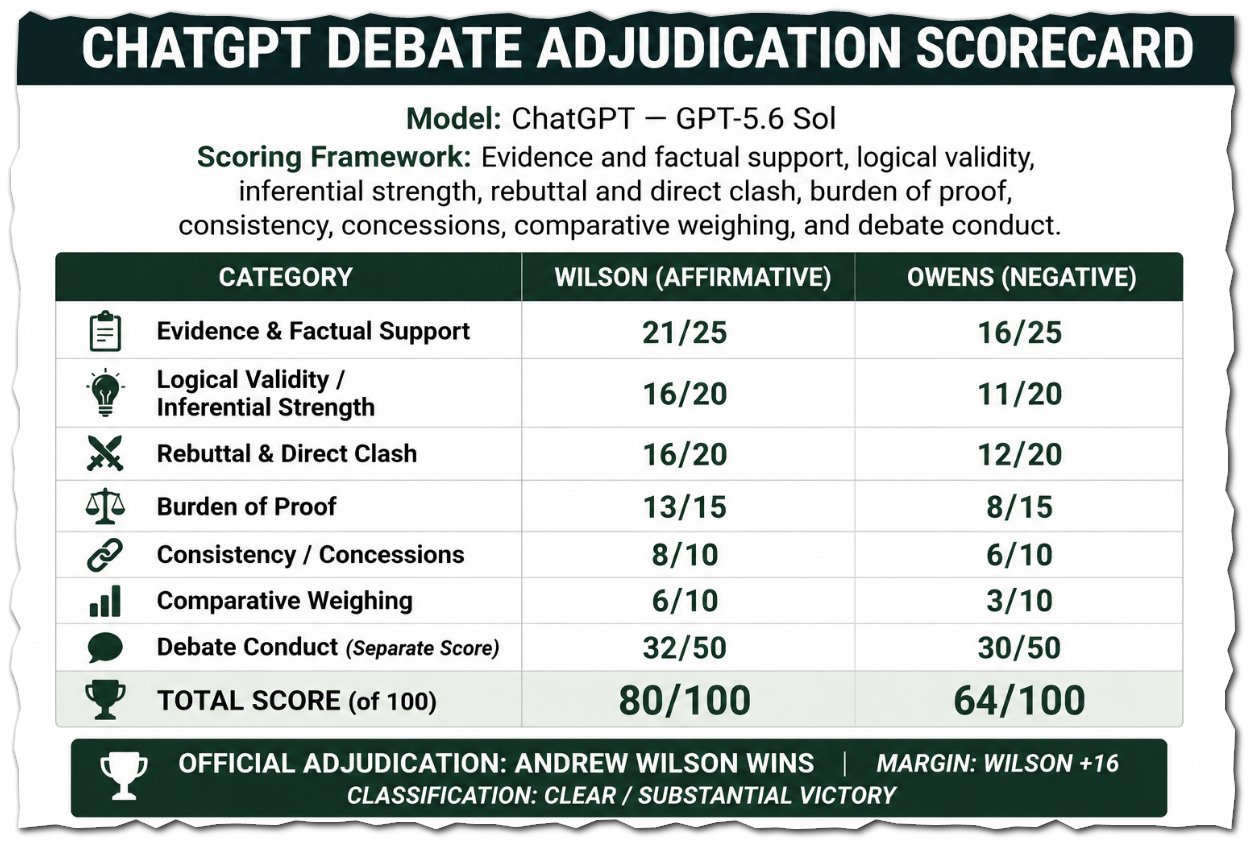
The substantive model scored six categories:
ChatGPT Scoring Framework
Evidence & Factual Support
Maximum Score: 25
Logical Validity / Inferential Strength
Maximum Score: 20
Rebuttal & Direct Clash
Maximum Score: 20
Burden of Proof
Maximum Score: 15
Consistency / Concessions
Maximum Score: 10
Comparative Weighing
Maximum Score: 10
TOTAL POSSIBLE SCORE
100 Points
A separate conduct score examined rhetorical behavior so that sarcasm, interruptions, personality, and presentation would not determine who actually won the argument.
ChatGPT Final Score
Andrew Wilson: 80/100
Candace Owens: 64/100
Margin: Wilson +16
Classification: Clear / Substantial Victory
Debate conduct was much closer:
Wilson: 32/50
Owens: 30/50
That distinction matters.
ChatGPT did not conclude that Wilson conducted a flawless debate.
It specifically penalized him for political and motive attacks, ridicule, repeated references to “dreams” and “vibes,” overstatement, aggressive cross-examination, and occasions where he treated Owens’s actual evidentiary challenges as though they amounted to nothing.
Owens, meanwhile, received credit for several meaningful challenges, especially on the firearm, DNA, fingerprint degradation, witness uncertainty, hearsay, and preliminary-hearing issues.
But the central logical problem remained.
Owens frequently demonstrated:
This evidence is strange.
Then:
Another explanation is possible.
Then:
A setup should be investigated.
Those propositions can all be reasonable.
The problem comes when that becomes:
Therefore the evidence establishes that Robinson was set up.
That final step requires additional evidence.
ChatGPT identified this as the central inferential gap in Owens’s case.
Wilson repeatedly asked essentially the same question throughout the debate:
Even if I grant the anomaly, how does that particular anomaly establish the patsy theory?
Owens often demonstrated possibility.
Wilson demanded probability.
Because Owens had placed the probability that Robinson was the shooter at 0%, the stronger burden belonged to her.
ChatGPT therefore concluded:
Owens successfully demonstrated legitimate reasons for further investigation, but she did not demonstrate overwhelming affirmative evidence that Robinson was framed and was not the shooter.
That is why Wilson won the substantive adjudication.
Grok’s Result
We then submitted the debate to Grok, independently of the ChatGPT scoring.
The Grok analysis used a different framework.
According to Grok’s own methodology report, it evaluated the debate using concepts drawn from:
-
the Toulmin Model of Argumentation;
-
NPDA/CEDA-style debate tabulation principles;
-
British Parliamentary and Worlds-style comparative analysis;
-
adapted Lincoln-Douglas burden concepts;
-
and systematic informal-logic fallacy coding.
Grok broke major arguments into the familiar Toulmin structure:
Claim → Data/Evidence → Warrant → Backing → Qualifier → Rebuttal
That is particularly useful in a debate like this because the largest dispute was not necessarily over whether an underlying fact existed.
It was frequently over the warrant connecting that fact to the conclusion.
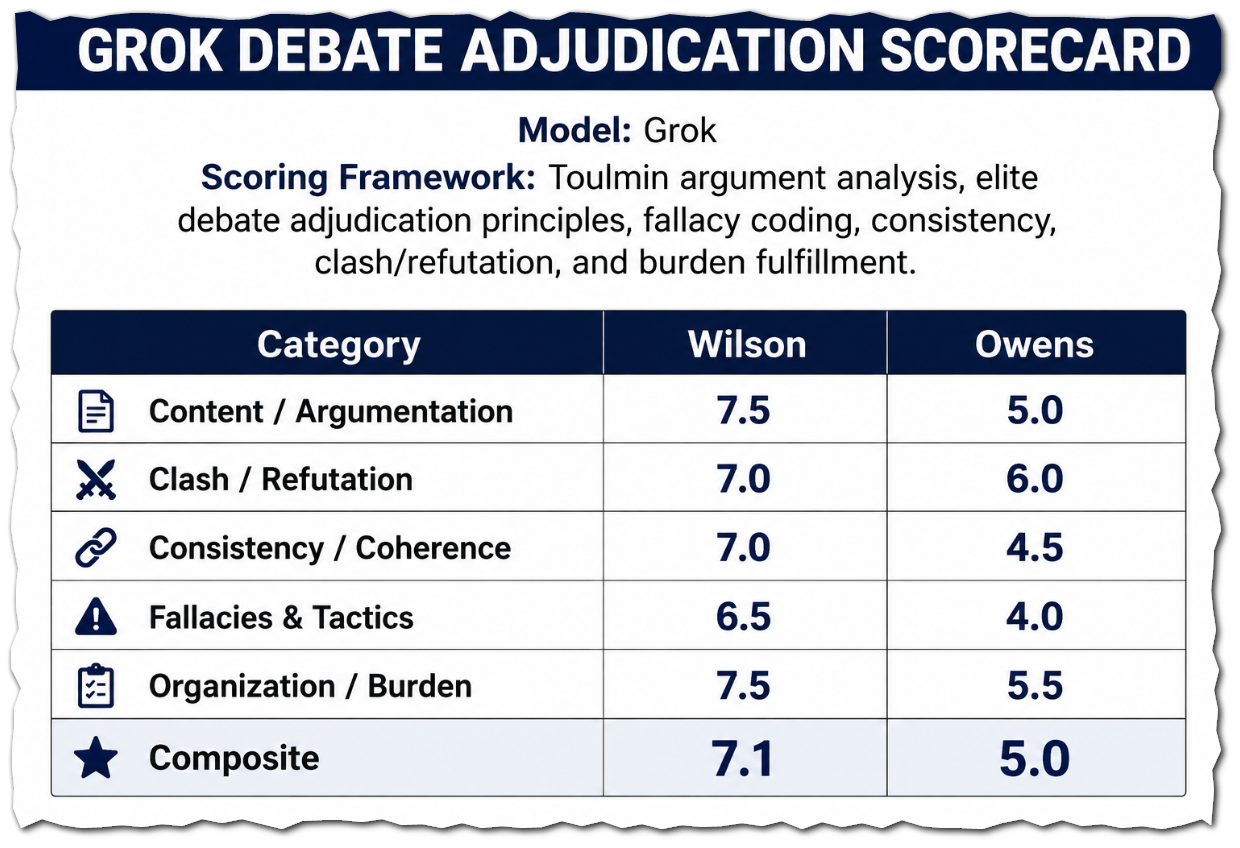
Grok scored five categories on a 0–10 scale:
Grok Final Scorecard
Content / Argumentation
Wilson: 7.5 | Owens: 5.0
Clash / Refutation
Wilson: 7.0 | Owens: 6.0
Consistency / Coherence
Wilson: 7.0 | Owens: 4.5
Fallacies & Tactics
Wilson: 6.5 | Owens: 4.0
Organization / Burden
Wilson: 7.5 | Owens: 5.5
COMPOSITE SCORE
Andrew Wilson: 7.1 / 10
Candace Owens: 5.0 / 10
Again:
Andrew Wilson won.
Grok’s conclusion closely paralleled ChatGPT’s despite using a different scoring system.
Its executive finding was that Owens successfully generated reasonable doubt concerning portions of the state’s preliminary evidentiary package and exposed procedural limitations.
But Grok concluded that she did not establish overwhelming affirmative evidence that Robinson was a patsy who did not fire the fatal projectile.
Grok also found that Wilson did a better job maintaining an organized affirmative case and forcing Owens to supply a positive logical chain from anomaly to setup.
And just as importantly, Grok did not simply award Wilson every disputed point.
For example, it regarded Owens’s discovery-timing argument concerning the alleged text messages as one of her stronger procedural criticisms.
It also recognized the legitimate problems she raised concerning Utah’s preliminary-hearing process and the evidentiary standard being applied there.
Yet Grok reached essentially the same overall conclusion:
The debate is competitive if the question is simply whether someone can reasonably remain skeptical of the state’s current case. It becomes much less competitive when the proposition becomes the affirmative claim that overwhelming evidence establishes Robinson as a patsy and non-shooter.
That is an important distinction.
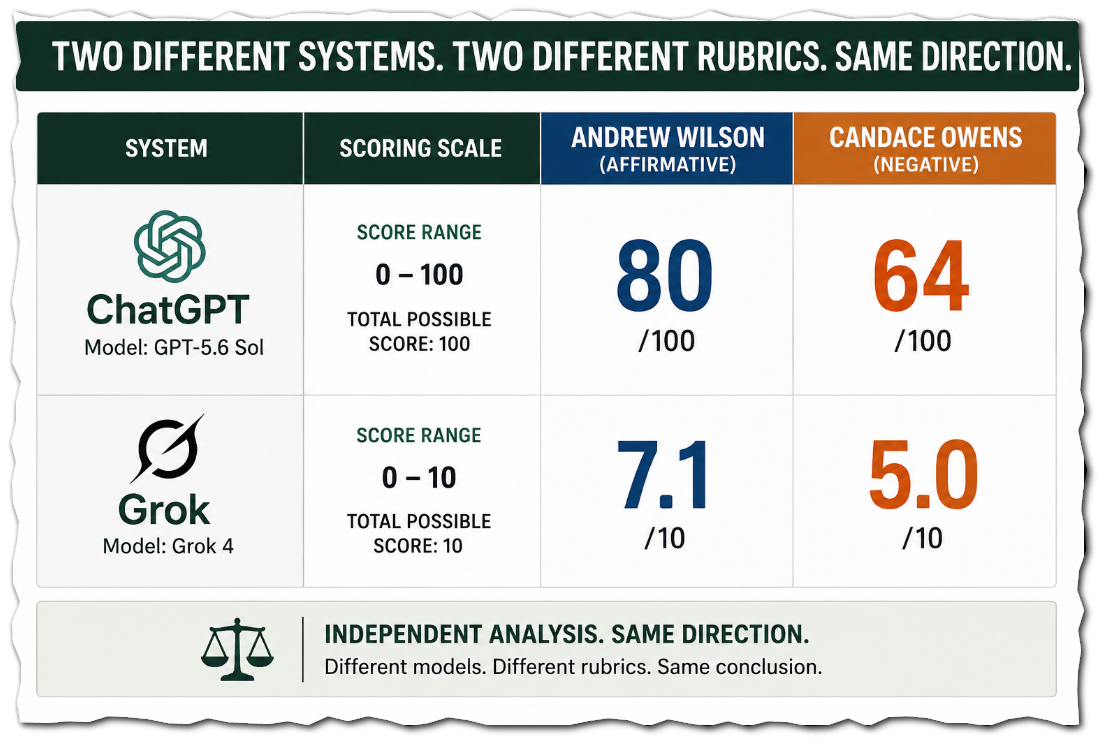
Two Different Systems. Two Different Rubrics. Same Direction.
This is the part we found most interesting.
The point is not that artificial intelligence is infallible.
It isn’t.
The point is not that ChatGPT or Grok can determine criminal guilt.
They cannot.
The interesting part is that two independent analytical systems, using different scoring structures, identified essentially the same central weakness in the losing case.
ChatGPT scored it:
80–64 Wilson
7.1–5.0 Wilson
Both found that Candace was effective at producing skepticism.
Both found that some aspects of the state’s narrative deserved scrutiny.
Both found legitimate weaknesses and unanswered questions.
Both nevertheless found that she repeatedly failed to complete the inferential chain necessary to transform those questions into the affirmative conclusion she was defending.
That is considerably more informative than simply saying:
“My side won.”
So What Is The Conservative TAKE’s Position?
Here is where we separate debate adjudication from our position on the case itself.
The Conservative TAKE increasingly approaches major political, criminal, institutional, and media narratives using something very close to an Occam’s razor standard combined with independently verifiable evidence.
That does not mean:
The simplest explanation is automatically true.
Occam’s razor is not proof.
Our approach is more modest:
When multiple explanations are possible and reliable information is incomplete, begin provisionally with the explanation requiring the fewest unsupported assumptions while remaining willing to change the conclusion when better evidence appears.
That qualifier matters.
Because at this point, we do not believe anyone outside the case possesses enough tested evidence to speak with absolute certainty.
We have not had the trial.
We have not heard the government’s witnesses subjected to full adversarial cross-examination.
We have not heard the defense put on its complete case.
We have not watched experts challenged under oath by attorneys who have access to discovery.
We have not seen how disputed forensic evidence survives admissibility challenges.
We have not seen what evidence is ultimately excluded, admitted, contradicted, authenticated, or impeached.
Until that happens, we should maintain intellectual humility.
Institutions Do Not Get Automatic Trust
There is another reason we take this approach.
The Conservative TAKE does not grant institutional narratives automatic credibility.
Government claims are not self-authenticating simply because they come from the government.
Media claims are not self-authenticating simply because a major news organization repeats them.
Claims made to protect a political party, ideological movement, government agency, foreign government, powerful organization, celebrity, donor class, or favored social group are not self-authenticating either.
History provides more than enough reason to verify rather than simply trust.
That does not mean:
The government is always lying.
It does not mean:
The media is always lying.
And it certainly does not mean:
Every alternative explanation must therefore be true.
That would simply replace one form of blind faith with another.
Our position is:
No institution gets a presumption of truth merely because of its institutional status.
Evidence should stand on its own.
And an alternative theory does not become true merely because the government could be wrong.
That principle has to cut in both directions.
Skepticism Is Not Evidence
This may be the most important lesson from the entire debate.
Distrust of government is not evidence that a particular government claim is false.
Distrust of media is not evidence that the opposite of a media narrative must be true.
A history of intelligence failures does not prove intelligence involvement in a particular event.
A suspicious coincidence does not automatically establish conspiracy.
An unanswered question does not automatically identify the answer.
And the fact that an alternative theory is possible does not establish that it happened.
Those distinctions are precisely where the Wilson–Owens debate became useful.
Candace Owens is absolutely correct that people have the right to question official narratives.
We would go farther:
They should question them.
But questioning a narrative and proving an alternative narrative are two very different activities.
Our Working Standard: Verifiable Evidence + Occam’s Razor
So, until the case actually reaches trial, our position remains provisional.
We will work primarily from:
Evidence that can be independently verified.
Facts that both sides substantially acknowledge.
Primary documentation where available.
Forensic claims whose methodology can be examined.
Statements that can eventually be tested through cross-examination.
And the explanation that currently requires the fewest unsupported assumptions to account for the verified evidence.
If new evidence changes that equation, then the conclusion should change.
There is no virtue in remaining loyal to yesterday’s theory after today’s evidence disproves it.
That applies whether the theory came from:
-
the government;
-
Candace Owens;
-
Andrew Wilson;
-
Turning Point USA;
-
the media;
-
an intelligence source;
-
an anonymous source;
-
an influencer;
-
ChatGPT;
-
Grok;
-
or us.
The evidence gets the final word.
What We Know and What We Don’t
At this stage, we believe the responsible position is:
We know there are legitimate unanswered questions.
We know the preliminary evidentiary record is not the same thing as a completed trial record.
We know some of the evidence raised during the debate deserves greater scrutiny.
We know Owens successfully exposed weaknesses in portions of the narrative.
We also know that exposing a weakness is not the same thing as proving a setup.
We know Wilson performed better under both structured debate-adjudication systems.
We do not know with courtroom-tested certainty what the complete evidence will ultimately establish.
And we will not pretend otherwise.
Cross-Examination Changes Everything
One reason criminal trials exist is that evidence frequently looks very different after cross-examination.
A written summary can sound devastating until the person who produced it is questioned.
A witness can sound certain until the basis for the identification is examined.
Forensic evidence can appear definitive until methodology, contamination, chain of custody, statistical interpretation, or laboratory procedure is challenged.
A defense theory can sound compelling until it confronts contradictory evidence.
And government evidence can sound overwhelming until it is forced to survive an adversarial process.
That is where we ultimately want to see this case tested.
Not on X.
Not on YouTube.
Not on a podcast.
Not on Substack.
Not by AI.
In court. Under oath. Subject to cross-examination.
Until then, any responsible conclusion should remain provisional.
Why We Ran The AI Analysis
Some people will inevitably object:
“You’re letting AI tell you what to think.”
No.
That is not what we did.
We used AI for something machines can actually be useful for:
processing an enormous transcript consistently and applying the same analytical categories across hours of argument.
A four-hour debate contains hundreds of assertions, objections, qualifications, concessions, interruptions, and repeated arguments.
Human viewers naturally remember dramatic moments.
They remember the line that made them laugh.
They remember the argument that confirmed what they already believed.
They remember the participant they already trusted.
A structured model can instead be instructed to track:
What was the claim?
What was the evidence?
What was the warrant?
Did the opponent answer it?
Did the speaker change the claim?
Was the conclusion stronger than the evidence?
Was the argument dropped?
Was there a concession?
Was this a fallacy or an actual rebuttal?
That doesn’t make AI omniscient.
It makes it a useful analytical tool.
And using two different models gives us another check against simply accepting one model’s preferences.
Read The Reports Yourself
We are not asking anyone to take our summary on faith.
Both complete reports are being made available free of charge.
No paywall.
No premium tier required.
No “subscribe to see the methodology.”
You can read the ChatGPT report.
You can read the Grok report.
You can compare their scoring systems.
You can examine where the two models agreed.
You can examine where they differed.
And you can decide whether their reasoning holds up.
The complete documents are attached to this article and will also be available through the Conservative TAKE’s Locals page / website for anyone who wants to download and examine them.
Everything associated with this analysis is being made available free.
the Conservative TAKE…
So where does our final position land today?
On the debate itself:
Andrew Wilson won.
Two independently structured AI adjudications reached that conclusion by substantial margins.
On Candace Owens’s questions:
Some are legitimate and deserve answers.
On the government’s case:
We are not granting it automatic credibility merely because the government presented it.
On alternative theories:
We are not granting them automatic credibility merely because official institutions have been wrong before.
On the media:
We treat media narratives as claims requiring verification, not as authoritative reality simply because they are repeated.
On the trial:
That is where much of this will finally become testable.
And until the witnesses are placed under oath, the evidence is challenged, the defense gets full opportunity to respond, and the competing narratives are subjected to actual adversarial cross-examination, we do not believe anyone outside the courtroom should pretend to know more than the evidence currently allows.
For now, we will continue doing what we believe serious analysis requires:
Verify what can be verified.
Separate evidence from speculation.
Use Occam’s razor as a provisional guide, not a substitute for proof.
Trust no institution simply because it demands trust.
Apply the same skepticism to alternative narratives that we apply to official ones.
And change our conclusions when the evidence changes.
That is where we stand.
And when the trial begins, we will be watching the evidence.
Not the narrative.