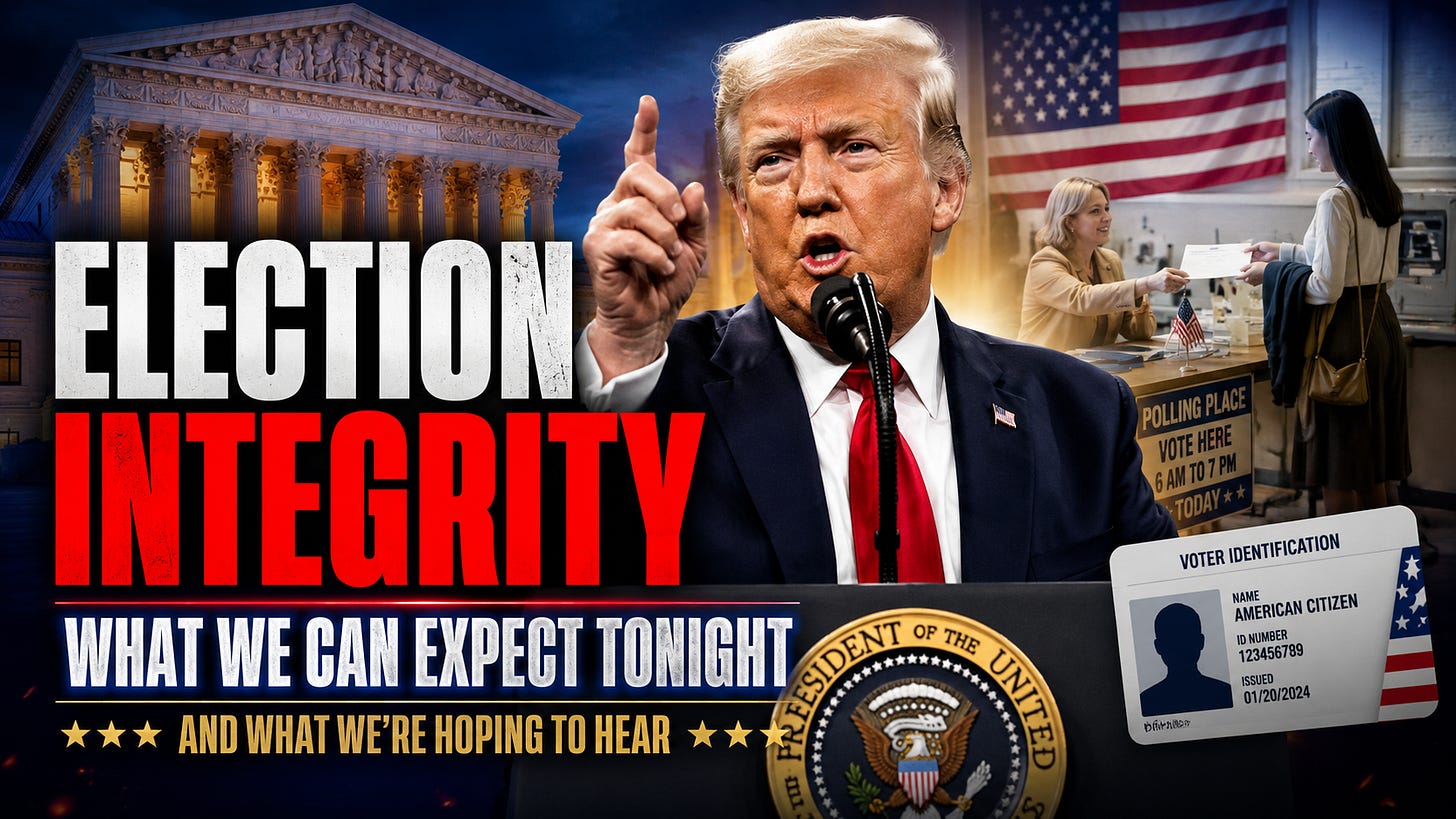
President Donald Trump is scheduled to address the nation tonight at 9 p.m. Eastern, and he has already signaled that free and fair elections will be a major part of the discussion.
That much is confirmed.
Everything beyond that must be handled with more care.
Conservative media has been circulating reports and analysis involving voting machines, foreign interference, declassified intelligence, Georgia, the 2020 election, senior national-security officials, and even the possibility of emergency action. Some of those possibilities may prove important. Some may turn out to be incomplete. Others may never be mentioned at all.
Trump himself has kept the details close. Fox News reported this morning that the SAVE America Act is expected to be a centerpiece, while the White House has emphasized that the full contents remain under wraps. That means any responsible pre-speech analysis has to distinguish what has already happened from what people believe may happen tonight. Fox News
But here is the part the legacy media is likely to miss—or deliberately minimize.
The election-integrity battle did not begin with tonight’s speech. Trump’s administration and congressional allies have already built several overlapping pressure points involving citizenship verification, voter-roll maintenance, mail-ballot procedures, federal enforcement, the Election Assistance Commission, and the SAVE America Act.
Tonight may connect those pieces. It may accelerate them. It may provide new evidence. It may also fall short of the most dramatic expectations.
The facts come first.
The Speech Is Tonight. The Facts Come First.
There are four categories readers should keep separate before Trump takes the podium.
CONFIRMED
Trump is speaking tonight, and election integrity is a central subject.
REPORTED
The address may focus heavily on the SAVE America Act and broader election-security concerns.
ANALYSIS
The speech may be intended to unite several administrative, legal, and legislative actions into one national argument.
CONJECTURE
Trump will reveal specific declassified evidence, identify a foreign attack, prove that voting machines changed votes, name a particular state, appear with intelligence officials, or declare a national emergency.
That last category matters because expectations have moved far ahead of the public record.
A serious conservative position does not require pretending that rumors are already facts. It requires taking the issue seriously enough to demand evidence.
The establishment press often treats election-integrity concerns as illegitimate before examining the underlying claim. That is not journalism. It is narrative protection.
But conservatives should not make the opposite mistake. A hostile media does not deserve blind trust—but neither does every government claim become true merely because we want it to be.
Tonight’s address should be judged by what Trump actually presents, not by what commentators predicted before he spoke.
The First Layer: Executive Action
Trump’s election-integrity agenda has already moved beyond speeches.
On March 25, 2025, he signed an executive order titled “Preserving and Protecting the Integrity of American Elections.” The order directed federal action involving documentary proof of citizenship, enforcement of Election Day ballot-receipt deadlines, foreign involvement in elections, voting-system standards, federal election grants, and the national mail voter-registration form.
The order’s basic argument was straightforward: free elections require more than access. They also require lawful eligibility, clear deadlines, secure systems, and procedures the public can trust.
Then, on March 31, 2026, Trump issued a second order titled “Ensuring Citizenship Verification and Integrity in Federal Elections.” It directed the Department of Homeland Security, working with the Social Security Administration, to compile and transmit state citizenship lists from federal records. It also directed the U.S. Postal Service to pursue secure and traceable procedures for official election mail and absentee-ballot envelopes.
These actions matter because they show a consistent theory of the problem.
The administration believes the federal government possesses data, enforcement authority, grant leverage, and mail infrastructure that can be used to strengthen citizenship verification and election security.
That does not mean every provision is already operating exactly as intended. Executive orders can face court challenges. Agencies must implement them. States may resist. Congress still writes election law, and state governments still administer elections under constitutional and statutory rules.
But the orders are real. They establish policy. They assign responsibilities. And they create a federal framework that did not exist before.
The Second Layer: DOJ Pressure on Voter Rolls
Policy becomes meaningful when enforcement begins.
The Justice Department has spent months pursuing statewide voter-registration information and filing lawsuits against jurisdictions that refused to provide it. DOJ has described accurate voter rolls as a basic requirement of election integrity and has relied on federal laws including the National Voter Registration Act, the Help America Vote Act, and the Civil Rights Act of 1960.
A May 2026 opinion from the Justice Department’s Office of Legal Counsel concluded that the Civil Rights Division may seek statewide voter-roll data and share it with the Department of Homeland Security for eligibility-related review.
This does not prove that every person flagged in a database is ineligible. It does not prove that every registration error resulted in an unlawful vote. It does not prove that every DOJ lawsuit will succeed.
It does prove that the federal government is no longer accepting blanket resistance to voter-roll examination as the final answer.
The conservative case is not that every clerical error equals fraud.
The conservative case is that voter rolls should be accurate, citizenship should be verifiable, election officials should follow the law, and states receiving federal election support should be prepared to demonstrate that their systems are being maintained properly.
Critics will argue that the federal government is centralizing power, mishandling voter data, or intruding into state election administration.
Those concerns should be answered with statutory authority, privacy safeguards, transparent standards, and judicial review (not with the claim that voter rolls should never be checked).
Accuracy is not voter suppression. Transparency is not extremism. Asking government to prove that it is doing its job is not an attack on democracy.
The Third Layer: An Election Commission Without Commissioners
Most Americans have heard of the Federal Election Commission, which handles campaign-finance rules.
Far fewer know about the Election Assistance Commission.
The EAC was created after the 2000 election and plays a major role in federal election administration. It develops voluntary voting-system guidelines, certifies voting-system testing laboratories, distributes election-security grants, supports state and local election officials, and maintains the national mail voter-registration form.
In early July, Trump reportedly removed Democratic commissioners Thomas Hicks and Benjamin Hovland while Republican commissioner Christy McCormick departed. Donald Palmer had resigned earlier, leaving the commission without sitting members, according to Breitbart’s July 10 report.
That is a major development—but it should not be exaggerated.
An empty commission can prevent the previous membership from approving major new policies. It can also slow certifications, guidance, and other formal action requiring commissioners.
At the same time, Trump does not simply “control” the commission.
Federal law provides for four commissioners. They are nominated by the president, confirmed by the Senate, and subject to partisan-balance requirements. No more than two may belong to the same political party.
That means the administration has created an opening to reshape the commission, but not a blank check.
The next appointments will matter. Their views on voting-system certification, federal guidance, citizenship verification, election technology, and state cooperation may influence how the EAC approaches the 2026 midterms and beyond.
The Fourth Layer: The SAVE America Act Returns
The legislative front is just as important.
The SAVE America Act is built around a simple public principle: American elections should be decided by American citizens.
The White House’s current proposal includes documentary proof of citizenship for federal voter registration, voter identification, removal of noncitizens from voter rolls, and major restrictions on mail voting outside specified circumstances.
Supporters see these provisions as basic safeguards.
Opponents call them voter suppression.
That political divide explains why the bill has repeatedly run into Senate resistance.
This week, House Republicans used a procedural maneuver to move the fight forward. On July 14, the House agreed to H. Res. 1423 by a vote of 215–211. The resolution governed consideration of H.R. 8595, a national-security and State Department appropriations measure.
The distinction matters.
The 215–211 vote was a procedural rule vote. It was not final passage of the SAVE America Act itself.
Conservative reporting has described the broader strategy as pairing election-security language with national-security or appropriations legislation so the Senate cannot ignore the issue as easily. Politically, that makes sense. Election security is being framed not as a narrow partisan preference but as a matter of citizenship, public confidence, and national sovereignty.
Procedurally, however, attaching a provision to an appropriations package does not automatically eliminate the Senate filibuster, guarantee reconciliation protection, or settle possible Byrd Rule disputes.
The strategy is real. The outcome is not guaranteed.
The Convergence Is Real. The Master Plan Is an Inference.
Put the pieces together.
Trump has issued two major election-related executive orders.
The Justice Department has pursued voter-roll data across the country.
Federal agencies have been directed to build citizenship-verification and election-mail systems.
The Election Assistance Commission has reportedly been left without sitting commissioners.
House Republicans have moved to connect the SAVE America Act with broader governing legislation.
And tonight, Trump will address the nation on free and fair elections.
Those are not imaginary developments.
They create overlapping legal, administrative, legislative, and political pressure.
What cannot yet be proved is that every move was designed from the beginning as one seamless master plan.
It is reasonable to infer that the administration now sees these actions as reinforcing one another. It is reasonable to believe that tonight’s speech may be intended to unite them publicly. It is reasonable to expect Trump to apply pressure on Republican senators and state officials.
It is not reasonable (before the speech) to report an emergency declaration, declassified proof, changed votes, specific foreign operations, or named officials as settled facts.
The convergence is real.
The master-plan theory is an inference.
The emergency declaration is conjecture.
That distinction does not weaken the conservative argument. It makes it stronger.
What Trump Must Show Tonight
Trump has raised expectations.
Now he must meet them.
If he presents evidence about voting machines, foreign interference, voter rolls, ballot handling, or past elections, the public should ask several basic questions:
-
What is the evidence?
-
Who produced it?
-
When was it collected?
-
What does it prove?
Does it show a vulnerability, an attempted intrusion, unlawful registration, unlawful voting, or changed votes?
-
What remains allegation?
-
What legal authority supports the proposed remedy?
-
Can the evidence be independently examined?
-
What happens next?
The legacy media will be tempted to dismiss the address before reading the documents.
Trump’s supporters may be tempted to declare victory before seeing them.
Both reactions would be premature.
Election integrity is too important to be reduced to establishment denial on one side and uncritical anticipation on the other.
Subscribe for the post-speech follow-up, where the Conservative TAKE will compare what President Trump actually announces with what was predicted beforehand.
the Conservative TAKE…
Election integrity is not a conspiracy theory, a campaign prop, or an excuse for unlimited presidential authority. It is a basic requirement of constitutional self-government.
Citizenship should matter. Voter rolls should be accurate. Election mail should be secure. Voting systems should be transparent. Foreign interference should be investigated. Election laws should be enforced consistently. Officials should be accountable to the public.
The media has spent years acting as though concerns about election administration are inherently illegitimate. That posture has protected institutions from scrutiny instead of protecting public confidence.
But conservatives should hold themselves to a higher standard.
Do not accept the media’s reflexive denial. Do not accept government claims without evidence. Do not confuse a possible vulnerability with a proven exploit. Do not confuse an attempted interference operation with changed votes. Do not confuse political momentum with legal authority.
The election-integrity fight did not begin with tonight’s speech, and it will not end when the cameras turn off. Trump has already built several overlapping fronts through executive action, federal enforcement, agency changes, and congressional pressure. Tonight will show whether he possesses the evidence and the plan to connect them.