When one examines the arc of the Trump era, it becomes clear: real political power is not about rhetoric. It is all about agenda and leverage. And in this most recent shutdown standoff, Democrats thought they had both.
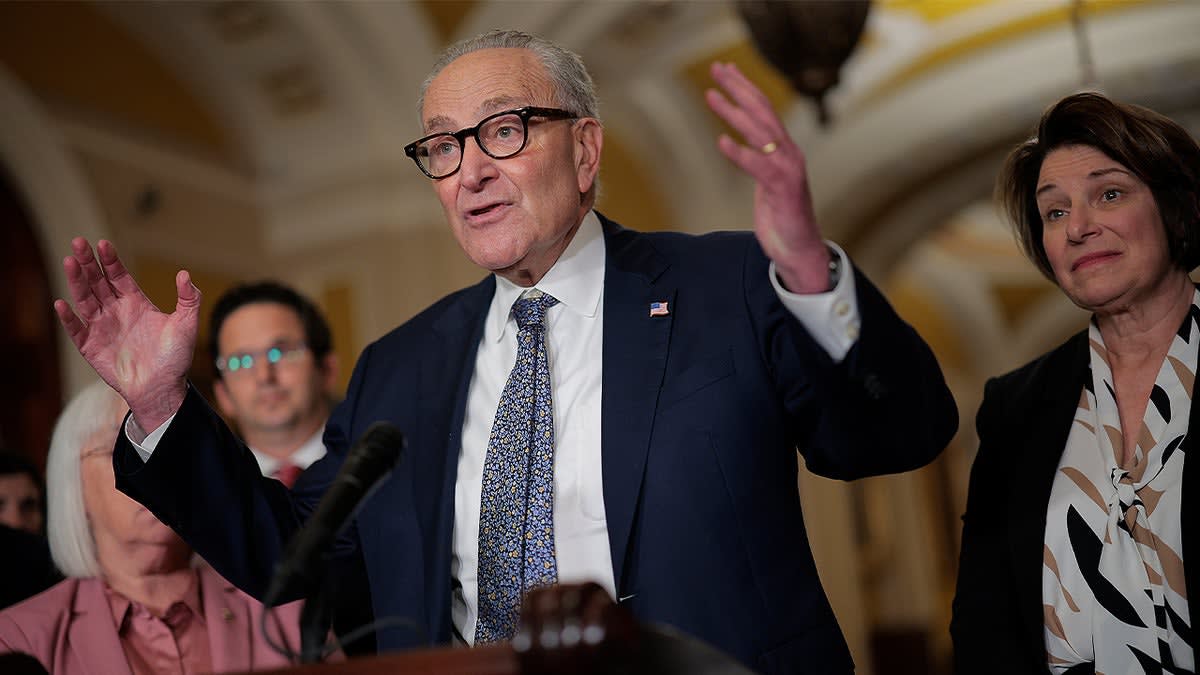
Led by Chuck Schumer, Senate Democrats forced the longest government shutdown in U.S. history, hoping to wring out billions in policy concessions. Their demands? A one-year extension of Obamacare subsidies, expanded federal healthcare for illegal immigrants, and a bloated stack of partisan pork barrel projects (all packaged as “essential funding”). They were betting that Republicans, and Trump in particular, would blink first.
He didn’t.
Instead, Trump detonated a domestic-policy bombshell. He introduced four major proposals that didn’t just steal the spotlight, but stripped Democrats of their last ounce of leverage. With the nation watching, he proposed $2,000 tariff rebate checks for working Americans, launched an antitrust offensive against Big Ag monopolies, introduced a 50-year mortgage to lower monthly housing costs, and unveiled a direct-to-citizen Health Savings Account (HSA) option to bypass the corrupt Obamacare subsidy pipeline.
The result? Schumer’s coalition collapsed. Eight Democrats crossed the aisle. The government reopened. And Democrats got nothing. No subsidies. No amnesty cash. No pork. Just political embarrassment and a month of shutdown pain they could’ve ended far earlier.
From an originalist lens, Trump’s maneuver is more than shrewd politics. It’s a realignment toward the Founders’ vision: limited government, economic self-reliance, and dismantling entrenched power (whether bureaucratic or corporate).
Let’s break down each of these four policy pivots. We will look at their constitutional “logic”, political impact, and how they handed Trump not just a policy win, but a commanding midterm strategy.
1. Going After Big Ag Monopolies (Meat‑packing in particular)
One of the more dramatic moves: Trump has ordered the United States Department of Justice (DOJ) to launch an antitrust investigation of the big meat‑packing firms, accusing them of collusion, price‑fixing, and manipulating beef prices. Specifically targeting the “Big Four” packers that control about 85 % of U.S. fed‑cattle slaughter was highlighted.
The relevant facts: the market concentration ratio has increased from roughly 36 % in 1980 to about 85 % now.
Trump publicly framed the move as protecting American ranchers and consumers, and restoring competition.
Why this matters politically:
-
This is a populist economic policy: standing up to “corporate monopolies” appeals to working‑class, rural, and small‑business voters who feel squeezed.
-
It shifts the narrative: instead of foreign policy or culture wars, it focuses on kitchen‑table issues like the cost of beef.
-
It erodes a traditional Democratic talking point (that they alone protect the little guy); by doing so, it undercuts their leverage.
-
Constitutionally, it re‑invigorates the antitrust enforcement power of the federal government (consistent with the Sherman & Clayton Acts) while aligning with the Founders’ suspicion of concentrated economic power interfering with free markets and state sovereignty.
Originalist framing:
The Constitution doesn’t explicitly mention monopolies, but the general principle of protecting “liberty” (economic and otherwise) undergirds antitrust law. Moreover, the federal government’s role under the Commerce Clause and the “general welfare” language is often cited in antitrust context. While some critics argue this is activist, an originalist reading plausible here: that government may act when concentrated private power threatens the freedom of ordinary citizens to transact, produce, and consume.
2. Introducing 50‑Year Mortgages
Another bold move: Trump floated the idea of a 50‑year fixed mortgage, backed by the Federal Housing Finance Agency (FHFA) under Director Bill Pulte, describing it as a “game changer” for young Americans facing affordability problems.
Media scrutiny quickly followed: critics note that while monthly payments drop, the total interest paid over 50 years could be much higher.
Why this matters politically:
-
Homeownership is a central part of the American dream; expanding access speaks to precisely the blue‑collar, first‑time‑buyer voters who may have felt left behind.
-
It allows Trump to shift from foreign‑policy spotlight back to domestic, more relatable issues: mortgages, housing, monthly budgets.
-
Strategically, it signals responsiveness: “Yes, we see rising housing costs; here’s a structural fix.” That undercuts opposition messaging that the GOP is indifferent to affordability.
-
It pulls support across generational lines (Millennials, Gen Z adult voters) who are largely priced out.
Originalist framing:
The Constitution vests broad power in Congress to regulate commerce, and the housing finance system is a federal‑state undertaking. From an originalist perspective, one might argue that enabling broader home‑ownership aligns with promoting the stability of citizenry, property rights, and self‑governance — all key to preserving liberty. The long‑term debt risk however raises questions about ensuring such policy truly empowers rather than impoverishes.
3. $2,000 Tariff Rebate Checks
Perhaps the most headline‑grabbing: Trump announced that revenue from his expanded tariff regime could be used to send at least $2,000 checks to most Americans (excluding high‑income earners).
He described tariffs not only as protectionism, but a fund to benefit the American people direct “dividends,” and to pay down national debt.
Why this matters politically:
-
Cash in the hands of voters is hard to beat. It meets the “kitchen table” test: inflation/affordability.
-
It flips the usual political script: Republicans are often criticized for cutting entitlements; here we have Republican‑style government delivering direct checks.
-
It links trade policy (often seen as abstract) to individual benefit, giving voters a tangible reason to support tariffs and by extension, Trump’s “America First” economic vision.
-
It weakens a key Democratic advantage: presenting themselves as the party of redistribution and working‑class protection. If Republicans start distributing, that advantage is blunted.
Originalist framing:
The Constitution does not provide direct wording for “dividend checks,” but under the Taxing and Spending Clause and the General Welfare Clause, Congress has broad power to appropriate funds. The question becomes one of federalism and limited government: is this a prudent distribution of federal resources, or does it risk expanding dependency and central control? In this framing, Trump’s move is defensible if the checks are tied to actual revenue from tariffs (i.e., the people benefit from trade policy directly) rather than expanding permanent entitlements.
4. HSA Option to Compete with the Obamacare Subsidy System
Finally, Trump is reportedly moving to introduce an HSA‑style alternative to the subsidy regime under the Affordable Care Act (ACA). According to the transcript, the idea is to “bypass greedy insurance companies” by sending money directly to individuals via health‑savings accounts, rather than letting insurance‑industry intermediaries soak up subsidies. (Note: I have not located a fully fleshed out public policy paper yet, but this appears consistent with the transcript.)
What we do know: the Democrats’ leverage in the recent shutdown hinged on extending ACA subsidies, and Trump’s pivot signals a move to undercut that leverage.
Why this matters politically:
-
Health care is a perennial concern. By shifting the subsidy model toward HSAs, the policy appeals to notions of consumer control, choice, and market competition, rather than entitlement‑expansion.
-
It allows Trump to cast Democrats as continuing to subsidize insurance middlemen, not the actual people. This fits the classic conservative critique of bureaucratic capture and hidden corporatism.
-
It undermines a major point of Democratic policy leverage: that Republicans would allow a cliff in ACA subsidies, affecting millions. If Trump offers a credible alternative, the Democrats’ threat loses bite.
-
It signals to independent and working‑class voters (especially those who backed Trump but didn’t turn out this past Tuesday) that their practical concerns are being addressed.
Originalist framing:
From a constitutional viewpoint, health‑care regulation is tangled between federal and state powers. But HSAs and market‑driven alternatives align with the principle of individual liberty in economic decision‑making, limited government interference, and federalism (by permitting more state and individual choice). The critique of insurance‑industry capture echoes the Founders’ wariness of concentrated economic power.
BONUS: Big Pharma
In addition to targeting Big Ag, Trump has launched a direct offensive against Big Pharma, rolling out a “Most Favored Nation” pricing strategy that forces drug companies to offer Americans the lowest prices they charge anywhere in the developed world. His administration also unveiled TrumpRx.gov, a direct-to-consumer platform that bypasses insurance middlemen and delivers medications at dramatically reduced prices (including slashing popular drugs like Ozempic and insulin by over 60%). It’s a clear message: the days of pharmaceutical giants exploiting American consumers are numbered.
Why This Wiped Out Democratic Leverage
When one steps back, these four proposals do something remarkable: they shift the focus, shift the benefits, and shift the narrative:
-
Focus: domestic, “middle‑America” issues (affordability, housing, food cost, healthcare) rather than foreign policy, identity politics, or niche issues. That plays directly into the disaffected working‑class, low‑propensity voter block which supported Trump in 2024 but didn’t show up this past Tuesday.
-
Benefits: These policies visibly shift resources (checks, better mortgages, consumer control). They create a tangible benefit stream that voters can understand and feel.
-
Narrative shift: Instead of Republicans being “against something,” here they are being “for something” that helps ordinary Americans. That allows Trump to reclaim the mantle of “America First” in a domestic economic sense, not just foreign policy.
-
Opposition undercut: The Democrats’ conventional levers (control of internal messaging, welfare‑state subsidies, regulatory power, party of the little guy) are weakened because Trump is eating their lunch. They have fewer credible counter‑moves: when you’re being outflanked on your own terrain, you lose leverage.
-
Timing: The proposals came just as the Democrats were reeling from the shutdown‑surrender and internal chaos ( Senators openly criticizing Chuck Schumer, etc.). That means Trump’s moves hit when the opposition is weak.
Thus, in constitutional‑political terms, Trump is reasserting the power of the executive (and his political coalition) to set the agenda, move major domestic policy, and re‑frame the relationship between the citizen and the state. That’s exactly what original constitutionalism envisioned: a government by, of, and for the people but with limits, competition, and decentralization.
The 2026 Midterm Implications
Given this repositioning, what are the implications going into 2026?
-
For Republicans: this offers a renewed playbook: focus on domestic economic appeals, working‑class voters, and visible benefits. If executed well, Republicans might reclaim seats not by cultural insurgency alone but by economic reinforcement.
-
For Democrats: they are on the defensive. If they cannot articulate a credible response or counter‑proposal that trumps (no pun intended) these four major policy shifts, they risk resembling a party in reaction rather than proposal. Their shutdown gambit collapsed; their leverage evaporated; now they must respond to an agenda set by their opponent.
-
For the broader constitutional narrative: this suggests a realignment: the populist working‑class coalition may anchor around economic sovereignty and affordability, not just identity or foreign policy. That shifts the Overton window in conservative domestic policy.
It must be said, however, that execution matters. These proposals are bold, yes but the details, the implementation, and the unintended consequences will test their staying power. For instance, the 50‑year mortgage idea has drawn serious criticism that it may deepen debt burdens.
Still: the strategic effect of putting them on the table is tremendous.
the Conservative TAKE
Zoom out, and the strategy becomes crystal clear: Trump didn’t just survive the Democrat-engineered shutdown. He turned it into a policy ambush.
While Democrats were trying to frame Republicans as heartless obstructionists, Trump re-centered the debate on cost-of-living concerns that actually matter to voters. From health care premiums to meat prices to housing payments, he didn’t negotiate from weakness. He flipped the chessboard.
Each policy struck a nerve:
-
The $2,000 checks tied tariffs to tangible voter benefits.
-
The HSA plan pulled the rug from under Obamacare subsidies.
-
The 50-year mortgage appealed to priced-out younger Americans.
-
The Big Ag antitrust probe reminded voters who’s really driving food inflation.
-
The Big Pharma crackdown slashed drug prices and cut out insurance middlemen, proving Trump’s serious about affordability and reform.
Meanwhile, Democrats walked away with nothing. Their shutdown gambit imploded. And their leadership is now in open civil war, with Chuck Schumer under fire from within his own caucus.
Most importantly, Trump is now re-engaging the very blue-collar, low-turnout voters who drifted after 2024. He’s showing that America First isn’t just a slogan. It’s a kitchen-table economic strategy.
If the midterms are going to be won on affordability, leverage, and momentum, Trump just seized all three. And the Democrats? They handed him the opportunity, gift-wrapped, then watched him run away with their agenda.