Something significant is unfolding in the United States Senate and it deserves sober, clear-eyed attention.
As of today, the Senate has formally taken up debate on the SAVE Act (Safeguard American Voter Eligibility Act), a bill that already passed the House and now faces its most difficult test: the Senate’s procedural gauntlet. At its core, the legislation is straightforward. It requires proof of citizenship to register to vote and government-issued ID to cast a ballot in federal elections. In other words, it seeks to enforce what is already embedded in federal law: that only citizens may vote.
But as is often the case in Washington, the substance of the bill is only half the story. The real battle is procedural and constitutional.
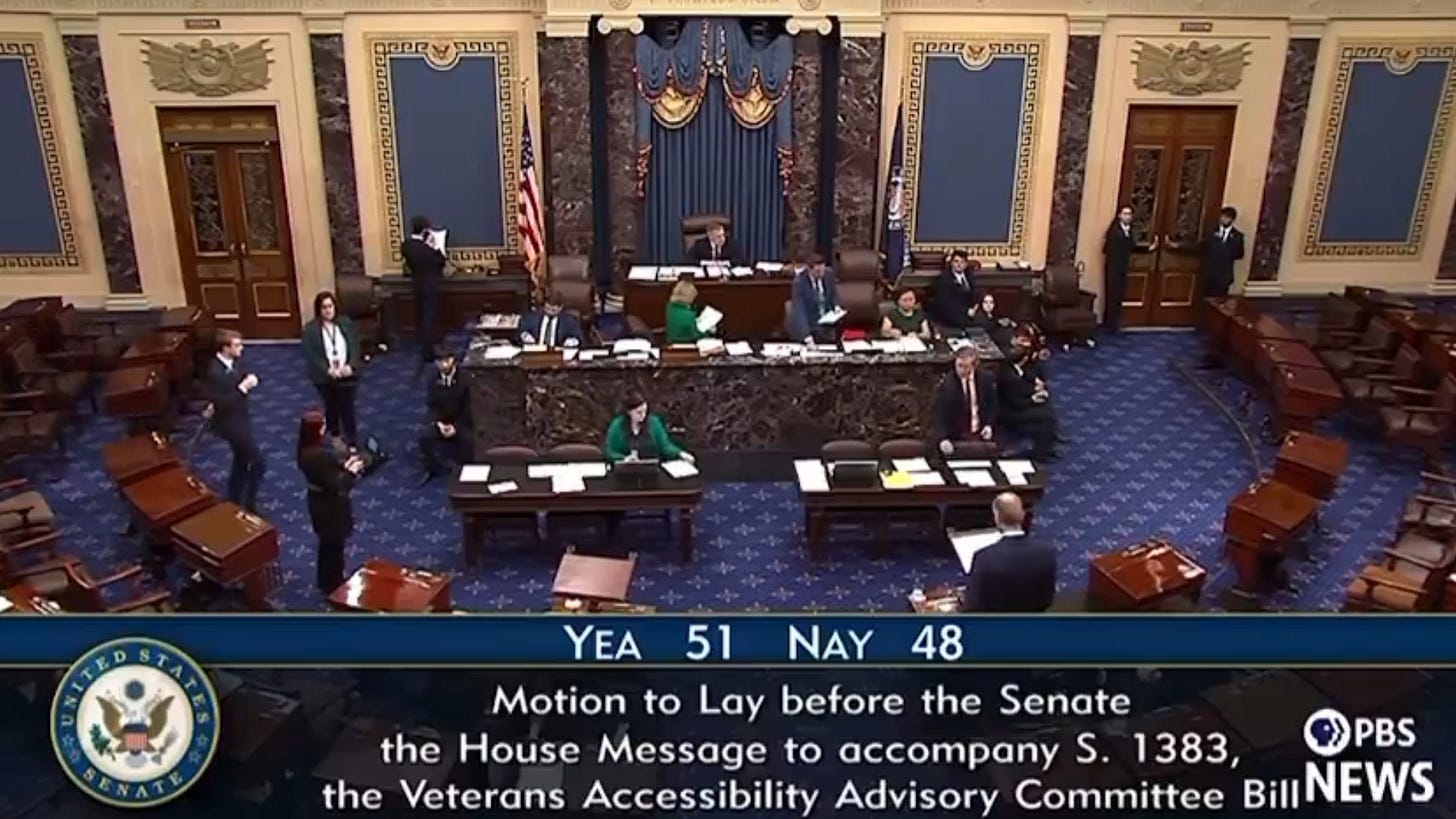
Editor’s Note (8:30 PM EST, 3/17/26): The SAVE Act has advanced by a 51–48 procedural vote, setting up full Senate debate as pressure intensifies for final passage.
The 60-Vote Barrier and a Familiar Historical Playbook
The central obstacle is the Senate’s 60-vote cloture threshold. Republicans do not currently have the votes to overcome a filibuster outright. That reality has forced a strategic pivot (one that draws directly from one of the most consequential legislative battles in American history).
During the Civil Rights Act of 1964, supporters faced a massive cloture deficit which was 32 votes short. Yet they did not retreat. Instead, they held the Senate floor for roughly 60 days, maintaining relentless pressure until opposition fractured.
That same model is now being revived.
Senate Republicans are effectively staging a “floor campaign” (extended debate, late-night sessions, and sustained public pressure). The goal is not merely to pass a bill, but to force continuous, visible accountability. Senators opposing the SAVE Act must do so publicly, repeatedly, and under scrutiny. This in which particularly the country approaches another election cycle.
This is not accidental. It is constitutional politics in action: persuasion, exposure, and pressure applied within the rules of the chamber.

The Talking Filibuster Debate
A key internal debate among Republicans now centers on whether to restore a true “talking filibuster” which would require senators to physically hold the floor and publicly sustain their opposition, rather than quietly blocking legislation through procedural maneuver.
This question carries added weight given the reported popularity of the SAVE Act itself. With polling cited at over 80% public support (including a strong majority of Democratic voters) the argument from proponents is simple: if a bill this widely supported is being blocked, that obstruction should be visible and accountable.
Senators like Mike Lee have therefore argued that a talking filibuster is not just a procedural preference, but a constitutional correction. It would shift the burden back onto those opposing the bill, forcing continuous debate in line with the Founders’ expectation that the Senate be a deliberative body (not one governed by silent veto).
Others within the conference remain more cautious. They warn that altering Senate rules could trigger unintended consequences, particularly opening the door to unlimited amendments that could bog the chamber down and derail the effort entirely.
What emerges is a familiar constitutional tension: how to preserve the Senate’s protection of minority rights while preventing those same rules from producing permanent legislative paralysis. It is a balance the Founders themselves grappled with and one that remains unresolved today.
Reconciliation: A Constitutional Workaround
If the traditional route fails, Republicans are exploring the reconciliation process (a mechanism that allows passage with a simple majority of 51 votes), provided the legislation has a direct budgetary impact.
Here, the argument is that enforcing citizenship requirements has fiscal consequences. Limiting access to federal benefits and public services to eligible citizens affects federal spending. This brings the bill within the scope of reconciliation rules.
This would not be unprecedented. In recent years, both parties have used reconciliation to pass major legislation when bipartisan consensus proved impossible.
From a constitutional originalist perspective (this is always our position here at the Conservative TAKE), this raises legitimate concerns about the expansion of procedural tools beyond their intended scope. Yet it also reflects a reality: when the ordinary legislative process is obstructed, Congress turns to the tools available within its rules.
The Backup Plan: Leveraging Must-Pass Legislation
If reconciliation fails (or is ruled out) there is yet another strategy: attaching the SAVE Act to must-pass legislation.
The leading candidate is the reauthorization of Section 702 of the Foreign Intelligence Surveillance Act (FISA), set to expire soon. This authority is widely considered essential to national security, creating immense pressure on Congress to act.
The strategy is straightforward: no SAVE Act, no FISA renewal.
This is high-stakes legislative leverage. It forces a choice. Either accept the election integrity provisions or risk being blamed for allowing critical intelligence authorities to lapse.
However, this approach carries risk. It opens Republicans to the charge of tying election law to national security in a way that could be framed as coercive. Even some supporters of the SAVE Act have expressed caution about this route.
A “Backup to the Backup”
What makes this moment notable is not just one strategy but the layering of strategies.
-
Floor pressure modeled on the Civil Rights Act battle
-
Potential revival of the talking filibuster
-
Reconciliation as a majority-vote pathway
-
Attachment to must-pass legislation like FISA
This is what legislative determination looks like. Not a single path—but multiple avenues, each prepared in advance.
A Reality Check…Without Cynicism
It is important to remain clear-eyed.
The SAVE Act still faces significant obstacles. The Senate is closely divided. Procedural rulings are uncertain. Political incentives are complex. There is no guarantee of success.
At the same time, it would be a mistake to dismiss what is happening.
There is measurable public support for voter ID and citizenship verification. There is visible coordination among House and Senate Republicans. And there is a willingness (unusual in recent years) to engage in sustained procedural conflict rather than accept quiet defeat.
Even critics within the conservative movement should take note: this is not inaction. It is an aggressive, multi-front legislative effort.
A Word on Internal Skepticism
There has been a tendency among some commentators (what might be called “permanent pessimists”) to assume failure before the process plays out.
That instinct is understandable given past disappointments. But it can also become self-defeating.
Legislative battles of this magnitude are not won overnight. The Civil Rights Act itself required persistence, pressure, and strategic adaptation over weeks and months.
Even Senator Rand Paul (often skeptical of federal overreach) has expressed support for the principle of election integrity embedded in this effort. That alone signals that this is not a fringe initiative, but one with broader constitutional grounding.
The Constitutional Stakes
At its heart, this debate is about more than a single bill.
It raises fundamental questions:
-
Who constitutes “the People” in a constitutional republic?
-
What mechanisms are necessary to preserve the integrity of elections?
-
How should the Senate balance minority rights with legislative functionality?
The Founders did not design a system for ease. They designed one for accountability and deliberation. What we are witnessing now is that system under stress, but still operating.

the Conservative TAKE
There is a path forward but not a guaranteed one.
Success will depend on sustained political pressure, strategic discipline, and a willingness to use every lawful tool available within the constitutional framework. Hope is warranted but only the kind grounded in reality: that change in Washington is difficult, contested, and rarely linear.
And that’s where the Conservative take becomes practical, not just philosophical: this only works if citizens engage. The Senate does not move in a vacuum. Instead, it moves when constituents make it impossible to ignore them.
If this matters to you, take two minutes and make the call. This is exactly how pressure builds in a constitutional republic.
Quick Call Script:
“Hi, my name is [Name], I’m a constituent from [City/State]. I’m calling to urge Senator [Last Name] to support the SAVE Act and to back every procedural path necessary to bring it to a full vote. I support requiring proof of citizenship and voter ID in federal elections. Thank you.”
What is clear is this: the effort is underway, the strategies are in motion, and the outcome is still being written.
And that, in itself, matters.