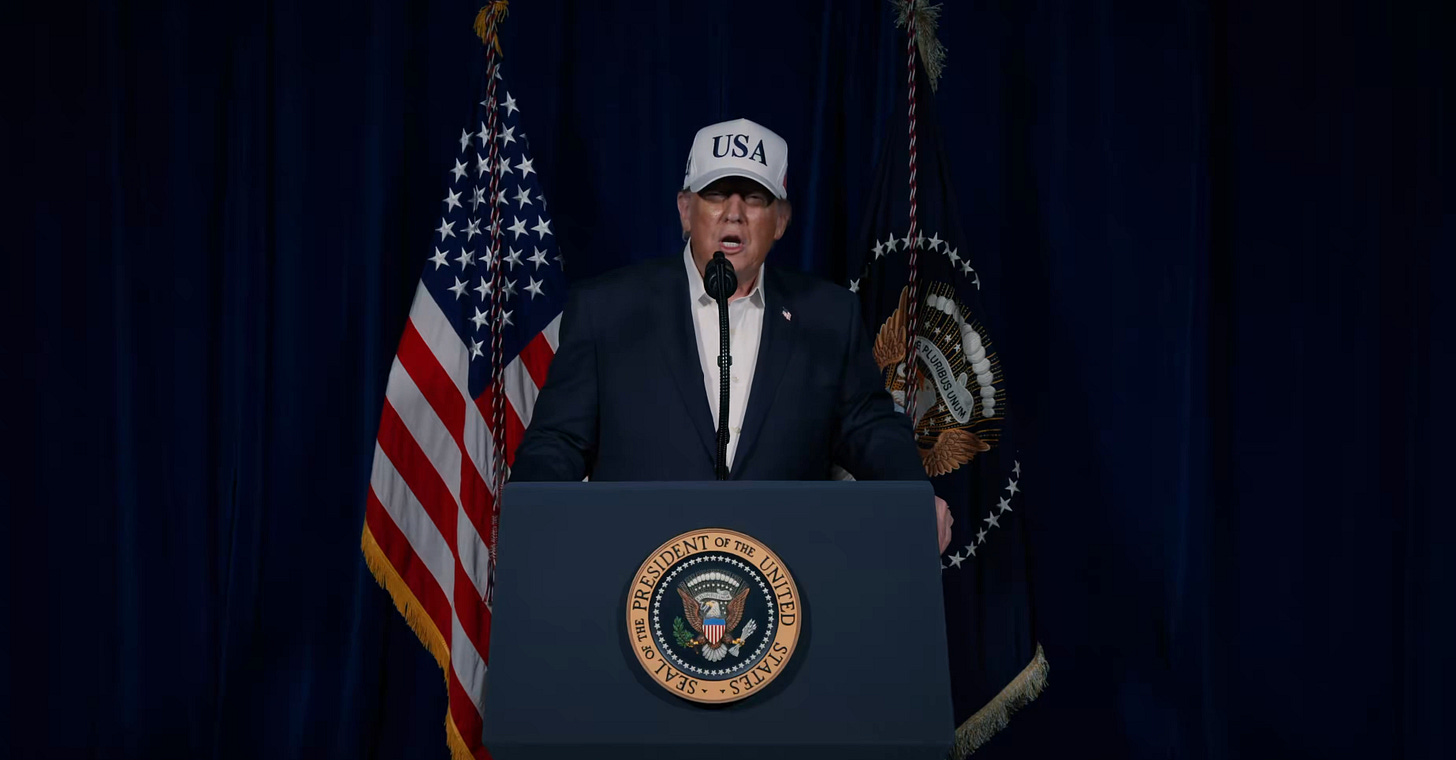
Before reacting emotionally to headlines, memes, or partisan commentary, Americans should step back and examine the full timeline. Serious national security decisions cannot be judged through selective clips or recycled tweets. They must be evaluated through facts, escalation patterns, and the consequences of action versus inaction.
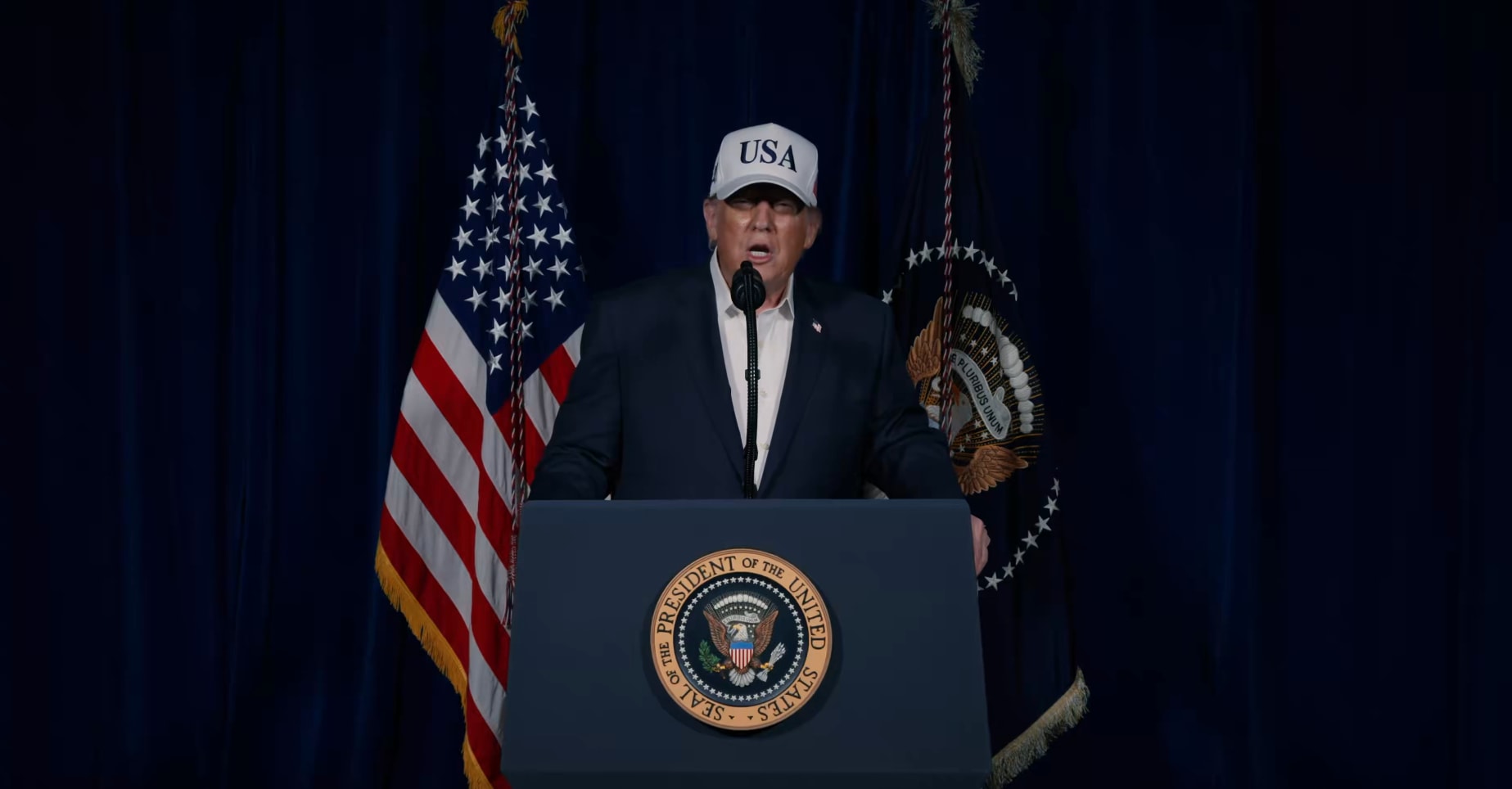
The debate over Trump’s strike on Iran is already being framed by critics on the left (and by some Republican opponents) as reckless escalation. But that framing skips the larger reality. Iran is not a neutral actor. For decades it has been designated a state sponsor of terrorism. It has funded and armed proxy militias across the Middle East. Those proxies have attacked U.S. personnel. The regime has violently suppressed its own citizens to maintain power. Meanwhile, its nuclear program has advanced closer to weapons capability, and its long-range missile development has continued.
These are not partisan talking points. They are documented strategic facts.
The real question is not who benefits politically. The real question is what happens if nothing is done.
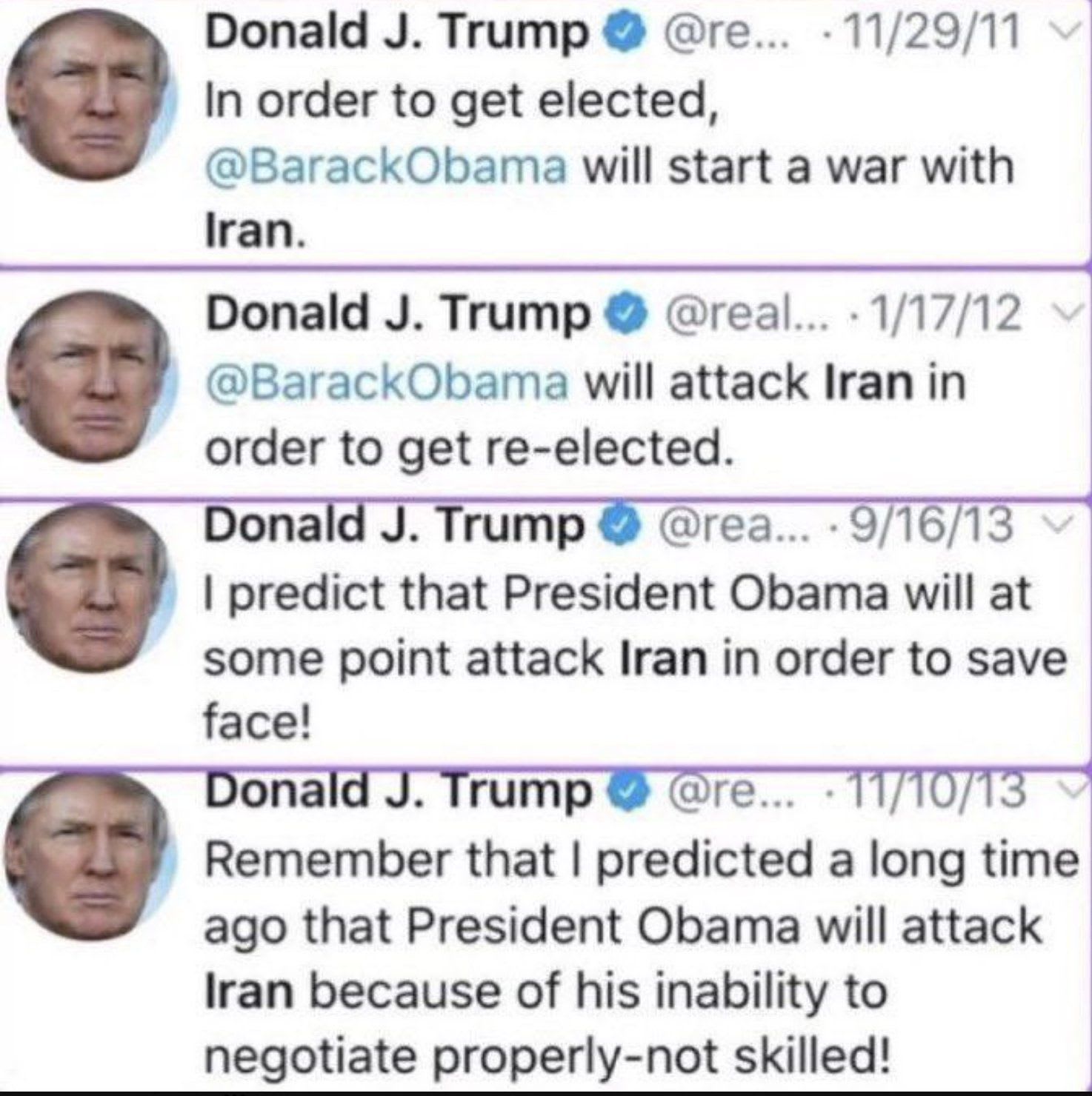
To understand today’s decision, we have to go back to 2011. The meme circulating online highlights tweets from Donald Trump criticizing President Obama and predicting he would strike Iran for political reasons. At the time, Obama’s approach was diplomatic. That strategy culminated in the 2015 nuclear agreement, designed to slow Iran’s enrichment through inspections and sanctions relief. No U.S. strike occurred under Obama. Trump’s comments then were political criticism, not policy execution. The predictions in those tweets never materialized.
But the world did not freeze in 2011.
Over the past decade, Iran’s nuclear capacity has advanced significantly. Enrichment levels increased. Inspection access narrowed. Breakout timelines shortened. Missile capabilities expanded. At the same time, Iran-backed groups intensified attacks across the region, targeting U.S. forces, threatening shipping lanes, and destabilizing allies. Internally, the regime relied on force to suppress dissent, revealing both instability and a willingness to escalate externally to maintain control.
That is the context of 2026.
Some critics have tried to label this action as “globalism.” By definition, that argument does not hold. Globalism prioritizes multinational consensus, international institutions, and negotiated frameworks over unilateral national decision-making. This strike was not carried out to strengthen global governance, satisfy international bodies, or pursue nation-building. It was justified publicly on the grounds of protecting American personnel, deterring direct threats, and preventing nuclear leverage against the United States and its allies. Agree or disagree with the strategy, but calling it globalism misunderstands the term. Acting to neutralize a specific threat to national security, independent of international approval, is the opposite of globalist policymaking.
Today’s strikes are not a replay of a decade-old political argument. They are framed as preemptive action aimed at nuclear infrastructure, missile production, and military facilities tied to direct threats. Supporters argue this is not about elections, optics, or international prestige. It follows years of stalled diplomacy, continued proxy aggression, and mounting intelligence concerns about nuclear proximity.
The policy argument is straightforward. A nuclear-armed Iran permanently alters the balance of power in the region. Once a regime possesses a nuclear deterrent, military options narrow dramatically. Leverage disappears. Waiting until after weaponization may remove the ability to act at all. Deterrence sometimes requires action before a threat fully matures.
Critics argue escalation risks wider war and that diplomacy should continue. Supporters respond that diplomacy has been attempted repeatedly, sanctions did not reverse enrichment, proxy attacks persisted, and breakout time shrank from years to weeks. The disagreement is not about whether war is desirable. It is about whether delay increases danger.
To illustrate the stakes, consider a hypothetical 2033 scenario. Imagine intelligence confirms that nuclear material proliferated through proxy networks linked to a regime that crossed the nuclear threshold years earlier. Imagine Americans asking why stronger measures were not taken when there was still time to prevent it. That scenario is not presented as inevitability, but as the risk calculation underlying preemptive arguments.

This debate ultimately comes down to one question: at what point does inaction become the greater threat?
National security decisions are rarely simple. But ignoring escalation does not make it disappear.
History offers a sobering reminder of what can happen when leaders mistake delay for stability. This lesson was captured in 1938, when Neville Chamberlain returned from Munich believing concessions would secure peace.

Munich Agreement: Benito Mussolini, Adolf Hitler, and Neville Chamberlain
(From left) Italian leader Benito Mussolini, German Chancellor Adolf Hitler, a German interpreter, and British Prime Minister Neville Chamberlain meeting in Munich, September 29, 1938.
German Federal Archives (Bundesarchiv), Bild 146-1970-052-24 Creative Commons Attribution ShareAlike 3.0 (Generic).