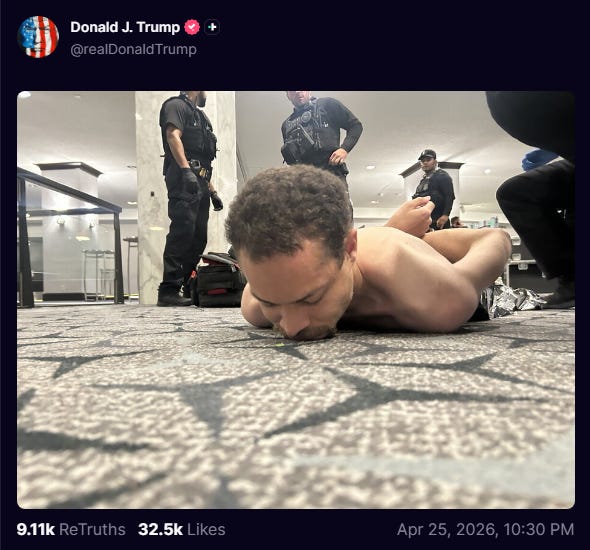
Last night, April 25, 2026, at the White House Correspondents’ Association Dinner held at the Washington Hilton, a shooting occurred that authorities are investigating as the fourth assassination attempt on President Donald Trump.
As of early morning on April 26, the following facts have been officially confirmed.
The suspect, 31-year-old Cole Tomas Allen of Torrance, California, was armed with a shotgun, a handgun, and multiple knives. He attempted to breach a security checkpoint near the main ballroom and opened fire on security personnel. One Secret Service officer was shot at close range, his bulletproof vest prevented serious injury, and he is reported to be doing well. President Trump, First Lady Melania Trump, Vice President JD Vance, and members of the Cabinet were safely evacuated. No other guests or officials were injured. Allen is now in custody, facing charges of using a firearm during a crime of violence and assault on a federal officer.

Hours later, President Trump addressed the nation. He spoke not just about the evening’s events, but about the weight of leadership itself, reflecting on consequence, on resolve, and on what it means to govern under sustained threat.
Then came the predictable line of questioning.
Members of the media asked him how he could “tone down the temperature.” After a man armed with multiple weapons attempted to breach a secured event and opened fire, after a Secret Service officer absorbed a close-range shot protecting others, the question posed to the President was not about security, not about the suspect, not about the broader climate of political violence. It was about whether he would change.
His answer was direct. To “tone down the temperature,” he said, would mean doing nothing, allowing mass illegal immigration to continue unchecked and permitting Iran to obtain a nuclear weapon.
That answer is the dividing line in American politics right now.
What the media calls “temperature,” many Americans recognize as resolve. What gets framed as “dangerous rhetoric,” millions of citizens understand as a refusal to surrender core national interests. And what last night exposed, once again, is that we are no longer dealing with a press corps interested in neutral inquiry. We are dealing with an ecosystem that has spent years constructing a narrative of illegitimacy and moral outrage around one man, and then acting surprised when that narrative poisons the public square.
No responsible person excuses violence. No responsible person condones what happened last night. The Secret Service and every security professional involved deserve respect and gratitude for preventing what could have been a national tragedy.
But we cannot pretend these acts occur in a vacuum.
This is the fourth known assassination attempt targeting President Trump. Fourth. At what point do we stop treating each incident as an isolated event and start asking harder questions about the political environment that produces them?
For years, major media outlets have trafficked in a steady drumbeat of hysteria, casting Trump not merely as a political opponent, but as an existential threat to democracy itself. Words matter. Narratives matter. Repetition matters. When every policy disagreement is framed as tyranny, when every speech is described as authoritarian, when every action is portrayed as a step toward dictatorship, it does not simply stay within the boundaries of commentary. It seeps outward.
We are told endlessly that rhetoric must be toned down. But whose rhetoric, and in what direction? Because what the media actually demands is not calm, it is compliance. A president who will step back, soften, abandon enforcement at the border, ease pressure on adversarial regimes, a president who will, in Trump’s own words, “do nothing.”
That is not leadership. That is abdication.
Americans understand strength when they see it. They understand that securing the border is not extremism, it is sovereignty. They understand that preventing Iran from acquiring nuclear capability is not warmongering, it is deterrence. And they understand that a president who refuses to yield under pressure, even after multiple attempts on his life, is not inflaming the country. He is standing firm in the face of it.
Even in a moment that could have been purely unifying, many in the media could not resist returning to the same script, the same insinuation that the problem is not the attacker, but the man he targeted. That instinct is not just misguided. It is dangerous. It erodes the basic moral clarity that should exist in moments like this, blurs the line between aggressor and target, and conditions the public to view violence not as an aberration but as a byproduct of political disagreement.
We are fortunate that the outcome last night was not worse. The systems held. The professionals did their jobs. But luck is not a strategy.
If we continue down a path where political opponents are demonized rather than debated, where headlines are crafted for outrage rather than accuracy, and where calls for unity are selectively applied, we should not be surprised when the temperature rises beyond anyone’s control.

Strong leadership matters most in moments like this. Leadership that does not flinch. Leadership that does not retreat. Leadership that understands that protecting this nation, its borders, its people, its future, is not negotiable. And leadership that refuses to accept the premise that defending those things is somehow the problem.
If we want fewer nights like April 25, 2026, we need more than better security. We need a return to seriousness, to truth, and to a shared understanding that political opposition is not a license for dehumanization. Because when that line is crossed often enough, someone eventually picks up a weapon, and when that happens, it is not just one man who is targeted. It is the stability of the republic itself.