The Super Bowl is often referred to as America’s unofficial national holiday. It has become a singular moment when families across the country gather around television sets, not just for football, but for a spectacle that tells us something about who we are. That’s why the halftime show carries more weight than mere entertainment. It reflects the soul of the culture. And this year, something quietly groundbreaking occurred. It didn’t happen inside the stadium. It didn’t need to.
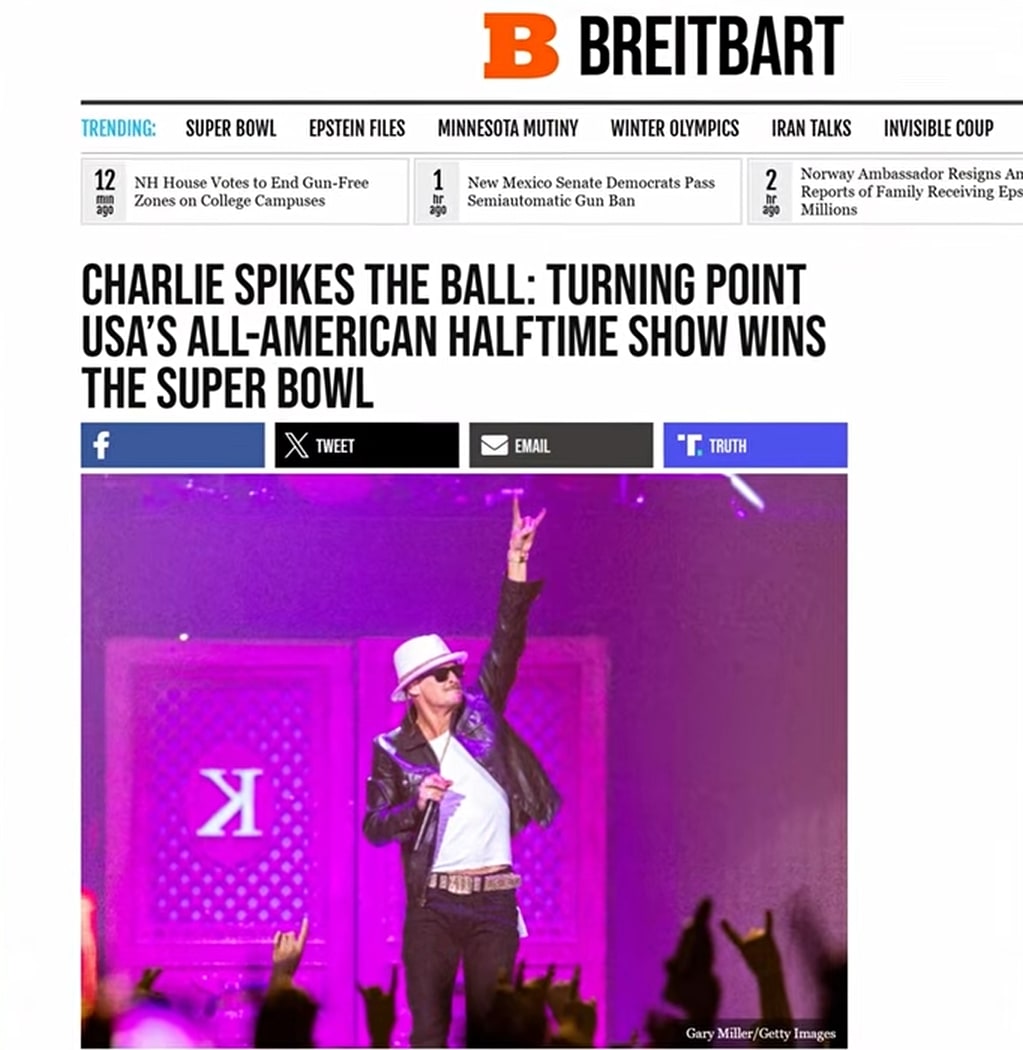
While the NFL handed its halftime stage to Bad Bunny (global reggaeton artist known for provocative lyrics and progressive politics) an entirely different kind of show was unfolding online, organized by Turning Point USA. Featuring Kid Rock and built around themes of redemption, faith, and love of country, the “All-American Halftime Show” reached tens of millions of viewers not by appealing to shock value, but by embracing enduring values that many Americans feel have been sidelined.
This wasn’t just an alternative performance. It was a referendum.
The Culture Clash
The NFL’s decision to feature Bad Bunny sparked immediate backlash. Despite a petition backed by over 120,000 signatures requesting a replacement (with suggestions like George Strait or Lee Greenwood) the league held firm. Bad Bunny, whose lyrics have drawn scrutiny for explicit content, performed a 13-minute set entirely in Spanish. He paraded foreign flags and closed with a political message about Puerto Rico’s status, declaring, “We are still here.”
While some praised the performance as a celebration of multiculturalism, others (particularly parents and conservative leaders) questioned whether this was truly representative of the Super Bowl’s broad audience. Speaker Mike Johnson called the show a “terrible decision,” while former President Donald Trump denounced it as “an affront to the greatness of America” and “disgusting… especially for young children.”
But instead of merely criticizing, millions of Americans made a different choice. They turned the channel. They voted with their remotes.
What they found was something that felt entirely new, not because of its flash or production, but because of its sincerity.

A Halftime Show Rooted in the Eternal
Kid Rock’s headlining performance in the TPUSA broadcast opened not with lights or dancers, but with a call to dust off the Bible to remember the man who died for our sins. “If you’ve got a chance,” he sang, “take it.” The words, and the spirit behind them, weren’t part of some marketing strategy. They were a prayer set to music.
Instead of a celebration of fame or identity, the All-American Halftime Show focused on the things that outlast the spotlight: faith in Christ, second chances, hard work, gratitude. In a moment where the official halftime show leaned heavily on image and politics, TPUSA chose to elevate something altogether countercultural… humility.
According to online tracking, the show was one of the top three livestreamed events in YouTube history, pulling in over 25 million viewers across platforms like YouTube and Rumble, with estimates surpassing 35 million when watch parties are included. Remarkably, even fans inside the stadium tuned in on their phones.
And then came a moment that underscored just how significant this cultural pivot was: Kid Rock’s single “’Til You Can’t” vaulted to the number one spot on the global music charts, overtaking Bad Bunny despite the latter’s saturation-level promotion. Commentator Benny Johnson captured the significance: “We have the power to change culture.”
This wasn’t manufactured. It wasn’t forced. It was real.

The Legacy Behind the Movement
What made the TPUSA performance feel so resonant wasn’t just the music, it was the meaning behind it. Throughout the show, there was a palpable sense that this wasn’t just a concert. It was a tribute. Charlie Kirk, the late founder of TPUSA, was honored not with fanfare, but with faith.
He didn’t live to see that moment, but it bore his fingerprints. It was a movement years in the making, culminating in the simple, powerful act of building something. Additionally, it was a stage that didn’t apologize for who Americans are, but celebrated it.
No doubt, there will be plenty of analysis over how a parallel show with no corporate sponsorship and no stadium lights managed to eclipse the most expensive halftime slot in the world. But perhaps the answer isn’t complicated. It’s found in the values millions of Americans still hold dear. It’s in the Bible that still sits on the coffee table. It’s in the quiet strength of a country that never forgot where it came from, or why it matters.
The All-American Halftime Show didn’t reject culture. It redefined it. Without shouting, it spoke. Without condemning, it offered hope. And in doing so, it did something that neither politics nor protests have been able to accomplish: it reminded a nation of what it still has the power to be.